Australian Customs Brokerage Fees: A Comprehensive Guide for Importers in 2026

Your customs broker is much more than a paperwork handler; they are the strategic gatekeeper of your supply chain’s profitability and speed. It’s completely understandable if you feel a sense of anxiety over unpredictable biosecurity delays or those “hidden” costs that often surface unexpectedly at the port. You deserve a clear, predictable path through the border that protects your bottom line. This comprehensive guide empowers you to master the complexities of australian customs brokerage fees while ensuring your shipments move with precision and total regulatory compliance.
While statutory government charges are set in stone, the service component of australian customs brokerage fees reflects the specific labor, liability, and technical expertise required to clear your unique cargo. It’s a dynamic area of your logistics spend; for those managing the complexities of importing household goods or office equipment, specialized teams like Anspach Removals & Storage provide the necessary physical moving expertise to complement your customs strategy. You’ll find that a transparent broker will always explain the variables that dictate their professional pricing. This allows you to plan your margins with total accuracy. Whether you’re moving a single container of raw materials or a complex manifest of retail goods, the level of detail involved directly influences the service fee.
We’ll provide a transparent breakdown of exactly what you can expect to pay in 2026, from the latest Australian Border Force Import Processing Charges to the 10% GST calculated on your Value of Taxable Importation. You’ll discover how to leverage Free Trade Agreements like ChAFTA to potentially eliminate duty costs entirely. If you’re looking for faster clearance times and a proactive way to avoid the stress of ABF audits, this breakdown gives you the expert-led clarity you need to import with absolute confidence. Let’s dive into the details and secure your cargo’s journey.
Key Takeaways
- Differentiate between mandatory government levies and professional service costs to establish a transparent and predictable importing budget.
- Identify the specific tiered Import Processing Charges (IPC) applied to your shipments to prevent unexpected financial surprises at the Australian border.
- Master the variables that determine australian customs brokerage fees, including how complex tariff classifications and line entries impact your final invoice.
- Unlock significant cost savings by utilizing Free Trade Agreements and ensuring total regulatory compliance to avoid costly ABF audits and biosecurity hold-ups.
- Transform your customs clearance into a competitive advantage by working with a proactive partner committed to meticulous detail and supply chain excellence.
Understanding Australian Customs Brokerage Fees: An Overview
Successful importing into Australia requires a clear-eyed understanding of the financial landscape. When you look at your final invoice, you’ll see that australian customs brokerage fees are actually a dual-layered cost structure. This means the total amount is comprised of two distinct parts: the professional service fee charged by your broker and the mandatory statutory charges collected by the government. It’s a common misconception that these are one and the same, but distinguishing between them is the first step toward effective cost management. You deserve total transparency in your logistics spend, and that starts with knowing where every cent of your investment is going.
While some small-scale importers attempt to manage their own lodgements, the vast majority of commercial enterprises require the expertise of a licensed customs broker to ensure compliance. The Australian Border Force (ABF) oversees the regulation of these declarations and the standards of lodgement across the country. Your broker acts as your dedicated legal representative, ensuring that every piece of data matches the strict requirements of the ABF. It’s also vital to remember that these brokerage costs are entirely separate from your international air or sea freight charges. Freight covers the physical movement of goods; brokerage covers the legal permission for those goods to enter Australian commerce.
Service Fees vs. Statutory Government Charges
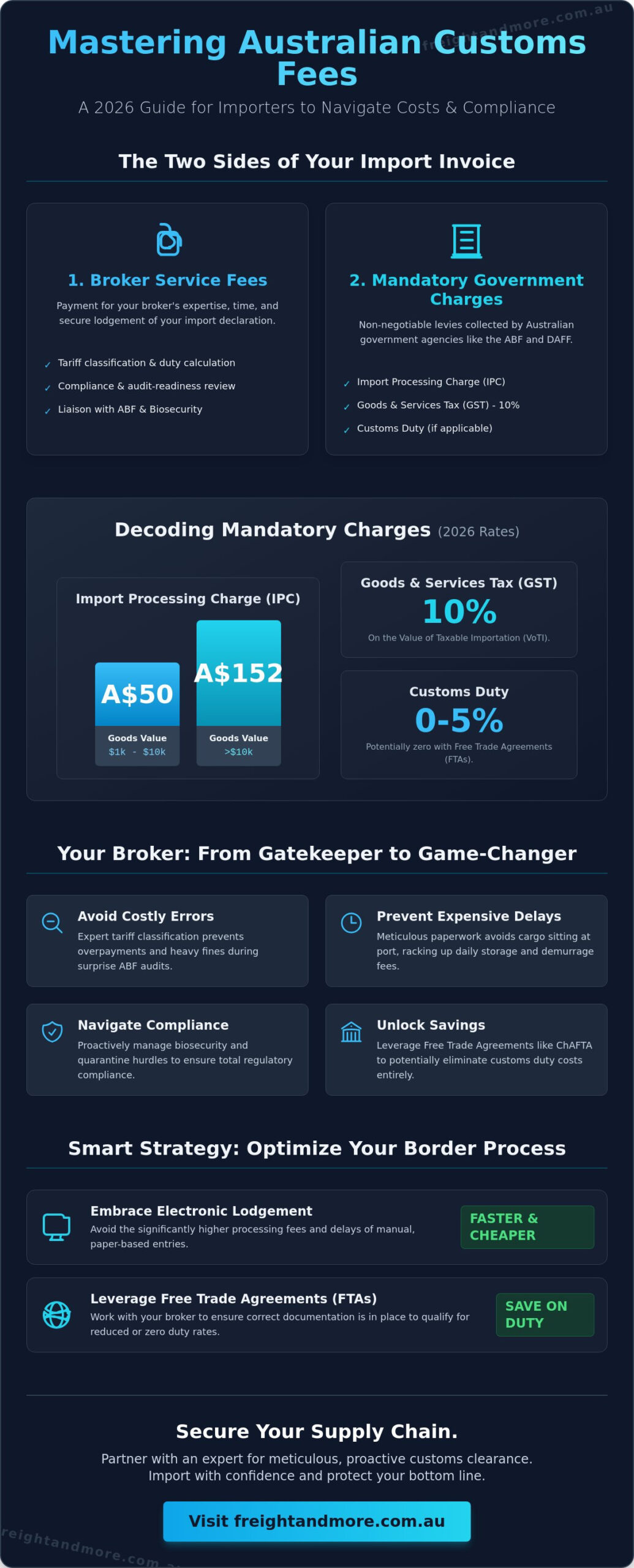
Professional service fees are what you pay for a broker’s expertise, time, and the secure lodgement of your import declaration. This covers the meticulous work of reviewing your commercial invoices, packing lists, and certificates of origin to ensure they are audit-ready. Statutory charges, on the other hand, are non-negotiable payments to the Australian government. These include the Import Processing Charge (IPC), which, as of 2026, is AUD 50 for goods valued between $1,000 and $10,000, and AUD 152 for consignments exceeding $10,000. Most brokers bundle these into a single quote for your convenience, providing a seamless payment experience that covers both their professional labor and your legal obligations.
The Value of Professional Customs Clearance
Investing in high-quality customs clearance is a proactive strategy to protect your profit margins. A minor error in a tariff classification can lead to significant overpayments in duty or, worse, heavy fines during a surprise audit. Expert brokers identify these risks early. They also prevent the accumulation of expensive storage and demurrage fees at the port. If your paperwork isn’t perfect, your cargo sits at the terminal, racking up daily costs while you wait for approval. By managing biosecurity and quarantine hurdles before they become roadblocks, a dedicated partner ensures your supply chain remains fluid and predictable.
Breaking Down Mandatory Government Import Charges
Beyond the expert guidance provided by your broker, the Australian government mandates specific levies that every importer must account for. These statutory charges are fixed and non-negotiable. Understanding how they’re calculated allows you to forecast your landed costs with precision. While the professional component of australian customs brokerage fees covers the labor and expertise of lodgement, these government charges go directly to the Australian Border Force and the Department of Agriculture, Fisheries and Forestry (DAFF). You’ll find that being aware of these tiers early in the process removes the “sticker shock” often associated with border clearance.
Most importers find that electronic lodgement is the most efficient and cost-effective way to manage these payments. Moving away from manual, paper-based “documentary” lodgements isn’t just about speed; it’s about avoiding the significantly higher processing fees the government applies to manual entries. We always recommend electronic submissions to keep your overheads low and your data accuracy high.
The Import Processing Charge (IPC) Explained
As of 2026, the Import Processing Charge (IPC) remains a primary cost driver for any consignment valued above AUD 1,000. The government utilizes a tiered structure to ensure that the cost of border security is distributed fairly across different shipment scales. For goods with a value between AUD 1,000 and AUD 10,000, you’ll pay a flat IPC of AUD 50. If your shipment’s value reaches or exceeds AUD 10,000, this charge increases to AUD 152. For sea cargo self-assessed clearance declarations, the charge is approximately AUD 50.70 per consignment. These rates are specifically for electronic declarations; choosing a partner who prioritizes digital integration is essential for maintaining these lower rates. If you’re importing goods valued below the AUD 1,000 threshold, you’ll generally be exempt from these specific IPCs, though GST may still apply at the point of sale. For a comprehensive breakdown of all the government fees and duty rates affecting your bottom line, our guide on understanding import costs in Australia for 2026 provides the detailed forecasting tools you need.
Biosecurity and Quarantine (DAFF) Fees
Australia maintains some of the world’s strictest biosecurity regulations to protect our unique environment from invasive pests and diseases. To fund this vital work, DAFF applies cost recovery charges to every entry. Sea freight consignments typically face higher biosecurity entry fees than air freight because of the increased risk and complexity associated with shipping containers and various packing materials. If your cargo requires a physical inspection or specific commodity treatments, such as fumigation, those costs will be added to your final bill. Proactive documentation and clean cargo are your best defenses against these escalating costs. If you want to ensure your cargo meets all requirements before it hits the water, a quick review of your customs clearance strategy can save you thousands in potential inspection delays. Precision at the start of the journey is always the most affordable option.
Managing these government levies requires a detail-oriented approach to ensure you aren’t overpaying or falling into non-compliance. When you calculate your total australian customs brokerage fees, always ensure these IPC and DAFF charges are clearly itemized. This transparency allows you to see exactly where your money is going and helps you build a more resilient, predictable supply chain for the long term.
While statutory government charges are set in stone, the service component of australian customs brokerage fees reflects the specific labor, liability, and technical expertise required to clear your unique cargo. It’s a dynamic area of your logistics spend. You’ll find that a transparent broker will always explain the variables that dictate their professional pricing. This allows you to plan your margins with total accuracy. Whether you’re moving a single container of raw materials or a complex manifest of retail goods, the level of detail involved directly influences the service fee.
Frequent importers often benefit from volume-based pricing structures. If you’re lodging declarations on a weekly basis, your broker can often streamline their internal processes, passing those efficiencies on to you through a more competitive rate. It’s about building a long-term, dependable partnership that rewards consistency. On the other hand, one-off shipments or first-time imports might involve more intensive consultation to ensure your business is correctly registered and compliant within the Integrated Cargo System (ICS).
Shipment Complexity and Tariff Lines
A “line item” is essentially a single entry for a specific type of product on your customs declaration. If your shipment contains 50 different styles of footwear, each requires its own tariff classification, duty calculation, and compliance check. This matters because each line adds a layer of technical verification to the process. Brokers must meticulously cross-reference your commercial invoice with the Australian Customs Tariff to ensure you aren’t overpaying. They also handle complex valuation rules, such as identifying if price influence or royalty payments must be added to the customs value. Managing these intricate manifests requires a high degree of precision to avoid the financial sting of an incorrect declaration.
Specialized Commodity Handling
Certain goods require much more than a standard lodgement. If you’re importing restricted items, hazardous materials, or goods subject to specific anti-dumping duties, your broker must coordinate with multiple government agencies beyond just the ABF and DAFF. This might include securing specific import permits or providing specialized advice on complex regulatory frameworks. These ancillary services are vital for ensuring you don’t face a “stop” at the border. For unique cargo or first-time ventures, bespoke advice on valuation and permit applications ensures your supply chain is compliant from day one. It’s an investment in risk mitigation that keeps your business moving forward without the anxiety of unexpected delays.
How to Optimize Your Customs Costs and Avoid Penalties
Optimization isn’t just about finding the lowest service rate; it’s about building a strategy that eliminates waste. You can significantly reduce the long-term impact of australian customs brokerage fees by focusing on the quality of your data before your goods even leave the origin port. Accurate documentation is your most powerful tool. If your commercial invoices and packing lists are precise, your broker can perform pre-lodgement. This proactive step allows the Australian Border Force to review your cargo while it’s still in transit, often resulting in an immediate release upon arrival. It’s a simple way to bypass the frustration of cargo being held up over a weekend, which can lead to expensive terminal handling charges.
Some importers attempt “Self-Assessment” to save on professional service costs. This often proves to be a false economy. Without a licensed expert, you risk misclassifying goods or missing out on legal concessions that could save you thousands. Misclassification can also trigger anti-dumping duties, which are significantly higher than standard rates. A dedicated partner identifies these pitfalls early, ensuring you pay only what is legally required and nothing more. Understanding the nuances of australian customs brokerage fees ensures you aren’t leaving money on the table through simple administrative errors. To ensure your business is fully prepared for every regulatory requirement, our import customs clearance Australia 2026 essential business checklist walks you through every critical compliance step.
Leveraging Free Trade Agreements (FTAs)
Australia’s extensive network of FTAs offers a goldmine of savings for the informed importer. Under agreements like the China-Australia Free Trade Agreement (ChAFTA), over 95% of Australian tariff lines for Chinese imports enjoy zero duty. To claim these concessions, you must provide a valid Certificate of Origin that matches the specific requirements of the agreement. Your broker automatically scans for these opportunities, verifying if your goods meet the specific “rules of origin” required for a duty-free entry. This isn’t just about checking a box; it’s about a meticulous review of how your goods were manufactured. This strategic oversight transforms your logistics from a cost center into a competitive advantage.
The True Cost of Compliance Failure
Compliance failure carries a heavy price tag that far outweighs any initial savings. If your documentation is flagged, your cargo may be held for inspection, leading to port storage fees, known as demurrage, which can exceed hundreds of dollars per day. These costs accumulate quickly, especially if the Department of Agriculture requires a physical inspection. Incorrect declarations also trigger ABF penalties that hit your bottom line directly. Infringement Notices are formal, preventable costs issued for making false or misleading statements to customs. If you want to secure your profit margins and ensure a seamless flow of goods, let us manage your customs clearance with the meticulous care your business deserves.
Secure Your Supply Chain with Freight and More Pty Ltd
Navigating the Australian border requires more than just a calculator; it requires a dedicated ally who treats your cargo with the same meticulous care as their own. At Freight and More Pty Ltd, we position ourselves as your strategic partner rather than a mere service provider. We understand that australian customs brokerage fees represent a significant investment in your business’s continuity and profitability. Our team provides an uncompromising attention to detail, ensuring every tariff classification and biosecurity declaration is audit-ready before your goods even arrive. We don’t just process paperwork. We proactively solve problems and remove obstacles so your supply chain remains fluid and predictable.
Our commitment to excellence is backed by a robust national reach and a sophisticated global network of agents. This connectivity allows us to manage your cargo across every stage of its journey, from the factory floor to your local warehouse. By maintaining a steady and methodical communication rhythm, we ensure you’re never left in the dark about your shipment’s status. We take immense pride in the quality of service we provide, creating a professional landscape where you feel supported, heard, and confident in your compliance standing.
Expert Guidance for Every Shipment
Our seasoned veterans have spent years navigating some of the strictest customs laws in the world. By integrating our specialized customs clearance expertise with our international air and sea freight capabilities, we provide a seamless, “under one roof” solution for your business. This integration eliminates the friction and communication gaps often found when dealing with multiple logistics providers. We also offer comprehensive warehouse management and local transport services to ensure your goods reach their final destination without delay. Our transparency is our bond; we provide a clear breakdown of your australian customs brokerage fees so you can manage your margins with total professional confidence.
Ready to Streamline Your Australian Imports?
We invite you to experience a logistics partnership defined by professional confidence and a welcoming, “can-do” attitude. Whether you’re a high-level corporate entity or an individual entrepreneur, our bespoke advice is tailored to your unique cargo needs and specific industry challenges. We’re eager to assist you in removing regulatory hurdles and optimizing your import processes for the long term. Your success is our primary motivation, and we remain dedicated to delivering a premium level of service that goes far beyond industry norms. Contact our expert team for a transparent customs quote today!
Master Your Border Strategy with Confidence!
Mastering your border costs is about more than just tracking numbers; it’s about securing the long-term predictability your business needs to thrive in a competitive market. You now understand that australian customs brokerage fees are a strategic blend of fixed government levies and the professional expertise required to navigate them safely. By prioritizing meticulous documentation and leveraging the financial benefits of Free Trade Agreements, you can effectively eliminate hidden charges while preventing expensive terminal delays. This proactive approach transforms your customs process into a streamlined engine for growth.
Since 2009, Freight and More Pty Ltd has combined decades of industry expertise with a robust global network of agents to deliver seamless door-to-door solutions across every major Australian port. We’re ready to provide the detail-oriented, “can-do” support your supply chain deserves. Get a Meticulous Customs Clearance Quote from Our Experts. We look forward to helping you move your cargo with total precision and ease!
Frequently Asked Questions
What is the average customs brokerage fee in Australia for 2026?
Professional service fees for customs clearance vary depending on the complexity of your shipment and the number of tariff lines required for your declaration. While the government charges like the Import Processing Charge are fixed, the service component reflects the expert labor involved in ensuring your cargo is compliant and audit-ready. To get an accurate picture of your australian customs brokerage fees, it is always best to request a tailored quote that reflects your specific cargo volume and frequency.
Do I have to pay GST on imported goods in addition to customs fees?
Yes, a 10% Goods and Services Tax (GST) is applied to most goods imported into Australia. This tax is calculated based on the Value of the Taxable Importation (VoTI), which is the sum of the customs value, any applicable duty, and the costs of international freight and insurance. Ensuring these values are calculated correctly is a core part of managing your total import costs and avoiding overpayment at the border.
Can I clear my own goods through Australian customs to save on broker fees?
You can technically lodge your own import declarations through the Integrated Cargo System, but this is rarely recommended for commercial shipments due to the high risk of administrative errors. Licensed brokers possess the technical training to navigate complex tariff classifications that individual importers often miss. Using a professional helps you avoid the severe penalties and storage costs that result from incorrect self-assessments or missing documentation.
What is the difference between an Import Processing Charge and a customs duty?
The Import Processing Charge (IPC) is a flat administrative fee for the lodgement of your declaration, while customs duty is a percentage tax based on the value of the goods. For 2026, the IPC is AUD 152 for goods valued over $10,000 and AUD 50 for goods between $1,000 and $10,000. In contrast, the standard duty rate is typically 5% of the Free On Board value, though this can be reduced through specific trade concessions. For a full breakdown of how duty rates and government fees interact to shape your total landed costs, explore our complete guide to understanding import costs in Australia for 2026.
How long does the customs clearance process typically take in Australia?
Most air freight consignments are cleared within 24 hours; sea freight typically takes between 24 and 48 hours if all documentation is submitted correctly. This timeline depends heavily on your broker performing pre-lodgement before the vessel or aircraft arrives. If your cargo is flagged for a random audit or a biosecurity check, these timeframes can extend, making proactive document management essential for maintaining your schedule.
What happens if my goods are held by biosecurity (DAFF)?
If the Department of Agriculture, Fisheries and Forestry holds your goods, they will be moved to a secure site for a physical inspection or required treatment like fumigation. You will be responsible for the cost recovery charges associated with these services, as well as any terminal storage fees that accumulate during the delay. A proactive broker helps minimize these risks by ensuring your packing materials and documentation meet all biosecurity standards before your cargo arrives.
Are there any exemptions for Australian customs brokerage fees for small shipments?
Goods valued at or below AUD 1,000 are generally exempt from formal import declarations and the associated government Import Processing Charges. These are known as Low-Value Imported Goods (LVIG). While you won’t face the standard australian customs brokerage fees for these small shipments, GST is usually collected at the point of sale by the overseas supplier or online marketplace. Commercial shipments above this threshold always require a formal entry.
How do Free Trade Agreements affect the total cost of my customs clearance?
Free Trade Agreements (FTAs) can significantly lower your total costs by reducing the standard 5% customs duty to zero. By utilizing agreements like ChAFTA or RCEP, you remove a major tax burden from your importation process. Your broker will identify these opportunities by verifying your Certificate of Origin and ensuring your goods meet the specific rules of origin required for the concession, providing a direct boost to your profit margins.
