Sea Freight from China to Australia: The Complete Importer’s Guide for 2026

Choosing the lowest port-to-port rate is often the most expensive mistake an Australian importer can make in 2026. You’ve likely felt the frustration of watching profit margins disappear under unexpected terminal fees, or perhaps you’ve dealt with the anxiety of biosecurity holds that stall your stock for weeks. With 40GP container rates jumping by 33% this June, it’s clear that managing sea freight from china to australia requires more than just a booking; it requires a sophisticated strategy.
We’re ready to help you transform these logistics hurdles into a streamlined strength for your business. This guide empowers you to master every detail of the shipping process, from identifying whether FCL or LCL suits your current volume to addressing the new July 1 duty changes for furniture and electronics. You’ll gain the clarity needed for predictable schedules and a meticulous port-to-door experience that ensures your cargo arrives exactly when and where you need it!
Key Takeaways
- Discover why sea freight remains the gold standard for high-volume commercial imports and how to leverage the China-Australia trade corridor for maximum efficiency.
- Master the strategic differences between FCL and LCL to identify the exact tipping point where full containers become more cost-effective for your sea freight from china to australia.
- Build a more resilient supply chain by understanding realistic transit times and the specific peak-season cost drivers that impact your bottom line.
- Navigate Australian customs with total confidence by learning the essential steps of the entry process and how professional clearance prevents costly cargo detention.
- Learn how to create a seamless port-to-door experience by integrating international shipping with reliable local transport and warehouse management.
Navigating the China to Australia Sea Freight Corridor in 2026
The economic bond between our two nations is forged in the vast ocean lanes of the Pacific. Understanding the nuances of Australia-China trade relations is vital for any importer looking to scale operations efficiently. While air freight offers undeniable speed, the sheer volume of goods moving through sea freight from china to australia makes it the lifeblood of the Australian retail and industrial sectors. Key departure hubs across China serve as the primary gateways, connecting Chinese manufacturing powerhouses with major arrival ports throughout Australia.
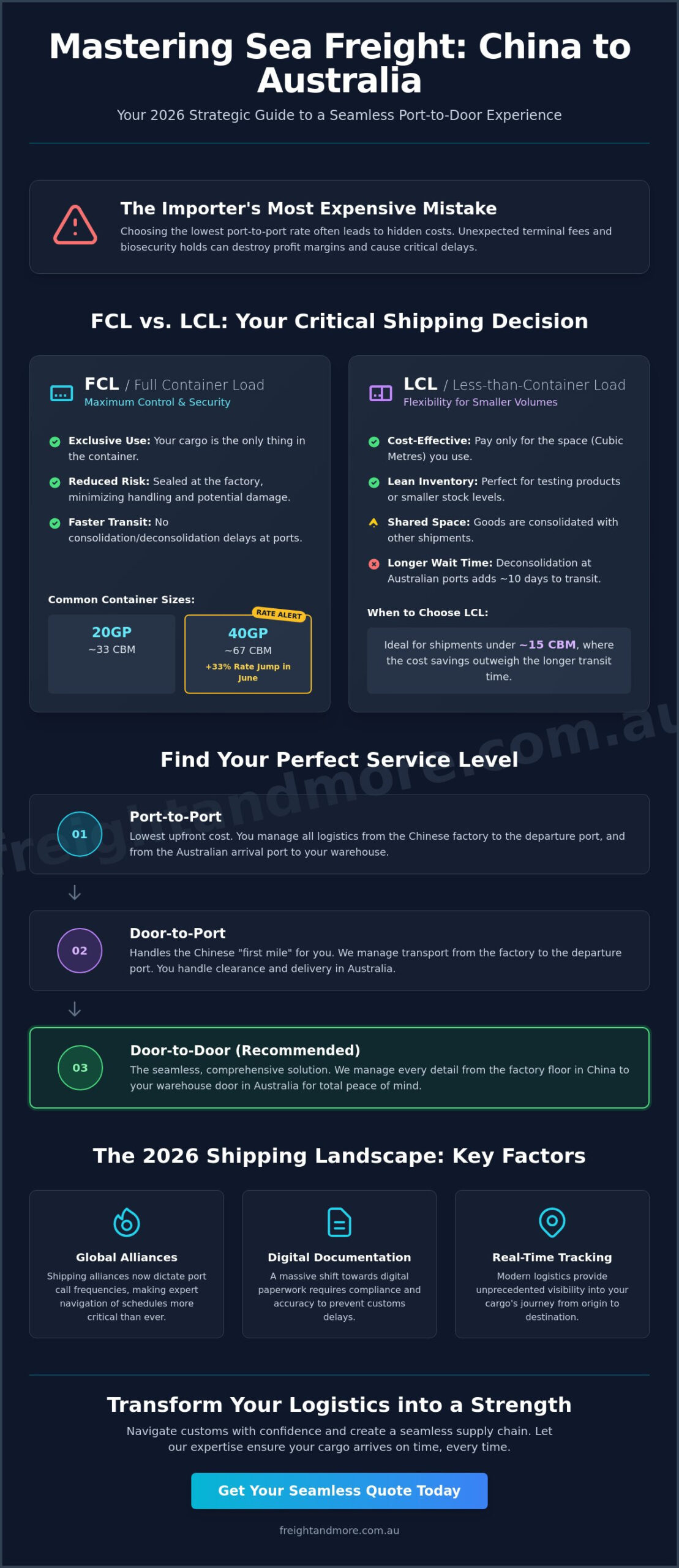
Choosing the right service level is your first strategic decision. A port-to-port arrangement offers the lowest upfront cost but leaves you responsible for the complex “first and last mile” logistics. Door-to-port services bridge the gap by handling the Chinese side of the journey, while a comprehensive door-to-door solution provides a seamless experience. Every detail from the factory floor to your Australian warehouse is managed with meticulous care. It’s about finding the balance between cost and convenience that fits your specific business model.
Why Ocean Freight is the Backbone of Australian Imports
When you’re moving large, heavy, or bulky commercial cargo, the cost-per-kilogram advantage of sea freight is unmatched. It’s the most logical choice for businesses transitioning from small parcel shipments to containerized loads. Beyond the budget, sea freight stands out as a a significantly lower-carbon alternative to air transport, aligning your supply chain with modern environmental expectations. This scalability allows your business to grow without being throttled by the high costs of rapid delivery. We help you manage this transition smoothly so your logistics don’t become a bottleneck.
The 2026 Shipping Landscape: What Importers Need to Know
The shipping environment has evolved rapidly this year. Global shipping alliances now dictate port call frequencies, making expert management more critical than ever. We’ve seen a massive shift toward digital documentation and real-time container tracking, giving you unprecedented visibility into your cargo’s journey. Freight and More Pty Ltd excels in this modern corridor, using our deep industry knowledge to navigate these complexities and ensure your sea freight from china to australia remains reliable, transparent, and ahead of the curve. You don’t have to face the complexities of international trade alone!
FCL vs LCL: Strategic Container Solutions for Your Cargo
Deciding between FCL and LCL is the most critical pivot point for your bottom line. While the previous section covered the general trade lanes, your specific choice of container dictates the physical safety and final cost of your goods. Understanding Australia’s trade relationship with China highlights the immense volume of cargo entering our ports; it makes strategic container selection a vital skill for any serious commercial importer. We’re here to ensure your choice aligns with your volume and budget requirements.
Full Container Load (FCL): Maximum Control and Security
FCL gives you exclusive use of a shipping container, typically in 20ft (20GP) or 40ft (40GP) sizes. A 20ft unit holds roughly 33 cubic metres, while a 40ft unit offers about 67 cubic metres. Market conditions in June 2026 have seen a 33% jump in rates for 40GP containers, the largest increase in the Oceania region. Because of this volatility, many savvy importers are currently finding 20GP containers to be a more economical choice for medium-volume shipments.
The benefits of FCL extend beyond just space. Since your cargo is the only thing in the box, it stays sealed from the factory until it reaches your warehouse, which significantly reduces the risk of damage from handling. It’s also the fastest ocean option. Your goods don’t have to wait at a consolidation hub, which streamlines the entire timeline. It’s the gold standard for high-value or fragile commercial shipments.
Less-than-Container Load (LCL): Flexibility for Smaller Volumes
LCL is the ideal solution if you aren’t ready to fill a whole container. You pay only for the space you use, measured in Cubic Metres (CBM). This flexibility is perfect for testing new product lines or maintaining lean inventory without the overhead of a full container. However, you must account for the extra steps. Your goods are consolidated with other shipments in China and then deconsolidated at an Australian wharf.
This shared nature means more handling and a slightly longer wait. The deconsolidation process at Australian ports typically adds about 10 days to your total transit time compared to FCL. The tipping point for cost-effectiveness usually happens around 13 to 15 CBM. Once your shipment exceeds this volume, booking a full 20ft container often becomes more economical than paying individual CBM rates. If you’re unsure which path suits your current inventory, Freight and More Pty Ltd can run the numbers to find your most cost-effective solution.
Choosing the Right Incoterms: FOB vs EXW
Your choice of Incoterms defines exactly where your liability and costs begin. We generally recommend Free on Board (FOB) for Australian businesses. Under FOB, the Chinese seller is responsible for the costs and risks of getting the goods onto the ship. This keeps your local logistics focused on the international leg and Australian arrival, where you have more control.
Conversely, Ex Works (EXW) means you’re responsible for the goods from the moment they leave the factory door. This can be incredibly risky if you don’t have established logistics partners on the ground in China to handle inland transport and export customs. FOB provides a much cleaner handoff. It ensures that the seller, who knows the local regulations best, handles the initial export hurdles before we take over the journey of your sea freight from china to australia.
Transit Times and Cost Drivers: Planning Your Supply Chain
Predictability is the foundation of a successful retail or industrial operation. While we’ve discussed container types, the actual journey of your sea freight from china to australia involves a complex interplay of geography, seasonal demand, and port logistics. Getting your goods onto the water is only half the battle. You must also account for the variables that dictate when those goods actually hit your shelves. We focus on providing you with a realistic roadmap, ensuring you aren’t left guessing when inventory levels run low.
Standard Transit Timelines for 2026
Port-to-port times are often the headline figure, but they don’t tell the whole story. For instance, a direct route from Shenzhen to Sydney typically takes 12 to 15 days, whereas Qingdao to Brisbane might range from 20 to 27 days. These are just the days spent at sea. You must add approximately 7 days for FCL or 10 days for LCL to cover the “door-to-door” requirements of pickup and final delivery. During peak periods like the lead-up to Chinese New Year or Golden Week, congestion can easily push general ocean freight into the 30 to 40-day range. We recommend booking your space at least 4 to 6 weeks in advance to secure a spot in this tightening market!
Decoding Sea Freight Surcharges and Fees
Base freight rates are just one component of your total landed cost when arranging sea freight from china to australia. Understanding the surcharges is how you avoid “bill shock” at the end of the journey. The Bunker Adjustment Factor (BAF) accounts for fuel price shifts, while the Currency Adjustment Factor (CAF) manages fluctuations between the AUD and other currencies. You’ll also encounter Terminal Handling Charges (THC) at both ends of the voyage. These fees cover the physical movement of your container at the wharf.
Market conditions in 2026 have seen significant shifts, including a 33% jump in rates for 40GP containers this June. Beyond these market trends, you must prepare for Australian customs clearance and biosecurity inspections, which can introduce both costs and delays if documentation isn’t perfect. We pride ourselves on providing transparent, comprehensive quotes that include these variables from the start. It’s about giving you total financial clarity before the ship even leaves the dock! Our proactive approach ensures your cargo moves through the corridor with precision and speed.
Mastering Australian Customs Clearance and Compliance
Navigating the regulatory requirements of the Australian Border Force (ABF) requires more than just a passing knowledge of tariffs. It demands a proactive approach to compliance. When your sea freight from china to australia arrives at the terminal, the clock starts ticking on potential storage fees. A licensed customs broker acts as your essential shield, ensuring every declaration is filed accurately and on time to prevent costly cargo detention. Accuracy isn’t just a goal; it’s a requirement for maintaining your standing as a reliable commercial importer.
The financial landscape of 2026 has introduced new variables for your bottom line. While ChAFTA continues to provide 0% duty on over 95% of tariff lines, you must be aware of the federal budget changes effective July 1, 2026. Furniture (HS 9400 series) now carries a 7.5% duty rate, while consumer electronics have moved from 0% to a 2.5% rate. If you import industrial machinery parts, prepare for a 1.5% duty starting September 1, 2026. For smaller businesses, the new SME Duty Deferral Program opening on October 1, 2026, offers a strategic way to manage cash flow by allowing quarterly payments. We’re here to help you navigate these shifts with total confidence!
Essential Documentation for a Smooth Entry
Precision in your paperwork is non-negotiable. The Bill of Lading serves as your title of ownership and is the most significant legal document in the journey of your sea freight from china to australia. Alongside this, your commercial invoices and packing lists must provide detailed descriptions. Vague terms like “metal parts” are no longer sufficient and frequently trigger delays. To benefit from ChAFTA, you must present a valid Certificate of Origin (CoO). Without it, the standard 5% duty rate will apply to most general goods, unnecessarily inflating your landed costs. We meticulously review your documents before the ship docks to ensure a seamless transition through the wharf.
Navigating Biosecurity and Quarantine
Biosecurity remains a primary cause of delays for goods originating from China. The Department of Agriculture, Fisheries and Forestry (DAFF) maintains strict oversight on any cargo that could harbor pests or contaminants. Timber packaging is a major trigger; it must be ISPM 15 compliant and clearly marked with the appropriate heat treatment or fumigation stamps. Furniture and machinery are also high-risk categories that often require detailed cleanliness declarations. By pre-clearing your cargo and ensuring all biosecurity documentation is lodged early, you can save days of waiting at the terminal. If you want to ensure your cargo clears the wharf without a hitch, contact our customs clearance experts today for a comprehensive compliance review.
Seamless Port-to-Door Logistics with Freight and More Pty Ltd
The journey doesn’t end when the vessel finally docks at Port Botany or the Port of Melbourne. For many businesses, the most complex phase of sea freight from china to australia begins once the container is unloaded from the ship and requires swift movement through the terminal. Using an Australian-owned forwarder with a deep-seated national network ensures your cargo doesn’t sit idle on the wharf while storage fees accumulate. We bridge the gap between international arrival and local delivery by integrating our sea freight expertise with robust local transport and warehouse management solutions. You’ll never feel like your shipment has fallen into a “black hole” because our proactive communication model keeps you informed at every milestone!
Integrating sea freight with 3PL warehouse management is a strategic move for optimizing your Australian supply chain. Instead of rushing to find temporary space for a newly arrived container, you can rely on our established facilities to handle de-vanning, sorting, and long-term storage. This seamless transition allows you to scale your imports from China based on actual consumer demand rather than physical storage limitations. It’s about creating a fluid movement of goods that supports your business growth and keeps your inventory levels healthy. We take pride in managing these details so you can focus on your core operations.
National Distribution: Moving Cargo Beyond the Port
Moving cargo across our vast continent requires a sophisticated mix of road and rail coordination. Whether your goods need to reach a metropolitan storefront in Sydney or a regional distribution center in Western Australia, we manage the entire “last mile” with absolute precision. Our tailored solutions for door-to-door delivery mean you don’t have to juggle multiple contractors or worry about missed connections. By centralizing your logistics with a partner that understands the Australian landscape, you gain better visibility and significantly reduce the risk of communication breakdowns that lead to expensive delays.
Why a Dedicated Partner Outperforms an Automated Platform
While automated shipping platforms might offer a quick quote, they often fail when things get complicated at the port or during biosecurity holds. Having a dedicated expert to troubleshoot terminal congestion or unexpected DAFF interventions is invaluable for your peace of mind. We provide bespoke advice on International Sea Freight strategies that align with your specific commercial needs. Freight and More Pty Ltd functions as a bold overachiever for your business, removing obstacles before they affect your bottom line. We take immense pride in providing the professional confidence you need to grow your operations!
Ready to streamline your imports? Contact Freight and More Pty Ltd for a tailored sea freight solution today.
Future-Proof Your Supply Chain for 2026 and Beyond
Mastering your logistics requires a proactive approach that balances cost-efficiency with uncompromising compliance. We’ve explored how strategic container choices and a deep understanding of the 2026 regulatory shifts can protect your profit margins. By integrating expert customs brokerage with a robust national distribution network, you ensure that your sea freight from china to australia doesn’t just reach the port; it arrives at its final destination exactly when you need it. Precision in planning is your greatest asset in this evolving trade corridor!
Since 2009, our team has functioned as a dedicated partner for Australian businesses, providing the meticulous care and global connectivity needed to navigate complex shipping lanes. With our full national coverage and integrated 3PL warehousing solutions, we remove the logistical obstacles that stand between you and a seamless import experience. It’s time to trade with total professional confidence and grow your business with a veteran team by your side!
Get a Professional Sea Freight Quote for Your China-Australia Shipments
Frequently Asked Questions
How long does sea freight from China to Australia actually take?
Port-to-port transit times typically range from 12 to 25 days depending on your specific departure and arrival points. For instance, a direct route from Shenzhen to Sydney is often completed in 12 to 15 days, while shipments from northern ports like Qingdao to Brisbane can take between 20 and 27 days. You should always factor in an additional 7 to 10 days for door-to-door logistics to account for local cartage, container packing, and Australian wharf processing.
What is the difference between FCL and LCL for my business?
Full Container Load (FCL) provides you with exclusive use of a 20ft or 40ft container, whereas Less-than-Container Load (LCL) involves sharing container space with other importers. FCL is generally faster and offers higher security since the container remains sealed from the factory to your warehouse. LCL is a highly flexible option for smaller volumes, usually becoming less cost-effective than FCL once your shipment exceeds 13 to 15 cubic metres.
Do I need a customs broker for sea freight imports?
While you can technically lodge your own declarations, a licensed customs broker is vital for ensuring compliance with the Australian Border Force and biosecurity regulations. We act as your expert guide to navigate complex tariff classifications and mandatory permits. This proactive management is the best way to prevent expensive cargo detention and ensure your business utilizes every available duty concession correctly.
How much does it cost to ship a 20ft container from China to Australia?
Base ocean freight rates for a 20ft container (20GP) currently range between A$1,215 and A$1,485 as of June 2026. It’s important to remember that these market figures represent the port-to-port cost only and do not include terminal handling charges, customs clearance, or local delivery. Because rates can fluctuate by 10% or more month-to-month, we always provide comprehensive, transparent quotes to help you calculate your true landed cost.
What are the most common reasons for customs delays in Australia?
Documentation errors and biosecurity concerns are the leading causes of cargo holds at Australian ports. Vague descriptions on commercial invoices or missing Certificates of Origin frequently trigger manual inspections by the ABF. Furthermore, the Department of Agriculture, Fisheries and Forestry (DAFF) strictly enforces quarantine standards; any timber packaging that fails to show ISPM 15 compliance will result in immediate delays and potential treatment costs.
Can I ship small volumes of goods via sea freight?
You can certainly ship smaller volumes by utilizing LCL services, which allow you to pay only for the cubic metres you occupy. This is a strategic solution for businesses managing lean inventory or testing new product lines without the commitment of a full container. It remains the most economical method for sea freight from china to australia when your cargo is too heavy or bulky for air freight but doesn’t fill a 20ft unit.
What is ChAFTA and how does it affect my import duties?
The China-Australia Free Trade Agreement (ChAFTA) provides a 0% duty rate for the vast majority of goods manufactured in China. To access these preferential rates, you must present a valid Certificate of Origin at the time of entry. It’s also essential to stay updated on recent federal budget changes; for example, furniture and consumer electronics now attract new duty rates of 7.5% and 2.5% respectively as of July 2026.
Is marine insurance necessary for sea freight shipments?
Securing marine insurance is a critical step in protecting your financial investment against the unpredictable nature of ocean transit. While we handle your cargo with meticulous care, international maritime laws like “General Average” can make importers liable for losses even if their specific goods aren’t damaged. We recommend checking with a specialist provider to ensure your shipment is covered for its full commercial value from the factory floor to your door.
