Essential Customs Clearance Documents for Australia

What if a single missing signature on a packing list ended up costing your business thousands in port storage fees? It is a stressful reality for many importers who find themselves overwhelmed when trying to determine exactly what documents are needed for custom clearance Australia. We understand that the technical jargon of the shipping world can feel like a barrier to your growth. You likely feel the pressure of balancing Australian Border Force mandates with the strict biosecurity requirements of the Department of Agriculture, Fisheries and Forestry, all while trying to avoid those dreaded hidden costs.
We are here to ensure your cargo moves through the border with meticulous precision and professional ease! By mastering the paperwork required for Australian customs, you can protect your bottom line from unexpected delays. This article provides a clear checklist of every essential document, explains the vital differences between import declarations under 2026 regulations, and gives you the expert knowledge to navigate the Integrated Cargo System like a seasoned pro. Whether you are managing a Full Import Declaration for high value goods or a Self-Assessed Clearance, you will find the clarity you need to lead your shipment to a successful delivery.
Key Takeaways
- Learn why the Commercial Invoice, Packing List, and Bill of Lading form the essential foundation for every successful Australian import.
- Discover how to navigate the specific requirements for both the Australian Border Force (ABF) and the Department of Agriculture, Fisheries and Forestry (DAFF) to ensure total compliance.
- Gain clarity on what documents are needed for custom clearance Australia, including the critical differences between Self-Assessed Clearance (SAC) and Full Import Declarations (N10) based on your shipment’s value.
- Identify common documentation pitfalls like currency errors and vague descriptions that frequently trigger costly biosecurity inspections or customs delays.
- Understand how partnering with a licensed customs broker provides a proactive shield against hidden storage fees and complex regulatory audits in 2026.
Understanding the Critical Role of Documentation in Australian Customs
In the high stakes world of global trade, your cargo is only as fast as your paperwork. Think of your documentation as the essential passport that allows your goods to navigate the complex Australian border. When business owners ask what documents are needed for custom clearance Australia, they are often searching for a way to bypass the frustration of held shipments. A precise Customs declaration serves as the official narrative of your cargo, telling the authorities exactly what is arriving, where it came from, and why it’s here.
To better understand how this process works on the ground, watch this helpful video:
ABF vs. DAFF: Two Different Sets of Eyes
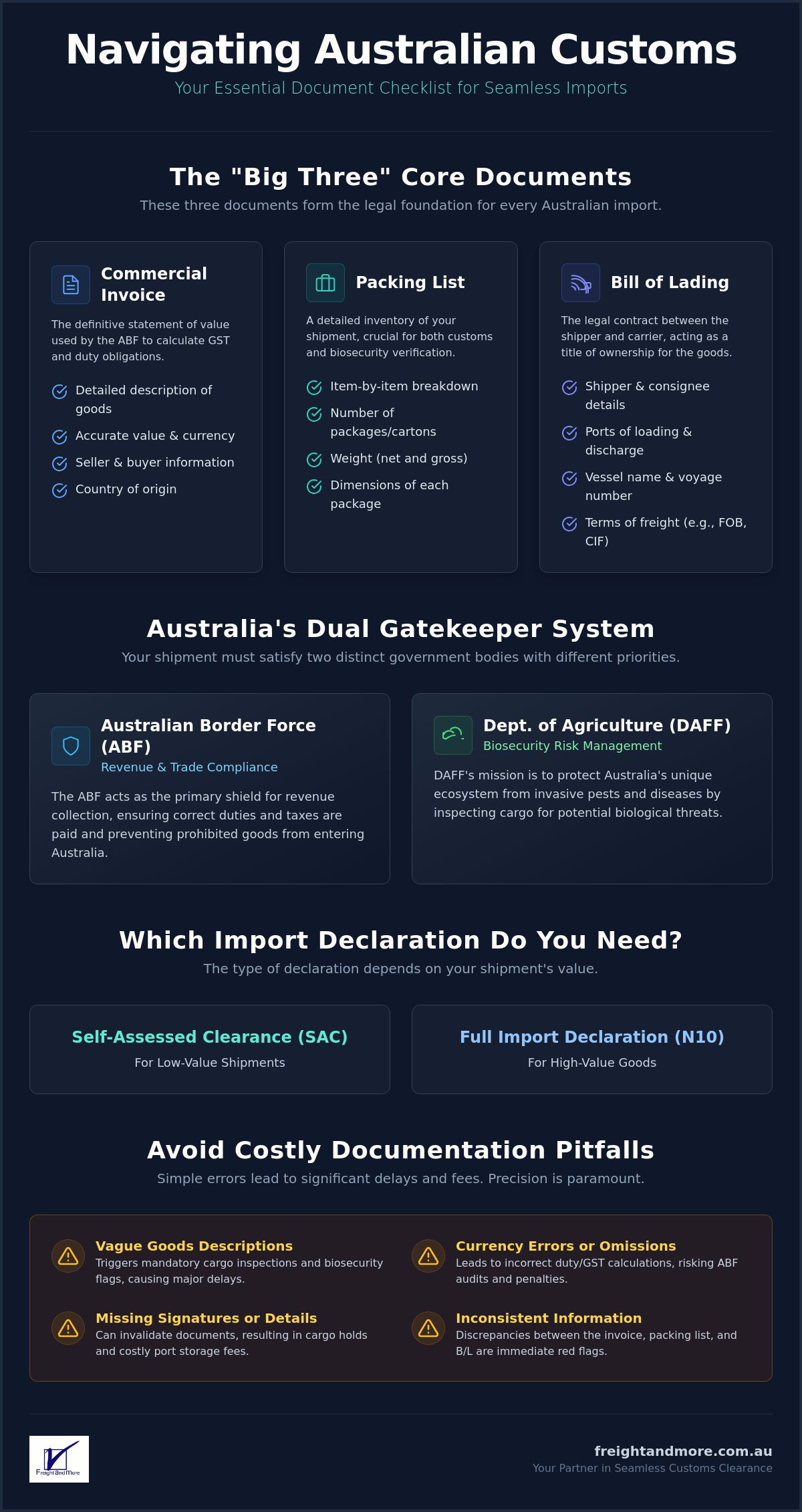
Australia operates a rigorous dual-gatekeeper system that requires your shipment to satisfy two distinct government bodies. The Australian Border Force (ABF) acts as the primary shield for revenue collection and trade compliance. They focus on detecting prohibited goods and ensuring the correct duties and taxes are paid into the national economy. In contrast, the Department of Agriculture, Fisheries and Forestry (DAFF) manages biosecurity risks. Their mission is to protect our unique ecosystem from invasive pests and diseases. Because these agencies have different priorities, a document that satisfies the ABF might still be flagged by DAFF for missing biosecurity details. Success requires a proactive approach that addresses both sets of requirements simultaneously.
The Cost of Non-Compliance
Errors in your paperwork are more than just a clerical headache; they’re a direct threat to your profitability. The Australian Customs Act provides for significant penalties for mis-declaration, even if the error was unintentional. Beyond legal fines, missing or inaccurate documents trigger mandatory cargo inspections. These physical checks are expensive and time consuming. While your cargo sits in a terminal awaiting clearance, you’ll likely face mounting port storage fees and demurrage charges. These costs can quickly erode the margins of a shipment. By 2026, the transition toward digital accuracy in the Integrated Cargo System (ICS) means that the ABF expects pre-arrival reporting to be flawless. At Freight and More, we specialize in customs clearance strategies that eliminate these risks before your goods even leave the port of origin. We ensure your documentation is a bridge, not a barrier, to your business goals.
The Essential “Big Three”: Commercial Invoice, Packing List, and Bill of Lading
When you start planning an international shipment, the question of what documents are needed for custom clearance Australia often boils down to three core pieces of paper. We call these the “Big Three” because they form the legal foundation for every interaction with the Australian Border Force. They aren’t just administrative requirements; they’re legal declarations of your cargo’s identity, value, and ownership. Precision here is the difference between a seamless arrival and a logistical nightmare.
The Commercial Invoice is far more than a simple request for payment. It acts as the definitive statement of value that the ABF uses to calculate your GST and duty obligations. To meet the minimum documentation required for customs clearance, this invoice must be exhaustive and transparent. If your invoice contains generic descriptions or vague values, you risk being flagged for an audit before your goods even touch the dock. If you’re feeling uncertain about how to format these documents for your next shipment, our team is ready to provide expert guidance tailored to your specific cargo.
What Your Commercial Invoice MUST Include
Accuracy starts with the unit price and the currency of the transaction. You must clearly state the agreed Incoterms, such as FOB (Free On Board) or CIF (Cost, Insurance, and Freight), as these dictate who’s responsible for costs at each stage of the journey. Avoid generic terms like “samples” or “merchandise” at all costs. Instead, use specific, industry-standard descriptions that allow customs officers to classify the goods correctly. This clarity prevents the ABF from applying the wrong tariff rate, which could save you from significant overpayments.
The Packing List: A Biosecurity Necessity
While the invoice focuses on money, the Packing List focuses on the physical reality of your shipment. It serves as the essential roadmap for DAFF inspectors, allowing them to verify the contents of your container without having to unpack every single box. Your packing list must include:
- Weight Breakdown: Clear differentiation between gross weight (including packaging) and net weight (the goods alone).
- Packaging Details: Specific markings indicating if the cargo is “palletized” or “loose” to assist with handling and inspection.
- Logical Linking: Every package should be clearly linked to the corresponding items listed on your Commercial Invoice.
Bill of Lading (B/L) or Air Waybill (AWB)
The final pillar is the Bill of Lading for sea freight or the Air Waybill for air freight. This is your legal contract of carriage and, in the case of a B/L, it represents the title to the goods. It proves you have the right to claim the cargo at the destination. We cannot emphasize enough that the data across all three documents must match exactly. Discrepancies in weight, piece counts, or descriptions between your B/L and your packing list are immediate red flags that trigger delays. We take pride in ensuring this “golden thread” of consistency is maintained for every client we serve.
Australia-Specific Requirements: ABF Declarations and DAFF Compliance
Beyond the foundational “Big Three” documents, the Australian border requires specialized declarations that vary based on the value and physical nature of your cargo. If you’re asking what documents are needed for custom clearance Australia, you must look closely at the threshold between simple clearances and formal entries. Australia is unique in its strict biosecurity protocols, meaning your paperwork must account for every piece of timber or straw used in your packing materials to satisfy our national environmental protections.
Choosing the Right Import Declaration
The primary differentiator for the Australian Border Force is the Free On Board (FOB) value of your goods. If your consignment is valued at AUD $1,000 or less, we typically lodge a Self-Assessed Clearance (SAC) declaration. However, for any shipment exceeding that $1,000 threshold, a formal Full Import Declaration (N10) is mandatory. It’s vital to remember that this value is calculated per consignment, not per individual item. For an N10 declaration, you’ll face import processing charges: AUD $50 for goods up to $10,000, and AUD $152 for anything above that amount.
When lodging an N10, precision in your Tariff Classification (HS Code) is non-negotiable. The wrong code can lead to incorrect duty rates or even legal penalties under the Customs Act. For businesses looking to manage cash flow, we can assist with Warehouse Declarations (N20), which allow you to move goods into a bonded warehouse and defer duty and GST until the items are ready for home consumption. Our customs clearance experts manage these complex digital submissions in the Integrated Cargo System (ICS) to ensure your business remains fully compliant with 2026 standards.
Managing Biosecurity (DAFF) Documents
The Department of Agriculture, Fisheries and Forestry (DAFF) has a specific focus on protecting our environment from invasive pests. For all sea freight containers, a Packing Declaration is a mandatory requirement. This document must explicitly state whether the packing materials contain timber, straw, or bamboo. If you use unmanufactured wood packaging, such as raw timber pallets, it will trigger immediate DAFF intervention and likely require expensive fumigation or heat treatment.
To streamline your operations, you can often utilize an Annual Packing Declaration if you work with the same supplier regularly. Otherwise, a shipment-specific declaration is needed every time. These Australian import documentation requirements are designed to mitigate risk before it reaches our shores. You should also consider the following:
- Treatment Certificates: Essential evidence of fumigation or heat treatment for high-risk materials or timber packaging.
- Manufacturer’s Declarations: Often required for machinery to prove “new and unused” status, helping you bypass certain high-risk inspection categories.
- BICON Checks: We recommend checking the Biosecurity Import Conditions system to see if your specific commodity requires an additional import permit.
We take pride in acting as your proactive partner, ensuring every certificate and declaration is in place before your ship even docks. This detail-oriented approach is what keeps your supply chain moving without the sting of unexpected biosecurity fees.
Avoiding Costly Delays: Common Documentation Mistakes and How to Fix Them
Even after you identify what documents are needed for custom clearance Australia, the way you fill them out determines your success. A tiny oversight in a currency code or a vague product description can trigger a cascade of financial penalties. We see it often; a well-intentioned importer submits paperwork that looks correct on the surface but fails the rigorous scrutiny of the Australian Border Force. Precision matters. When you provide us with your documents, we take pride in our meticulous review process to catch these errors before they reach the border.
Currency confusion is a prime example of a high cost mistake. If your commercial invoice is in USD but is mistakenly declared in AUD, you risk a 10% GST overpayment or, worse, an underpayment that leads to audits and fines. Similarly, using “Pro-Forma” invoices for formal customs entry is a recipe for rejection. The ABF requires a final Commercial Invoice to verify the actual transaction value. Vague descriptions like “General Merchandise” or “Machine Parts” are equally dangerous. They almost always trigger a “Request for Information” (RFI), as customs officers can’t determine the correct tariff classification from such broad terms.
The “Request for Information” (RFI) Trap
Understanding what documents are needed for custom clearance Australia is only half the battle; ensuring they are RFI-proof is the other. When the ABF or DAFF flags your paperwork as “insufficient”, they issue an RFI that effectively pauses your clearance process. Typical turnaround times for these responses can stretch into days, quickly eating into your “free time” at the port. Once that free window closes, port storage charges begin to accumulate at an alarming rate. A seasoned customs clearance expert vets every document pre-departure to ensure your cargo moves through the border without these avoidable interruptions.
Digital Accuracy in the Integrated Cargo System (ICS)
As we move through 2026, the Australian trade environment is strictly digital-first. The Integrated Cargo System (ICS) is where your shipment’s digital record lives, and accuracy is paramount. Once a declaration is lodged and “locked” in the system, correcting paper-based errors becomes significantly more complex. We advocate for a “Lodge Early” strategy, aiming for full clearance before the vessel even berths. This proactive approach ensures that if an issue does arise, we have time to solve it while your cargo is still at sea.
Late documentation remains the primary cause of avoidable port storage. If your broker doesn’t have the paperwork before the ship arrives, your cargo sits idle. We take a proactive stance, chasing suppliers for documents weeks in advance to protect your bottom line. If you want to ensure your next shipment is handled with this level of meticulous care, contact our expert team today for a tailored consultation.
Streamlining Your 2026 Imports with Professional Customs Brokerage
While mastering what documents are needed for custom clearance Australia is a vital step toward trade success, the true competitive advantage lies in how you manage that data. A Licensed Customs Broker isn’t just a service provider; they’re your primary defense against the complexities of Australian Border Force audits. We act as your dedicated shield, ensuring that every digital entry in the Integrated Cargo System is backed by impeccable evidence. By choosing a partner that integrates freight forwarding with expert brokerage, you eliminate the communication gaps that often lead to expensive terminal delays.
We take immense pride in our proactive approach. It’s not enough to simply react to problems as they arrive at the wharf; we aim to solve them while your goods are still at the origin. This end-to-end management ensures that your sea or air freight moves through the border with the professional ease your business deserves; for instance, US-based exporters can discover Postal Xpress N More for reliable shipping and business support. When you trust us with your cargo, you’re gaining a partner that treats your deadlines with the same meticulous care as you do.
The Value of a Dedicated Customs Partner
Success in the 2026 trade environment requires a sophisticated understanding of global logistics. We engage in proactive document auditing to catch supplier errors before the cargo even leaves the origin port. This foresight is especially critical when managing Free Trade Agreement (FTA) certificates. If your goods qualify for preferential rates from major partners like China or the USA, we ensure the documentation is flawless so you can legally minimize duty payments and protect your margins. We provide a single, energetic point of contact for the ABF, DAFF, and your local transport logistics, removing the obstacles that slow down your supply chain.
Get Started with Freight and More
Since our founding in 2009, Freight and More Pty Ltd has established a reputation as a bold overachiever in the Australian logistics landscape. We possess the national reach to handle complex customs entries across every major port while maintaining the personal attention of a bespoke advisor. Whether you’re navigating the $152 import processing charge for high-value N10 declarations or managing the strict biosecurity requirements for machinery, we have the seasoned expertise to guide you. We don’t just move boxes; we manage the entire documentation trail so you don’t have to.
Don’t leave your 2026 supply chain to chance. We invite you to contact our team today for a comprehensive document review or a tailored quote. Before you ship your next container, ensure you have your “Big Three” ready, your packing declarations signed, and your tariff classifications verified. Let’s work together to ensure your cargo clears the border with total confidence and without a single unexpected cost!
Secure Your Supply Chain Success in 2026
Identifying exactly what documents are needed for custom clearance Australia is the first vital step toward building a resilient international business. We have explored how the alignment of your commercial invoice, packing list, and bill of lading creates a “golden thread” of consistency that satisfies both the ABF and DAFF. By focusing on digital accuracy and addressing biosecurity risks before departure, you can effectively eliminate the threat of port storage fees and costly inspections.
Our team of Licensed Australian Customs Brokers is ready to act as your proactive partner; we provide the deep expertise in ABF and DAFF compliance required to navigate these 2026 standards with ease. We offer national door-to-door logistics solutions that simplify the complex documentation trail for importers across all industries. This commitment to precision ensures your cargo moves through the border without a hitch.
Don’t let paperwork errors slow down your growth! Get a Professional Customs Clearance Quote Today and experience the peace of mind that comes with meticulous, expert-led management. We are excited to help your cargo clear the border with total confidence!
Frequently Asked Questions
Do I need a customs broker to import goods into Australia?
While it’s not a legal requirement to use a licensed customs broker, it is highly recommended for commercial importers. Brokers possess the technical expertise to navigate the Integrated Cargo System and ensure your cargo complies with all 2026 regulations. Attempting to manage the process alone often results in technical errors that lead to costly storage fees that far outweigh the cost of professional assistance.
What happens if I don’t have a Commercial Invoice?
You cannot clear goods through the Australian border without a final Commercial Invoice. This document is essential because it defines the customs value of your goods for duty and GST calculations. The Australian Border Force will typically reject pro-forma invoices for formal entry, so you must ensure your supplier provides a final, accurate invoice before your shipment arrives.
How long does customs clearance take in Australia?
Customs clearance usually takes between 24 and 48 hours for standard shipments, provided all documentation is accurate and submitted pre-arrival. Air freight is often processed faster than sea freight. However, if the Department of Agriculture, Fisheries and Forestry (DAFF) flags your cargo for an inspection or issues a Request for Information, the timeline can extend by several days.
What is an N10 Import Declaration?
An N10 Import Declaration is the formal entry required for all goods with a Free On Board (FOB) value exceeding AUD $1,000. It is a critical component of what documents are needed for custom clearance Australia for commercial entities. This declaration allows the Australian Border Force to calculate the correct duty and GST while ensuring your shipment meets all trade compliance standards.
Are there any goods that don’t require customs clearance?
All goods imported into Australia must be cleared through customs, though the specific process depends on the value and type of cargo. Goods valued at AUD $1,000 or less generally use a simpler Self-Assessed Clearance (SAC) declaration. Even duty-free items brought in by travelers must be declared if they exceed the standard AUD $900 allowance for adults.
Can I clear my own goods through customs to save money?
Yes, individuals can lodge their own import declarations, but the process is exceptionally complex for those without industry training. You would need to register with the Australian Border Force and gain access to the digital Integrated Cargo System. Most businesses find that the risk of making an error, which leads to port storage fees and penalties, makes self-clearing a risky financial choice.
What is a Packing Declaration and is it mandatory for air freight?
A Packing Declaration is a mandatory document for all sea freight container shipments but is not required for air freight. This document specifically addresses biosecurity risks associated with packing materials like timber, straw, and bamboo. Because air freight follows different handling and risk protocols, the Department of Agriculture, Fisheries and Forestry focuses its timber packaging scrutiny primarily on sea cargo.
How much are the customs brokerage fees in Australia for 2026?
Customs brokerage fees in Australia are determined by the complexity of your shipment and the number of tariff lines on your invoice. These service fees are separate from the fixed government import processing charges, which are AUD $50 for goods up to $10,000 and AUD $152 for goods above that value. Most importers view these professional fees as a necessary investment to prevent the much higher costs of terminal storage and biosecurity delays.
