FCL Sea Freight Australia: The 2026 Strategic Guide to Full Container Shipping

What if the biggest threat to your 2026 profit margin isn’t the rising cost of goods, but the hidden “black hole” of Australian port charges and biosecurity delays? You’ve likely felt the frustration of watching a shipment stall at the wharf while demurrage fees climb, or perhaps you’re tired of the radio silence from massive forwarders when your cargo is actually on the line. Managing FCL sea freight Australia should be a powerful strategic lever for your business growth, yet the reality often involves a dizzying array of shifting regulations and volatile market rates. We understand that you need more than just a slot on a vessel; you need a partner who treats your bottom line with the same meticulous care as you do.
In this comprehensive 2026 guide, we promise to help you master the complexities of full container shipping so you can achieve predictable costs and total compliance. You’ll gain expert clarity on the latest Australian Border Force requirements, including the July 2026 import processing charges and the upcoming 2026-2027 BMSB season protocols. We’re going to preview the essential strategies for container selection, customs brokerage, and national distribution that ensure your goods move seamlessly from the port to your warehouse. It’s time to replace shipping anxiety with the professional confidence of a seasoned industry veteran.
Key Takeaways
- Learn why FCL remains the premier choice for security and speed in the 2026 market, providing exclusive use of dedicated equipment for your high-value cargo.
- Discover how to strategically select between standard 20ft and 40ft containers to balance volume capacity with weight restrictions for maximum cost-efficiency.
- Master the latest 2026 biosecurity and customs protocols for FCL sea freight Australia to ensure total compliance and avoid expensive terminal delays.
- Identify the critical links in port-to-door logistics, from efficient wharf cartage to sophisticated warehouse management and seamless national distribution.
- Understand the value of a proactive logistics partner who anticipates operational obstacles and provides the personalised guidance necessary for a resilient supply chain.
Understanding FCL Sea Freight in the 2026 Australian Market
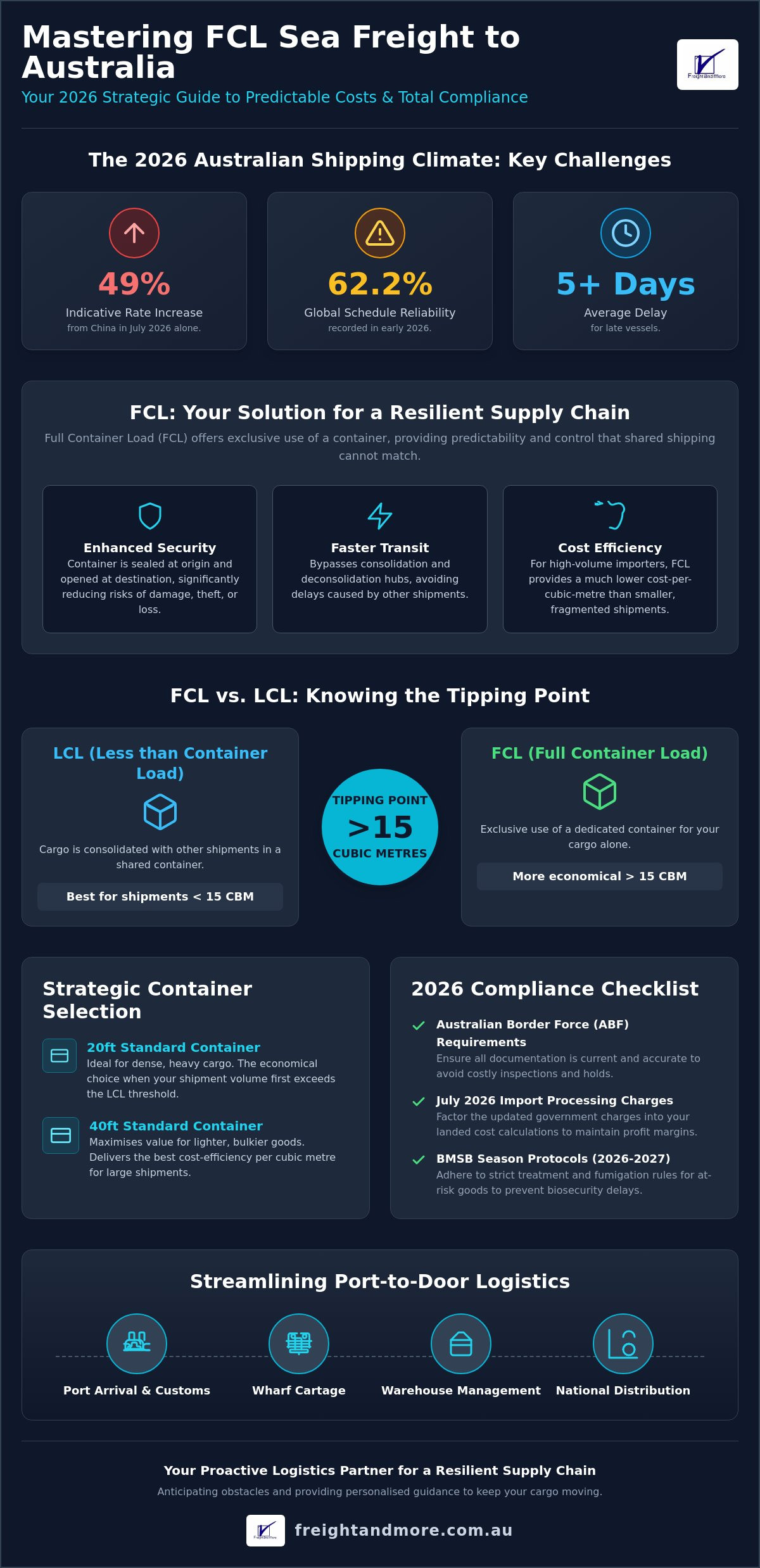
The current climate for FCL sea freight Australia is defined by a rapid evolution in both capacity and cost. As we move through 2026, major Australian ports like Sydney, Melbourne, and Brisbane are witnessing a significant peak-season capacity crunch, with indicative rates from China increasing by approximately 49% in July alone. For businesses that rely on steady inventory, securing a dedicated container isn’t just about logistics; it’s a vital move to protect your supply chain from the volatility of a fluctuating global market.
Full Container Load (FCL) refers to a shipment where a single importer or exporter has exclusive use of a dedicated sea container, a process that significantly reduces port-side delays by bypassing the consolidation and deconsolidation queues common with smaller loads. Since its inception, this method has become the global standard in freight for entities that prioritise security, speed, and total control over their cargo. It remains the gold standard for Australian enterprises because it offers a level of predictability that shared shipping simply cannot match.
To better understand how these shipments move across the ocean to our local shores, watch this helpful video:
Global trade shifts are currently impacting sea freight capacity to Australia, with carriers actively managing space to combat geopolitical disruptions. With global schedule reliability recorded at 62.2% in early 2026, late vessels are averaging over five days behind schedule. By choosing an FCL solution through a dedicated provider like Freight and More, you gain a partner that anticipates these obstacles and works proactively to keep your cargo moving through the congestion.
The Core Benefits of Dedicated Container Shipping
The most immediate advantage of FCL is the drastic reduction in handling risks. Because your container is sealed at the point of origin and only opened at its final destination or during a mandatory biosecurity inspection, the risk of damage or loss is significantly lower than in shared environments. You also benefit from faster transit times since your cargo doesn’t need to wait at a consolidation hub for other shipments to arrive. For high-volume importers, the cost-effectiveness of FCL is undeniable when calculated per cubic metre, providing a much lower unit cost than smaller, fragmented shipments.
FCL vs. LCL: When to Scale Up
Determining the ‘tipping point’ between FCL and Less than Container Load (LCL) is a strategic decision that depends on your specific volume and urgency. Generally, once your shipment exceeds 15 cubic metres, moving to a 20ft FCL container becomes more economical. Beyond the numbers, FCL allows for better control over your supply chain timeline, which is essential when managing tight Australian distribution schedules. If you’re dealing with sensitive goods or strict delivery windows, scaling up to a dedicated container ensures your cargo isn’t at the mercy of another shipper’s documentation errors or delays.
Strategic Container Selection: Maximising Value for Your Cargo
Securing the ideal equipment represents your first major opportunity to optimise the total cost of FCL sea freight Australia. It’s a strategic calculation that balances the physical dimensions of your cargo with the legal weight limits of Australian infrastructure. Choosing the wrong container type doesn’t just lead to wasted space; it can trigger unexpected surcharges, specialised handling fees, or even legal complications during the final leg of transport. Our team takes a proactive approach to equipment selection, ensuring your cargo fits perfectly within both the vessel’s hold and your budget.
Standard Container Dimensions and Payload Capacity
The 20ft General Purpose (GP) container remains the “heavy lifter” of the industry. It’s the preferred choice for dense, heavy commodities such as machinery, minerals, or palletised tiles. While it has less volume than its larger counterparts, its ability to handle significant weight makes it indispensable for industrial imports. Conversely, the 40ft General Purpose and the increasingly popular 40ft High Cube (HC) are the gold standards for “volume” cargo. If you’re importing furniture, textiles, or electronics, the High Cube offers an extra foot of vertical space, allowing you to maximise every cubic metre of the container.
You must consider how payload affects your final delivery; an overloaded container might require specialised heavy-haulage trailers or permits that quickly erode your profit margins. We help you navigate these road weight restrictions to ensure your door-to-door journey remains cost-effective and compliant with local transport regulations. If you’re unsure which size fits your current inventory cycle, we’re always ready to provide a tailored equipment assessment for your next shipment.
Specialised FCL Solutions for Complex Cargo
Standard containers aren’t always sufficient for the diverse needs of the Australian market. For out-of-gauge (OOG) industrial equipment that exceeds standard dimensions, Open Top or Flat Rack containers provide the necessary flexibility for top or side loading. These specialised units are essential for preventing “double-handling” at the wharf, where incorrect equipment choice often leads to exorbitant specialised crane fees.
The Australian food and pharmaceutical sectors rely heavily on Refrigerated (Reefer) containers to maintain strict temperature controls throughout the transit. When dealing with these sensitive goods, meticulous attention to biosecurity and documentation requirements is non-negotiable. Selecting the right specialised equipment from the outset ensures your cargo meets all safety standards while avoiding the delays that come with inadequate protection. By matching your specific cargo profile to the right equipment, we remove the obstacles that typically hinder complex international moves.
Navigating Australian Customs and Biosecurity Compliance
Australia maintains some of the world’s most rigorous border protections, making compliance a cornerstone of successful FCL sea freight Australia. You aren’t just moving cargo; you’re entering a highly regulated environment where precision is the only currency. A licensed customs broker acts as your essential guide through this landscape, proactively identifying potential hurdles before they result in heavy fines or terminal delays. As of July 1, 2026, the Australian Border Force has updated the Import Processing Charges, with sea consignments valued over $10,000 attracting a $152.00 fee. Staying ahead of these costs and regulatory shifts is what separates a seamless delivery from a logistics nightmare.
Understanding the threshold between a Self-Assessed Clearance (SAC) and a Full Import Declaration (FID) is vital for your bottom line. Goods valued at or below AUD $1,000 generally fall under the SAC category, but for most commercial FCL shipments, a FID is required. For the 2026-2027 financial year, the biosecurity cost recovery charge for a sea-based FID is set at $71.00. We manage the meticulous details of these declarations to ensure you’re never caught off guard by the ‘Tailgate Inspection’ process, where biosecurity officers conduct a physical check at the terminal to verify the cleanliness of your container’s exterior and the status of its wooden packing components.
Essential Documentation for Seamless Clearance
Accuracy in your paperwork is non-negotiable if you want to avoid the “black hole” of port storage fees. Your commercial invoice, packing list, and bill of lading must align perfectly to satisfy the Australian Border Force import requirements. Discrepancies in these documents are the leading cause of avoidable delays at the wharf. You can gain deeper insights into these processes by reviewing our expert guide on import customs clearance australia. All FCL shipments entering Australian territory require a mandatory biosecurity packing declaration to confirm the status of wood packaging and dunnage materials.
Biosecurity and Quarantine: Protecting the Australian Border
Seasonal measures add another layer of complexity to your shipping strategy. The 2026-2027 Brown Marmorated Stink Bug (BMSB) season begins on September 1, 2026, requiring mandatory heat treatment or fumigation for high-risk goods from target countries. If you fail to comply with these seasonal protocols, the consequences are severe; the Department of Agriculture, Fisheries and Forestry (DAFF) may order expensive container cleaning or even the immediate re-exportation of your cargo at your expense. We treat these requirements with the highest level of priority, removing the biosecurity obstacles that could otherwise derail your national distribution plans. Our proactive approach ensures your cargo is cleared quickly, maintaining the steady flow of your supply chain.
Port-to-Door Logistics: Streamlining National Distribution
The journey doesn’t end when the vessel berths; in many ways, the real strategic work begins once the container hits the terminal floor. Efficiently managing FCL sea freight Australia requires a firm grasp of wharf cartage, an area where a lack of foresight leads to significant futile truck charges if time slots aren’t coordinated with surgical precision. These charges occur when a transport carrier arrives for a scheduled pickup but is turned away because the container hasn’t yet been released or the terminal is experiencing excessive congestion. We take a proactive stance on time slotting, acting as the bridge between the shipping line and the transport provider to ensure your cargo never sits idle.
Deciding between de-vanning at a facility or opting for a full container delivery directly to your door depends entirely on your site’s infrastructure and your speed-to-market requirements. For those with limited space, a side-loader is an invaluable asset. These specialised vehicles place a container directly on the ground for easy unloading without the need for a dedicated loading dock. You must also remain hyper-aware of your “Free Time” at the wharf. Most carriers only provide a few days of grace before demurrage and detention fees begin to erode your profit margins. If your distribution requirements extend beyond the port city, integrating interstate transport into your initial plan is the best way to maintain a fluid supply chain.
Wharf Transport and Side-Loader Logistics
Managing the physical movement of a container requires more than just a truck; it requires a strategy that anticipates terminal bottlenecks. Side-loaders offer the ultimate flexibility for on-site delivery, allowing you to unload at your own pace while the vehicle moves on to its next job. However, the clock is always ticking on container detention. By coordinating the return of the empty equipment to the designated park immediately after de-vanning, we remove the obstacles that typically lead to unexpected post-shipment costs. It’s this level of meticulous care that protects your ROI during the final mile, where reliable transport equipment and trailers maintained with components from Superior Trailer Parts play a vital role in local distribution.
Warehousing and 3PL Integration
For businesses looking to scale, leveraging a 3PL integration for warehousing and final-mile delivery offers a level of flexibility that in-house logistics often can’t match. Bonded warehousing is a particularly bold move for high-value imports, allowing you to manage cash flow more effectively by deferring duty and GST payments until the goods actually leave the warehouse. By using a partner for de-vanning and palletising, you ensure that empty containers are returned to the park well within their detention-free window. If you’re looking to anchor your operations in a major trade hub, exploring 3PL warehouse solutions can provide the infrastructure needed to reach your customers faster and more reliably.
Why Freight and More is Your Strategic FCL Partner
Choosing a partner for FCL sea freight Australia isn’t just about finding the lowest rate; it’s about securing a dedicated ally who understands that your cargo represents your reputation. Founded in 2009, Freight and More has built its foundation on a proactive, ‘can-do’ attitude that anticipates logistics obstacles long before they manifest as costly delays. While global giants might offer scale, they often lack the meticulous, high-touch attention that Australian businesses require to thrive in a volatile market. When you work with us, you aren’t funnelled through a faceless call centre. Instead, you gain direct access to seasoned experts who take personal pride in managing every detail of your shipment from the global origin right to your Australian doorstep.
Our role as a bold overachiever in the industry means we go beyond the standard norms of a freight forwarder. We don’t just book a slot on a ship; we act as a dedicated guide through the entire lifecycle of your cargo. This involves a steady, methodical approach that moves from initial planning to final-mile delivery. We’ve spent decades refining our expertise within the Australian logistics landscape, ensuring that we can solve problems with a level of precision that only comes from experience. Reliability isn’t just a promise for us; it’s the standard we live by every day.
A Global Network with a National Heart
Customised Logistics Solutions for Every Business
Every business has a unique rhythm, and your logistics should reflect that. We specialise in tailoring sea freight services to meet the specific demands of your industry, whether you’re importing heavy industrial machinery or time-sensitive consumer goods. By handling the complex layers of customs clearance, wharf cartage, and warehouse management, we remove the friction from your supply chain. This allows you to stop worrying about terminal time slots or packing declarations and start focusing on your primary goal: growth. If you’re ready for a logistics experience that prioritises your needs, contact us today for a tailored FCL sea freight enquiry and let us show you what a dedicated partnership looks like!
Master Your Australian FCL Strategy for 2026 and Beyond
Mastering the complexities of FCL sea freight Australia involves more than just moving boxes; it’s about building a resilient supply chain that can withstand the volatility of the 2026 market. You now have the strategic tools to select the right equipment, navigate the latest Australian Border Force requirements, and streamline your national distribution from the wharf to your warehouse. By prioritising meticulous compliance and proactive communication, you remove the obstacles that often lead to hidden costs and frustrating delays.
At Freight and More, we’ve been Australian owned and operated since 2009, providing the licensed customs brokerage expertise and end-to-end national logistics network you need to scale with confidence. Our team is ready to act as your dedicated partner, ensuring every meticulous detail is handled with care and personal attention. We take pride in being a bold overachiever that goes beyond industry norms to protect your bottom line.
We’re eager to help you transform your shipping operations into a powerful competitive advantage for your business!
Frequently Asked Questions
What is the difference between FCL and LCL sea freight?
Full Container Load (FCL) means you have exclusive use of a dedicated container for your goods, whereas Less than Container Load (LCL) involves sharing space with other shippers. FCL is typically the faster and more secure option because it avoids the consolidation and deconsolidation hubs that add handling risks and transit time to LCL shipments. If your cargo exceeds 15 cubic metres, FCL often becomes the more cost-effective choice for your supply chain.
How long does FCL sea freight take to reach Australia from China?
Transit times for FCL sea freight Australia from major Chinese ports generally range between 18 and 25 days for direct services. However, you should factor in current global schedule reliability, which was recorded at 62.2% in March 2026 with average vessel delays of 5.48 days. Port congestion and carrier capacity management can also impact these windows, so we recommend allowing a buffer for your inventory planning.
What are the standard sizes for shipping containers in Australia?
The two primary standards are the 20ft and 40ft General Purpose containers. A 20ft container is the “heavy lifter” designed for dense, heavy goods like machinery, while the 40ft container is built for volume. For light, high-volume commercial goods, the 40ft High Cube (HC) is the preferred choice as it provides an additional foot of vertical height, allowing you to maximise your shipping spend per cubic metre.
How much does it cost to ship a full container to Australia?
Total shipping costs are influenced by a volatile mix of base freight rates, fuel surcharges, and port handling fees that change frequently. Because carriers implement general rate increases and peak season surcharges based on market demand, static pricing is rare in the 2026 landscape. We recommend building a 10% to 15% buffer into your logistics budget and requesting a personalised quote to capture the most current market rates for your specific route.
What is demurrage and how can I avoid it?
Demurrage is a daily fee charged by shipping lines when a container remains at the terminal beyond the agreed “free time” period. You can avoid these expensive penalties by ensuring all customs documentation is submitted well before the vessel berths and by coordinating with a proactive transport partner. We manage the time slotting at the wharf meticulously to ensure your container is picked up as soon as it’s released by the terminal.
Do I need a customs broker for FCL shipments?
Yes, engaging a licensed customs broker is essential for navigating the complexities of FCL sea freight Australia without incurring fines. A broker ensures your cargo complies with the latest Australian Border Force requirements and manages the specific July 2026 import processing charges on your behalf. We proactively handle the tariff classifications and biosecurity risks, preventing the terminal delays that often plague unassisted importers.
What is a packing declaration and why is it required for FCL?
A packing declaration is a mandatory document that informs Australian biosecurity officers whether wood packaging or dunnage was used in your container. It’s a critical tool for protecting the Australian environment from pests like the Brown Marmorated Stink Bug. If your declaration is missing or contains inaccuracies, your container will likely be held for a mandatory tailgate inspection at the wharf, leading to significant delays and additional handling fees.
Can I ship a car or personal effects via FCL?
Yes, FCL is an ideal method for shipping vehicles because it provides a secure, dedicated environment that protects the car from external elements and handling risks. Once the vehicle arrives and is unloaded, the next step is coordinating safe inland delivery. For those seeking reliable professional vehicle shipping, Canoe Auto Transport provides expert open and enclosed carrier solutions that prioritize the safety of your automotive cargo during its domestic journey.
Additionally, whether you are importing a car into Australia or assessing the equity in your existing vehicle before transit, consulting My Car Value provides an accurate market valuation to help you budget for duties and transport expenses.
