How to Avoid Customs Delays in Australia: The 2026 Importer’s Compliance Checklist

If you’re waiting until your cargo arrives at the wharf to manage your paperwork, you’ve already invited a costly delay into your supply chain. We understand that the pressure of unpredictable port storage fees is a constant worry, especially when confusing acronyms like ABF, DAFF, and the ICS seem designed to complicate your operations. It’s exhausting to watch your margins shrink while goods sit idle, but we believe that importing should be a source of growth, not a logistical headache! To successfully avoid customs delays Australia requires a shift in perspective where clearance is treated as a sophisticated documentation strategy that begins long before your vessel departs the port of origin.
We know you’re looking for more than just a basic checklist; you need a reliable way to ensure your cargo flows seamlessly through the border every single time. This guide promises to help you master the latest 2026 biosecurity regulations and Australian Border Force requirements, providing you with a proactive roadmap to keep your cargo moving without expensive holds. We’ll explore how to achieve ‘pre-clearance’ status, navigate the specific IPC fees for shipments over AUD 1,000, and leverage the 10% GST deferral scheme so your delivery timelines remain perfectly predictable and your compliance is absolute.
Key Takeaways
- Master the dual-gatekeeper system by understanding the distinct regulatory requirements of the Australian Border Force and the Department of Agriculture, Fisheries and Forestry.
- Eliminate valuation holds by auditing your commercial invoices and packing lists for absolute accuracy before your goods leave the supplier.
- Navigate high-risk biosecurity delays by ensuring all timber packaging meets the ISPM 15 standard and your cargo valuation aligns with ABF transaction value rules.
- Adopt a proactive five-step strategy to avoid customs delays australia by classifying your cargo and securing necessary permits at least 30 days prior to shipping.
- Leverage expert brokerage services and Tariff Concession Orders to streamline your clearance process and legally minimize duty costs to as low as 0%.
Understanding the Australian Customs Landscape in 2026
Australian borders operate under a sophisticated dual-gatekeeper system that requires meticulous attention to detail from every importer. To effectively avoid customs delays australia, you must recognize that your shipment must pass two distinct regulatory hurdles before it can be released into the local market. This isn’t just about paying taxes; it’s about navigating a high-stakes environment where the Australian Border Force (ABF) and the Department of Agriculture, Fisheries and Forestry (DAFF) work in tandem to secure the nation. We’re here to ensure you feel confident and prepared as you move your goods across these digital and physical boundaries.
To better understand this concept, watch this helpful video:
Failing to align with these agencies creates what we call the "Hidden Costs of Friction." When a shipment is held, you aren’t just losing time; you’re accruing daily demurrage fees for port space, detention charges for the late return of containers, and mounting wharf storage costs that can quickly exceed the value of the goods themselves. Proactive planning is the only way to avoid customs delays australia and protect your bottom line from these avoidable penalties. The Integrated Cargo System (ICS) serves as the digital backbone of Australian trade in 2026, acting as the primary electronic interface for all import declarations and cargo reporting.
The Role of the Australian Border Force (ABF)
The ABF acts as the primary guardian of Australia’s economic interests and social safety. Their mandate focuses heavily on revenue protection, ensuring that the standard 5% customs duty and 10% GST are accurately calculated on the Value of Taxable Importation for all goods over the AUD 1,000 threshold. Under the Customs Act 1901, importers are legally responsible for their own declarations, making precision a non-negotiable requirement. This agency also manages community protection, screening every shipment for prohibited imports and illicit goods to maintain a secure trading environment. If you need assistance with these complexities, our customs clearance experts are ready to guide you.
Biosecurity and the DAFF Gatekeeper
While the ABF looks at the financial and legal aspects, DAFF focuses on the biological risk to the continent. Australia’s biosecurity laws are among the world’s strictest because our unique ecosystem is incredibly vulnerable to foreign pests and diseases. Even if your products are inanimate, your packaging materials like timber or straw are high-risk targets that require strict adherence to the ISPM 15 standard. In 2026, the shift toward automated biosecurity risk assessment means that any discrepancy in your treatment certifications will trigger an immediate hold for inspection or fumigation. We take great pride in helping you navigate these hurdles with ease and meticulous care!
The Critical Documentation Audit: Your First Line of Defence
Your documentation strategy is the single most important factor in whether your shipment clears in hours or languishes for weeks. To effectively avoid customs delays australia, you must treat every document as a legal declaration that must withstand intense scrutiny from both the ABF and DAFF. We’ve seen that the most common cause of unnecessary holds isn’t a lack of effort, but a lack of precision in the initial audit phase. If your paperwork is vague, your shipment is vulnerable to manual inspections that eat into your margins and disrupt your supply chain.
Commercial Invoice Requirements for 2026
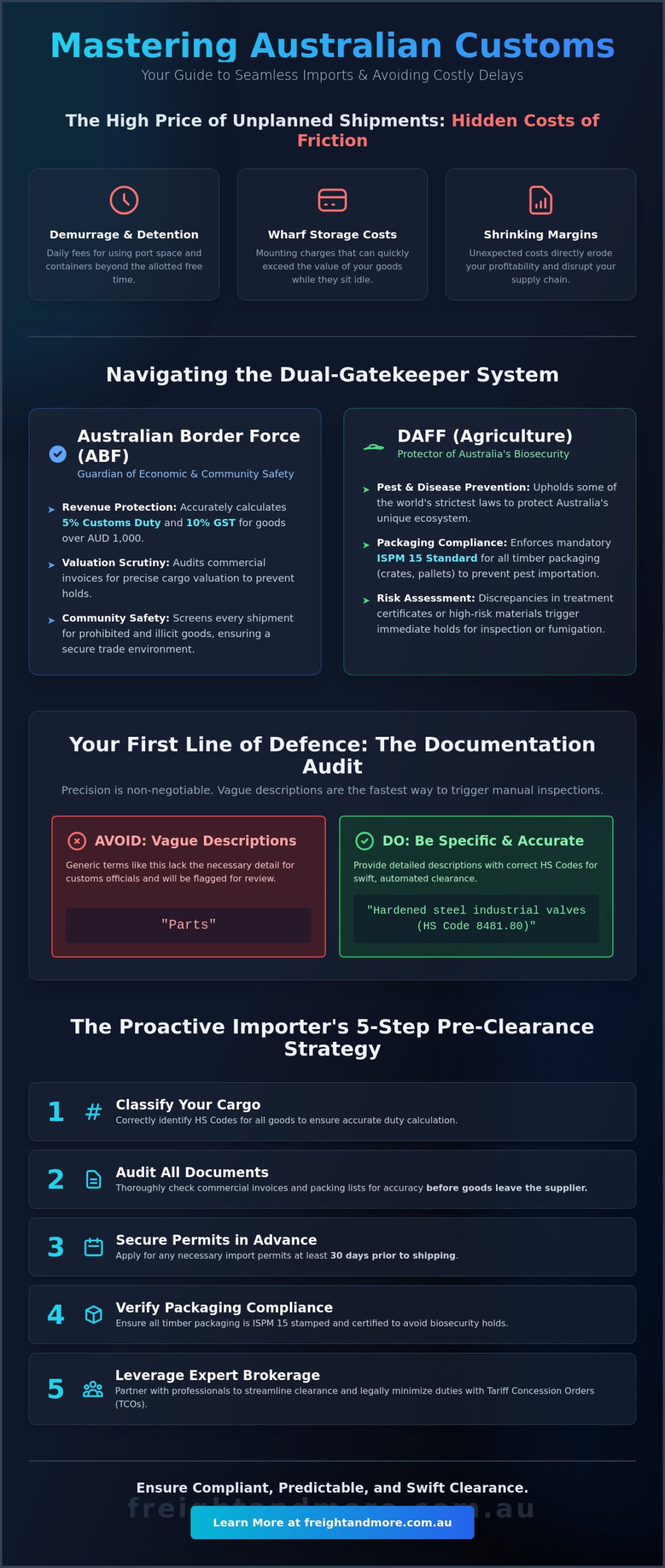
Generic descriptions are the fastest way to trigger a manual valuation hold. If your invoice lists "parts" instead of "hardened steel industrial valves (HS Code 8481.80)", the ABF will likely flag the shipment for a classification review. You must ensure that line items are granular and that the currency is clearly stated alongside the correct Incoterms® 2020. It’s also vital to ensure your invoice value matches your bank transfer exactly. This alignment is a primary audit requirement for verifying the transaction value and ensuring you don’t face penalties for under-valuation.
Packing Lists and Physical Verification
A packing list functions as your cargo’s physical map. Discrepancies between gross and net weight often lead to random weigh-bridge inspections, which add unnecessary days to your delivery timeline. For those utilizing sea freight, the container packing declaration remains a non-negotiable requirement to meet Australia’s biosecurity import conditions. Every carton must have "Marks and Numbers" that link directly back to the digital declaration to ensure a seamless verification process. We take immense pride in helping our clients perfect these details before the cargo ever leaves the factory floor!
Don’t overlook the financial advantages of Free Trade Agreements (FTAs). Australia currently has agreements with 15 countries, and a valid Certificate of Origin can often reduce your duty rate from the standard 5% to 0%. Whether you’re using a Bill of Lading for ocean transit or an Air Waybill for urgent cargo, ensure the "Title to Goods" is correctly endorsed to avoid ownership disputes at the border. If you’re feeling overwhelmed by these requirements, you can always reach out for a professional documentation review to ensure your paperwork is bulletproof. By taking a proactive stance now, you’ll ensure your cargo moves through the Integrated Cargo System without a single hitch.
Biosecurity and Valuation: Navigating High-Risk Delays
Navigating the intersection of biosecurity and financial valuation is where many importers find their momentum halted. While your paperwork might be in order, the physical state of your packaging or the nuances of your financial reporting can trigger an immediate ‘DAFF Hold’. To successfully avoid customs delays australia, you must look beyond the product itself and examine the entire ecosystem of your shipment. We believe a proactive approach to these high-risk areas is the hallmark of a seasoned importer who values precision and reliability.
All timber packaging, including pallets, crates, and dunnage, must strictly adhere to the ISPM 15 standard. This means every piece of wood must be heat-treated or fumigated by a certified provider and carry the appropriate stamp. If your supplier cuts corners here, your cargo won’t just be delayed; it may be ordered for immediate export or destruction at your expense. Similarly, the ABF remains vigilant regarding prohibited and restricted goods. Whether it’s the specific safety certifications required for lithium batteries or the strict intellectual property laws surrounding branded items, being caught with non-compliant goods can lead to permanent seizure. For a comprehensive overview of your legal obligations, we recommend consulting the official Australian Border Force importing guide.
Managing Biosecurity Risks in Sea Freight
The seasonal ‘Brown Marmorated Stink Bug’ (BMSB) measures are a critical consideration for shipments originating from target risk countries during the high-risk season. These regulations often require mandatory offshore treatment for certain goods, and failing to verify this can result in your container being turned away at the wharf. We encourage you to utilize our specialized sea freight services to ensure your carriers and suppliers are fully compliant with these evolving biosecurity protocols. Understanding the difference between a routine ‘Inspection’ and a ‘Directed Treatment’ is essential for managing your budget and delivery expectations.
Valuation, GST, and Duty Accuracy
Customs valuation is far more complex than simply stating the price paid for goods. The ABF calculates ‘Transaction Value’ by scrutinizing transfer pricing and looking for ‘assists’ like free tooling, royalties, or packing costs that weren’t included in the invoice price. Incorrect classification using the wrong HS Codes is a leading cause of post-clearance audits and financial penalties. To avoid these pitfalls, you should refer to our detailed guide on understanding import costs Australia to ensure your tax and duty calculations are 100% accurate. We’re dedicated to helping you remove these obstacles before they impact your margins!
The Proactive Importer’s Checklist: 5 Steps to Pre-Clearance
Successful importing isn’t a matter of luck; it’s the result of a disciplined, chronological strategy that addresses risks before your cargo ever leaves the factory floor. To effectively avoid customs delays australia, you must transition from a reactive mindset to a proactive one where every detail is verified in advance. We take immense pride in helping our partners implement this five-step checklist to ensure their shipments move with precision and speed.
- Step 1: Classify your goods early. Use the Australian Customs Tariff to determine the correct HS Code before you even place your order. This prevents last-minute scrambles and ensures your costings are accurate from day one.
- Step 2: Secure permits 30 days prior. If you’re importing restricted goods like industrial chemicals or heavy machinery, ensure all DAFF or ABF permits are approved at least 30 days before the vessel departs.
- Step 3: Audit supplier documentation. Review every invoice and packing list for vague descriptions. If a document lists "metal parts" instead of a specific technical name, send it back for a revision immediately.
- Step 4: Verify ISPM 15 compliance. Confirm that all timber packaging features clear, legible stamps. If the stamps are faded or missing, your shipment will likely face a biosecurity hold for directed treatment.
- Step 5: Pre-lodge your declaration. Engage your broker to submit the import declaration at least 48 hours before the ship berths or the plane lands. This is the single most effective way to keep your supply chain moving.
The Power of Pre-Lodgement
Pre-lodging your documentation allows the ABF to assess your shipment while it is still in transit. If your paperwork is perfect, you can achieve ‘Status 1’ clearance, which is the gold standard for Australian importers. This means your cargo is cleared for release the moment it hits the wharf! Waiting for the vessel to berth before starting your paperwork is a recipe for expensive storage fees and unnecessary stress. We’re here to help you hit that Status 1 mark every time.
Supplier Management and Education
Your overseas manufacturers are your most important compliance partners. We recommend drafting a formal ‘Shipping Instruction’ document that outlines exactly how you need invoices formatted and how packaging must be treated. Always insist on high-resolution digital copies of all original documents as soon as they’re generated. For a deeper dive into these requirements, you should consult our import customs clearance Australia checklist for more granular steps. If you’re ready to streamline your next shipment, contact our expert team today to discuss a tailored compliance strategy.
Partnering for Compliance: How Professional Brokerage Eliminates Friction
While the tactical checklist in the previous section provides a solid foundation, the ultimate way to avoid customs delays australia is to secure expert representation. A Licensed Customs Broker is far more than a simple data entry service; they act as your legal advocate and strategic advisor before the Australian Border Force. We take immense pride in our role as dedicated partners, ensuring that your business doesn’t just clear the border, but does so with the highest level of financial efficiency and regulatory integrity. It’s about more than just moving boxes; it’s about protecting your reputation and your margins.
One of the most significant advantages of professional brokerage is the ability to navigate complex Tariff Concession Orders (TCOs). These orders allow you to legally reduce your duty rate to 0% if no local manufacturers produce a substitutable good. Identifying these opportunities requires deep technical expertise and a thorough understanding of the Australian Customs Tariff. Furthermore, an integrated customs clearance and freight forwarding solution ensures that your documentation flows seamlessly from the origin factory to the destination warehouse. This synergy eliminates the communication gaps that frequently lead to ‘Random Compliance Checks’ and costly wharf storage.
Beyond Data Entry: The Broker as a Strategic Advisor
A professional broker identifies tax-saving opportunities that DIY importers often miss, such as alternative valuation methods or specific duty drawbacks. We also understand that compliance matters long after your goods have been delivered. The ABF conducts ‘Post-Clearance Audits’ that can scrutinize your records up to five years after an import event. By maintaining meticulous digital records and ensuring 100% accuracy in every declaration, we provide you with total peace of mind. Our global network also allows us to resolve origin-port documentation issues in real-time, preventing errors from ever reaching Australian shores.
Streamlining Your Supply Chain with Freight and More
At Freight and More, our proactive approach is designed to identify ‘red flags’ before your cargo ever leaves the supplier. We don’t just react to holds; we prevent them through rigorous pre-shipment audits and a deep knowledge of the latest 2026 Australian border regulations. With national coverage across every major Australian port, we provide the local expertise and personal attention your business deserves. We’re ready to help you remove every obstacle in your path! Contact Freight and More for a comprehensive customs compliance review today.
Master Your Logistics with Proactive Border Strategies
Navigating the Australian border in 2026 doesn’t have to be a source of stress or unpredictable costs. By implementing a rigorous documentation audit and focusing on pre-lodgement strategies, you can ensure your cargo moves seamlessly from the vessel to your warehouse without the burden of wharf storage fees. To consistently avoid customs delays australia, you must treat compliance as a proactive, continuous strategy rather than a reactive fix at the port of arrival. We believe that with the right preparation and a meticulous eye for detail, your international trade operations can become a significant competitive advantage for your business!
Our team of Licensed Customs Brokers brings decades of Australian trade experience to every shipment, offering national coverage across all ports and airports to serve your needs wherever they arise. We specialize in proactive pre-clearance strategies designed to remove obstacles before they impact your bottom line, providing you with the reliable, expert-led guidance you need to succeed in a complex regulatory environment. We’re eager to help you achieve total compliance and predictable delivery timelines! Secure your supply chain with expert Australian customs clearance services from Freight and More.
Frequently Asked Questions
How long does customs clearance typically take in Australia?
Most shipments that are pre-lodged correctly clear within 24 to 48 hours of arrival at an Australian port or airport. However, if your documentation is incomplete or requires a manual review by the Australian Border Force, this timeline can stretch to several days or even weeks. To successfully avoid customs delays australia, you should always aim for ‘Status 1’ clearance by submitting your import declaration at least two days before your cargo arrives.
Can I clear customs myself without a licensed broker?
You are legally permitted to lodge your own import declarations through the Integrated Cargo System, but it’s a highly complex process that carries significant legal responsibility. Most businesses find that the risk of incorrect classification or valuation far outweighs the cost of a professional service. A Licensed Customs Broker ensures your declarations are accurate, protecting you from the heavy fines and post-clearance audits that often follow DIY errors.
What are the most common items that get held by DAFF biosecurity?
The Department of Agriculture, Fisheries and Forestry frequently holds shipments containing untreated timber packaging, used machinery with traces of soil, and any goods containing plant or animal materials. Even seemingly "clean" industrial products can be flagged if they’re packed on pallets that don’t meet ISPM 15 standards. We recommend always verifying your supplier’s packaging materials to ensure they carry the necessary heat-treatment or fumigation stamps before the vessel departs the origin port.
What happens if my shipment is selected for a random compliance check?
If your cargo is selected for a random compliance check, the ABF will pause the clearance process to physically inspect the goods or perform a detailed audit of your paperwork. This is a standard procedure used to verify that the physical cargo matches your digital declaration in the ICS. Having high-resolution digital copies of your commercial invoices and packing lists ready for immediate electronic submission is the best way to resolve these checks quickly.
How much are the storage fees if my cargo is delayed at the port?
Port storage fees, often called demurrage or wharfage, are calculated on a daily basis and usually escalate the longer your cargo remains on the wharf. Most stevedores offer a very limited "free period" of roughly three days before these heavy charges begin to eat into your profit margins. These costs are external to your freight and clearance fees, making a proactive pre-clearance strategy essential for maintaining your logistics budget.
What is a Tariff Concession Order and how can it help avoid delays?
A Tariff Concession Order is a legal instrument that allows you to import specific goods at a 0% duty rate when there are no local Australian manufacturers producing identical or substitutable items. While TCOs are primarily a cost-saving tool, using them correctly reduces the likelihood of classification disputes with the ABF. We take great pride in helping our clients identify and apply the correct TCOs to streamline their financial compliance and speed up the clearance process.
Does air freight clear customs faster than sea freight in Australia?
Air freight generally moves through the clearance process faster than sea freight because the reporting requirements for airlines are more immediate. The ABF and DAFF are geared toward the rapid turnover of airport cargo, often clearing shipments within hours of arrival if they were pre-lodged. To effectively avoid customs delays australia for urgent items, air freight remains the premium choice for time-sensitive supply chains that require rapid border movement.
Is GST always payable on imported commercial goods?
A 10% GST is applied to almost all commercial goods imported into Australia, calculated on the Value of Taxable Importation which includes the customs value, duty, freight, and insurance. However, if your business is GST-registered and meets certain criteria, you can apply for the Deferred GST scheme to delay payment until your next Business Activity Statement is due. This provides a significant cash flow benefit, though the initial declaration must still be 100% accurate to pass through the border.
