How to Choose a Freight Forwarder in Melbourne

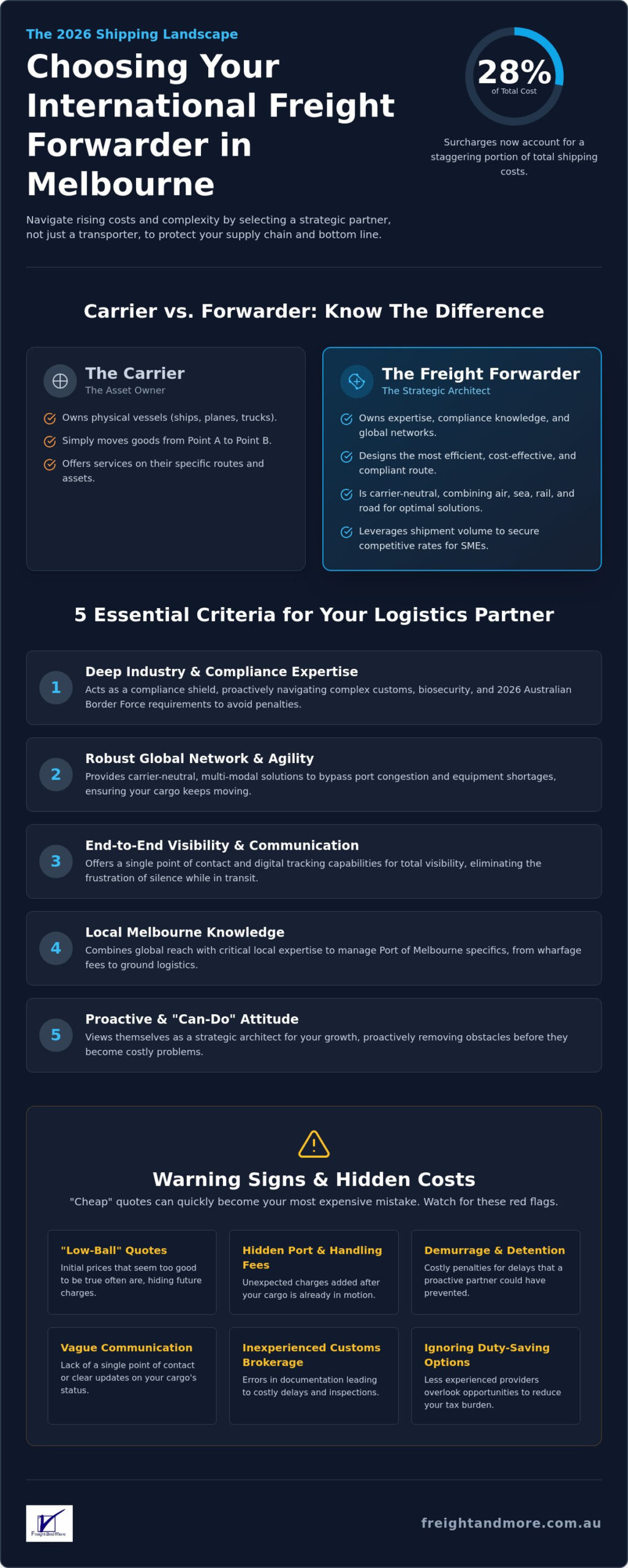
With surcharges now accounting for a staggering 28% of total shipping cost in 2026, the “cheapest” quote you receive today might actually be the most expensive mistake your business makes this year. You likely feel the constant pressure of rising Port of Melbourne wharfage fees and the frustration of total silence while your cargo is in transit. It is a common struggle for Victorian businesses trying to maintain a lean supply chain amidst increasing regulatory complexity. Learning how to choose an international freight forwarder in Melbourne is no longer just about finding a transporter; it’s about securing a strategic partner who acts as a compliance shield against costly customs errors and unpredictable delays.
This guide empowers you to master the selection process so you can finally achieve predictable shipping costs and total visibility over every cargo movement. You’ll learn how to identify partners who provide a single point of contact for end-to-end logistics, ensuring your goods move seamlessly through biosecurity and customs without the threat of unexpected penalties. We will explore the essential benchmarks for reliability in the current market, from digital tracking capabilities to the local expertise required to manage the latest 2026 Australian Border Force requirements. By the end of this article, you’ll have the confidence to choose a logistics expert who treats your global growth with the same meticulous care and proactive energy that you do!
Key Takeaways
- View your logistics provider as a strategic architect rather than a simple carrier, focusing on comprehensive supply chain management that proactively removes obstacles before they arise.
- Understand exactly how to choose an international freight forwarder in Melbourne by prioritizing providers with deep industry expertise, robust global networks, and a dedicated “can-do” attitude.
- Identify the warning signs of “low-ball” quotes to shield your business from hidden port fees, handling charges, and the risk of costly customs clearance errors.
- Benefit from the agility and local knowledge of an Australian-owned veteran that offers the bespoke advice and meticulous care global giants often fail to provide.
- Approach your first partner meeting with total confidence using a structured checklist to ensure your new logistics provider is as detail-oriented and motivated as your own team!
Defining the Strategic Value of an International Freight Forwarder
In the volatile trade environment of 2026, your freight forwarder is far more than a middleman; they’re the architect of your entire global supply chain. While a carrier simply moves goods from point A to point B, a strategic partner designs the most efficient, cost-effective route while shielding you from the complexities of international regulations. Understanding how to choose an international freight forwrader in Melbourne means looking for a firm that prioritizes risk mitigation and proactive problem-solving over just a low transport rate. This distinction is critical because comprehensive logistics management involves navigating fluctuating fuel surcharges and evolving biosecurity requirements that a basic transport service simply won’t cover.
Legally and operationally, a freight forwarder acts as an expert agent who organizes the shipment of goods for individuals or corporations to ensure products move from the producer to the final point of distribution with total compliance. To gain a deeper understanding of this role, you can explore the foundational definition of What is a Freight Forwarder? and how they function as the essential glue in global commerce. They take on the burden of documentation and coordination, allowing you to focus on your core business goals.
To better understand the strategic role a logistics partner plays in your business growth, watch this helpful video:
The Difference Between a Carrier and a Forwarder
Carriers, such as shipping lines or airlines, own the physical vessels and planes, whereas forwarders own the high-level expertise and the global network required to manage them. Because forwarders are carrier-neutral, they can coordinate multi-modal solutions that combine air, sea, rail, and road to bypass port congestion or equipment shortages. This neutrality is vital. It allows your partner to pivot when a specific route becomes blocked or too expensive. Smaller businesses especially benefit from this model, as forwarders leverage their total shipment volume across many clients to secure competitive rates that an individual SME could never access on their own. It is about having a guide who knows which carrier is performing best on a specific lane at any given moment.
Why Your Choice Impacts Your Bottom Line
The decision of who manages your cargo has a direct effect on your profitability. Opting for a “cheap” provider often leads to hidden expenses like demurrage and detention charges, which can quickly erase any initial savings. A seasoned veteran knows how to spot these traps before they happen. They also identify specific duty-saving opportunities within Australian customs regulations that less experienced providers might overlook. By integrating our services into your operations, you gain a dedicated team that handles everything from customs brokerage to 3PL warehousing under one roof. This level of comprehensive coordination ensures your bottom line remains protected through precision and meticulous care. When your logistics partner is proactive, you spend less time worrying about missed sales and more time growing your brand!
5 Essential Criteria for Evaluating International Freight Services
Selecting a logistics partner is one of the most critical decisions your business will make this year. Determining how to choose an international freight forwrader in Melbourne involves looking for specific benchmarks of excellence that go far beyond a simple price estimate. In 2026, the complexity of global trade requires a partner who acts as a proactive guide through shifting regulations and volatile market conditions. You need a team that demonstrates a “can-do” attitude while maintaining meticulous attention to the finer details of your cargo requirements.
When you begin your evaluation, prioritize these five essential pillars of service. First, seek out industry expertise tailored to your specific cargo. Whether you are moving perishables that require a strict cold chain or oversized machinery needing heavy-lift coordination, your forwarder must understand the unique risks involved. Second, evaluate their network reach. A forwarder is only as strong as their global agent partnerships; these local connections are what ensure your goods move smoothly through foreign ports. Third, insist on compliance proficiency. Having in-house customs brokerage expertise is a non-negotiable requirement for avoiding costly delays at the Australian border.
The final two pillars focus on how the business operates daily. Fourth, demand modern communication technology. In 2026, real-time shipment visibility platforms and digital documentation are standard requirements for maintaining a lean supply chain. Finally, look for total financial transparency. A reliable partner provides comprehensive, itemized quotes that account for the 15% to 28% in surcharges currently typical in the industry. For those new to the process, the International Trade Administration shipping guidance provides a robust foundation for understanding these essential logistics layers.
Verifying Accreditation and Licensing
Reliability starts with proper credentials. Ensure your chosen partner employs licensed customs brokers and maintains active memberships in recognized industry bodies. These affiliations signal a commitment to professional standards and ethical conduct. Furthermore, Marine Transit Insurance should always be presented as a standard offering rather than an afterthought. Protecting your investment is paramount, and a proactive forwarder will ensure you are covered before the first container leaves the dock. Compliance is the cornerstone of smooth importing, so we recommend reviewing our detailed guide on Customs Clearance to understand the latest 2026 benchmarks.
Scalability and Multi-Modal Flexibility
Your logistics needs will inevitably change as your business grows. It’s vital to partner with a firm that handles both Less than Container Load (LCL) and Full Container Load (FCL) shipments with equal precision. Having Sea Freight and air freight options under one roof allows you to pivot your strategy based on urgency or budget. A truly flexible partner also manages the “Port-to-Door” journey, utilizing local transport networks to deliver your cargo directly to your warehouse. If you are ready to see how a detail-oriented partner can streamline your movement, feel free to reach out for a bespoke consultation tailored to your specific trade lanes.
Identifying Red Flags: Avoiding Hidden Costs and Customs Delays
Many business owners mistakenly believe that all logistics providers are essentially the same until that final, unexpected bill arrives. This is the most common trap in the industry. When researching how to choose an international freight forwrader in Melbourne, you must look beyond the initial dollar sign to see if the provider is truly being transparent. A “low-ball” quote often intentionally excludes essential Australian port charges, such as wharfage and terminal handling fees, only to surprise you with them once your cargo is already at the dock. This lack of upfront honesty is a major red flag that suggests a reactive, rather than proactive, partnership.
Another critical warning sign is the outsourcing of customs clearance to third-party brokers. When a forwarder doesn’t have an in-house team, you lose that direct line of accountability and the meticulous care required for complex shipments. This disconnect frequently leads to poor communication; if you find yourself constantly chasing your provider for a status update, they aren’t managing your supply chain effectively. A seasoned veteran will always provide proactive movement reports without being prompted. They understand that in the high-stakes trade environment of 2026, silence is never a good sign.
The Anatomy of a Transparent Freight Quote
A trustworthy quote should be comprehensive and easy to read. It must include specific line items such as origin handling, ocean or air freight, fluctuating fuel surcharges, and the final local delivery costs. You should be extremely wary of “all-in” rates that fail to break down statutory fees or port-related expenses. These opaque figures often hide margins that should have been disclosed upfront. The hidden cost of poor documentation manifests as expensive storage fees and Australian Border Force hold-ups that can paralyze your sales cycle for weeks. Always insist on a quote that leaves no room for “estimated” surprises later on.
Common Causes of Australian Customs Delays
Most delays at the border are entirely preventable with the right expertise. Incorrect tariff classifications and missing commercial invoices are the primary culprits that trigger “Red Line” inspections, where the authorities physically examine your cargo. Having a dedicated customs clearance expert on your side ensures that every document is cross-checked against the latest 2026 Australian Border Force requirements. Beyond basic customs, your partner must also navigate the strict Department of Agriculture, Fisheries and Forestry (DAFF) quarantine protocols. If your forwarder doesn’t ask about your packaging materials or specific biosecurity risks, they aren’t protecting your interests. Learning how to choose an international freight forwrader in Melbourne requires finding a team that anticipates these regulatory hurdles before your ship even leaves the origin port.
Local Knowledge vs. Global Giants: Why Network Depth Matters
Many businesses fall into the “Global Giant” trap, assuming that a massive multinational corporation is the safest bet for their cargo. In reality, being a small fish in a massive pond often leads to your shipments being deprioritized when carrier capacity tightens or port congestion peaks. When you are researching how to choose an international freight forwrader in Melbourne, you’ll find that an Australian owned veteran offers a level of personal attention that global entities simply cannot match. Local experts possess a deep, lived-in knowledge of national ports and transport networks, allowing them to navigate the specific challenges of the Port of Melbourne with professional confidence and agility.
The difference often comes down to the structure of the network. While giants rely on rigid, owned offices that must follow strict corporate mandates, a proactive local forwarder utilizes a global agent network. These agents are independent business owners in their own countries who are highly motivated to provide exceptional service to maintain their partnerships. This creates a flexible, high-energy environment where you receive bespoke advice tailored to your specific trade lanes. It is about having a partner who acts as a dedicated guide rather than an automated system that treats your business as just another account number on a spreadsheet.
The Personal Touch in Logistics
Nothing is more frustrating than navigating an automated phone tree when you need an urgent update on a delayed shipment. A local partner provides direct access to decision-makers who can provide immediate answers and take action. This is especially critical for “exception handling”, those moments when things go wrong at the port due to weather or industrial action. By choosing a partner with a comprehensive suite of international shipping services, you ensure that a human eye is monitoring every touchpoint. Our team takes pride in this meticulous care, ensuring that every obstacle is removed before it impacts your bottom line.
Integrating 3PL and Local Distribution
A truly streamlined supply chain requires a seamless transition from international arrival to local delivery. Choosing a partner that understands the intersection of customs clearance and local distribution offers a significant competitive advantage, as it removes the need for multiple contractors. Managing the “Last Mile” is just as important as the ocean crossing; you need a partner who can coordinate local and interstate transport with precision. At Freight and More Pty Ltd, we manage the entire movement from the moment it hits the wharf to its final destination. If you’re ready to experience the difference that local expertise and a “can-do” attitude can make, reach out to our Melbourne team today for a tailored logistics strategy.
Partnering for Success: Your Next Steps in Freight Selection
Mastering how to choose an international freight forwrader in Melbourne requires a shift in perspective. It’s about moving from a transactional mindset to a collaborative partnership built on professional confidence and a genuine “can-do” attitude. When you find a partner who takes pride in removing obstacles, you’re not just buying transport; you’re investing in the stability of your global supply chain. This final step is where your research turns into action, allowing you to secure a logistics expert who treats your cargo with meticulous care and personal attention.
Many businesses hesitate to switch providers because they fear a breakdown in their current operations. However, a seasoned veteran makes this transition seamless by managing the handover of existing shipments and coordinating with your previous agent. They act as your advocate, ensuring that the move to a more proactive partner is steady and methodical. By choosing a team that is both globally minded and locally attentive, you’re setting the stage for long-term growth and predictable shipping costs.
Preparing for Your Initial Consultation
To get the most out of your first meeting, you’ll need to have your data ready. A detail-oriented forwarder will want to understand the specifics of your business to offer bespoke advice. Before you reach out, gather the following information:
- Shipping Volume and Frequency: Are you moving one container a month or ten?
- Typical Cargo Dimensions: Do you have standard pallets, or is your freight oversized?
- Primary Trade Lanes: Do you have specific requirements for high-volume lanes like China to Australia?
- Key Pain Points: Are you more concerned with transit speed or minimizing landed costs?
Don’t be afraid to ask direct questions about their experience with your specific industry. You want to know exactly how they handle biosecurity risks or customs hurdles on your most frequent routes. This level of transparency is what builds immediate trust.
The Freight and More Advantage
At Freight and More, we believe that every client deserves a premium level of service, regardless of their size. We position ourselves as a bold overachiever that goes beyond industry norms to provide a professional-standard logistics partnership. Our team is highly motivated to solve your problems and streamline your movement through the Port of Melbourne. We combine an extensive global network with the personal touch that only an Australian-owned veteran can provide.
If you’re ready to move away from inconsistent transit times and hidden fees, we’re here to help. Experience the difference of a partner who is proactive, dependable, and deeply client-focused. You can start the process today by submitting an online enquiry to speak with our Melbourne experts. Let’s work together to build a supply chain that is as resilient and energetic as your business!
Securing Your Supply Chain for the Future
Choosing a logistics partner is a pivotal decision that defines your business’s ability to scale without being hampered by hidden costs or regulatory delays. By now, you understand that the strategic value of a forwarder lies in their ability to act as a compliance shield; they provide end-to-end visibility and bespoke advice that automated systems simply cannot replicate. Focusing on financial transparency and local expertise ensures your cargo is managed with the meticulous care it deserves. It’s about finding a partner who is as motivated by your success as you are.
Learning how to choose an international freight forwrader in Melbourne is the first step toward a more resilient and predictable global supply chain. As an Australian owned and operated veteran since 2009, Freight and More provides the perfect balance of national coverage and a global network of trusted logistics agents. We offer complete integration across customs clearance and 3PL warehousing to remove every obstacle from your path with professional confidence. Ready to experience a professional-standard partnership? Request a Tailored Freight Forwarding Quote Today and let our proactive team take the lead. We look forward to helping your business thrive in the global market!
Frequently Asked Questions
What is the difference between a freight forwarder and a customs broker?
A freight forwarder acts as the architect of your cargo movement, managing the logistics and carrier relationships, while a customs broker focuses specifically on the legal requirements for entering or leaving a country. Many businesses searching for how to choose an international freight forwrader in Melbourne prefer a partner that provides both services under one roof to ensure seamless communication. This integration prevents the documentation gaps that often occur when two separate entities handle the same shipment.
How do I know if I should choose air freight or sea freight for my international shipment?
Your choice depends on the urgency of your delivery and the total weight of your cargo. Air freight is the preferred option for high-value or time-sensitive goods that need to arrive in days rather than weeks. Sea freight is significantly more cost-effective for bulky or heavy shipments, such as machinery or large retail orders, where lead times are flexible. We help you evaluate the total landed cost to determine which mode best supports your bottom line.
What are Incoterms and why do they matter when choosing a forwarder?
Incoterms are the standardized international commercial terms that define exactly when the risk and cost of transport transfer from the seller to the buyer. They are essential because they dictate which party is responsible for paying for freight, insurance, and customs duties. When you are learning how to choose an international freight forwrader in Melbourne, you need a partner who can explain how different terms like FOB (Free on Board) or DAP (Delivered at Place) impact your final logistics bill.
Can a freight forwarder help me reduce my import duties in Australia?
A proactive freight forwarder identifies duty-saving opportunities by ensuring your goods are classified under the most accurate tariff codes. With the Australia-EU Free Trade Agreement expected to eliminate duties on 97.8% of Australian exports in 2026, having an expert who understands these treaties is vital. We analyze your cargo to see if it qualifies for specific concessions or exemptions that could significantly lower your tax obligations at the border.
What documents do I need to provide to my freight forwarder for an international shipment?
You must provide a commercial invoice, a detailed packing list, and a Bill of Lading or Air Waybill to initiate any international movement. Depending on the type of goods, you might also need a Certificate of Origin or specific biosecurity permits for the Australian Border Force. Providing accurate and complete documentation from the start is the most effective way to prevent “Red Line” inspections and costly port storage fees.
How much does it cost to hire an international freight forwarder in Australia?
The cost of hiring a forwarder is typically built into the service fees and handling charges associated with your specific shipment volume and route. While base freight rates fluctuate based on global demand, you should also account for surcharges like the Bunker Adjustment Factor (BAF), which can represent 10% to 30% of your total cost. A transparent partner provides an itemized breakdown of these fees so you can plan your budget with total professional confidence.
What happens if my goods are damaged during international transit?
If your goods are damaged, your primary protection is a comprehensive marine transit insurance policy. Carriers have limited liability under international law, which often covers only a fraction of the actual value of your cargo. We recommend securing independent insurance for every shipment to ensure you are fully reimbursed for any losses. Our team assists you in the claims process to resolve the issue as quickly and efficiently as possible.
How does a freight forwarder handle LCL vs FCL shipments?
For Full Container Load (FCL) shipments, we dedicate an entire container to your cargo, which is ideal for large volumes and provides the highest level of security. Less than Container Load (LCL) involves consolidating your goods with those of other shippers to share the cost of the container space. This flexibility allows smaller businesses to import or export frequently without waiting to fill a whole container, and we manage the entire consolidation and de-consolidation process on your behalf.
