Managing Retail Inventory via Sea Freight in Australia

In July 2026, the Shanghai to Melbourne rate climbed past USD 1,808 per TEU, yet the most successful brands aren’t scaling back; they’re getting smarter. Managing retail inventory sea freight Australia requires more than just booking a container; it demands a proactive strategy to turn long transit times into a reliable stock buffer. We understand the stress of checking tracking numbers only to find your shipment delayed by five days or more, and we know how hidden biosecurity charges can quietly erode your margins. It’s a complex landscape where a single missed document can lead to costly stockouts or unexpected terminal handling fees. We’re committed to helping you navigate these hurdles with absolute confidence and professional precision.
You deserve a supply chain that feels like a competitive advantage rather than a constant source of worry. This article provides the expert insights you need to lower your landed cost per unit and ensure consistent stock replenishment. We’ll explore the latest July 2026 customs duty removals, explain how to coordinate multiple suppliers into efficient shipments, and show you how to achieve a seamless delivery from the port straight to your warehouse shelf.
Key Takeaways
- Learn how to transform longer lead times into a strategic inventory buffer that protects your business from the impact of global supply chain volatility.
- If you are aiming for lower landed costs, identify whether FCL or LCL shipping is the most cost-effective model for your specific stock volumes.
- Master the complexities of retail inventory sea freight Australia by understanding how expert customs brokerage prevents terminal bottlenecks and ensures total compliance.
- Discover how to optimize your middle-mile logistics to achieve a seamless, reliable transition from Australian ports to your distribution centers.
- Learn why a proactive logistics partner with a global network is the key to coordinating multiple suppliers and securing container space during peak seasons.
The Strategic Importance of Sea Freight for Australian Retail Inventory
Sea freight is more than just a delivery method; it’s the lifeblood of our local economy. For Australian retailers, managing retail inventory sea freight Australia is a fundamental necessity because of our geographic isolation. While air freight offers speed, the sheer volume of goods required to stock national storefronts makes ocean transport the only viable way to maintain healthy margins. It’s about finding that perfect balance between operational costs and product availability. We see this as a dedicated partnership where your success is our primary focus.
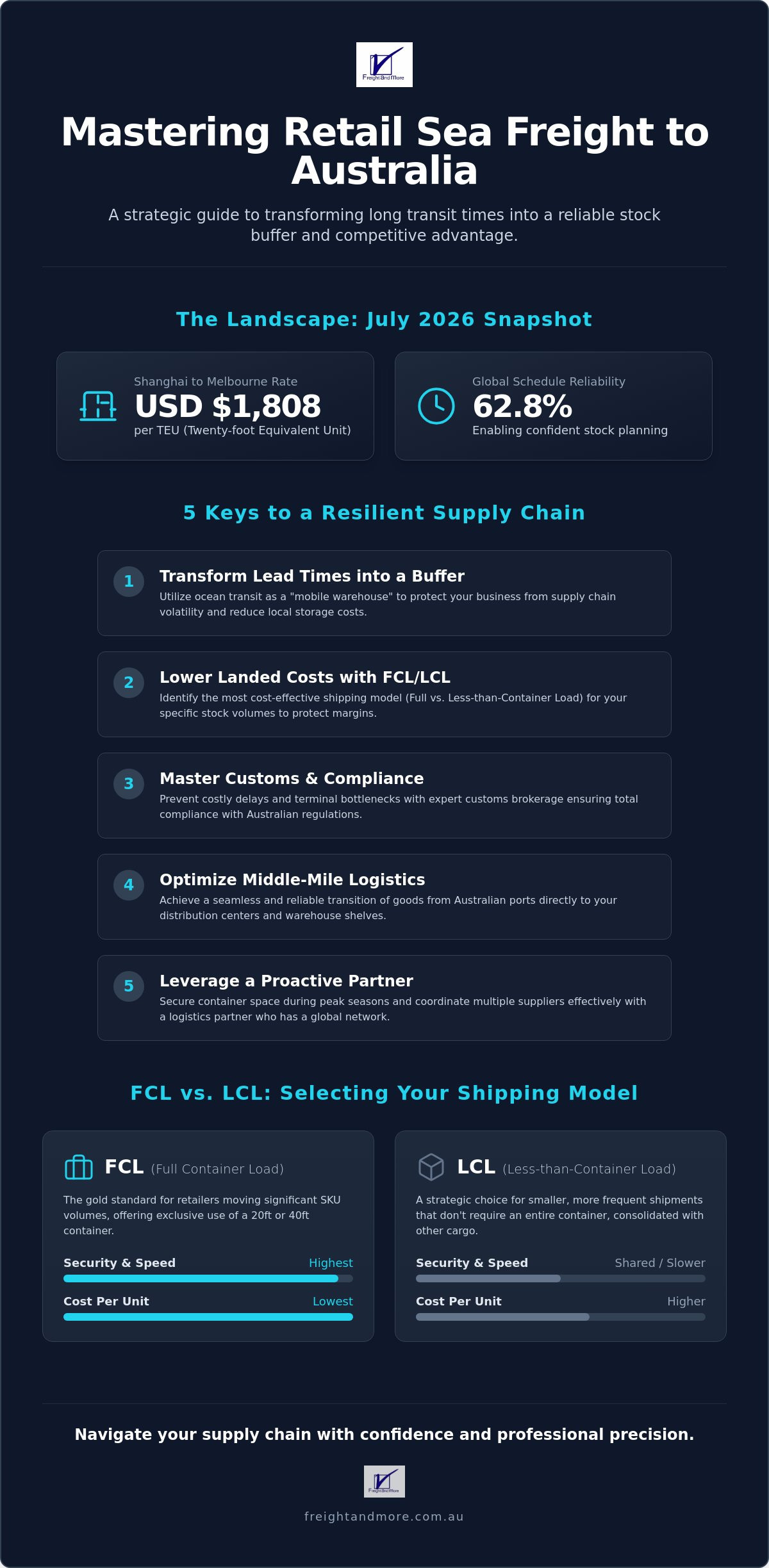
Successful importers apply core supply chain management principles to treat the ocean transit time as a strategic asset. By July 2026, global schedule reliability has reached approximately 62.8%, meaning savvy businesses can plan their stock arrivals with a high degree of confidence. This predictability allows you to use the weeks at sea as a “mobile warehouse,” keeping inventory moving toward your customers without clogging up expensive local floor space. It’s a smart way to stay lean and agile.
To better understand this concept, watch this helpful video:
Cost-Efficiency vs. Speed in Retail Logistics
The cost-per-unit advantage of international sea freight is undeniable for high-volume, low-margin goods. With Shanghai to Melbourne rates reaching USD 1,808 per TEU in mid-2026, shipping by sea remains significantly more affordable than the premium prices of air transport. You’ll find the “tipping point” for air freight usually occurs only during emergency stockouts or for high-value electronics where the speed of sale justifies the expense. We help you analyze these costs to ensure your landed price stays competitive. For everything else, the ocean is where your profit margins are protected.
Sea Freight as an Inventory Management Tool
Think of your containers as an extension of your warehouse. By staggering shipments, you can ensure a steady flow of goods that matches your sales velocity. This approach is particularly effective during major Australian retail peaks, such as the lead-up to Christmas or end-of-financial-year sales. Consistent schedules allow for “Just-in-Time” replenishment, reducing the need for massive, static stockpiles. It’s a proactive way to manage your cash flow while keeping your shelves full and your customers happy. Even with current trends like blank sailings and equipment shortages in Southeast Asia, a well-planned sea freight strategy keeps your supply chain resilient and ready for anything. We are here to handle the details so you can focus on growing your brand.
FCL vs. LCL: Selecting the Right Shipping Model for Stock Replenishment
Choosing between Full Container Load (FCL) and Less-than-Container Load (LCL) isn’t just about the size of your order; it’s a strategic decision that impacts your entire retail stock turn. Every choice you make should align with the broader National Freight and Supply Chain Strategy to ensure your business remains resilient in a changing market. We take pride in guiding you through these options to find the most efficient path for your goods, ensuring your shelves are always stocked and your margins are protected.
Full Container Load (FCL) for High-Volume Retailers
FCL is the gold standard for retailers moving significant SKU volumes. When you book a dedicated 20ft or 40ft container, you gain exclusive use of that space, which translates to fewer touchpoints and faster discharge at the Australian port. By avoiding the consolidation warehouse, you reduce the risk of damage and shave days off your lead time. It’s often the most effective way to lower your landed cost per unit when your inventory levels justify the volume. If you’re unsure if your current order volume meets the threshold, we can help you calculate your shipping requirements to maximize your investment.
Less-than-Container Load (LCL) and Buyer’s Consolidation
For smaller boutiques or brands that prioritize frequent updates over bulk shipments, LCL is an indispensable tool. It allows you to maintain a lean inventory without waiting for a full container’s worth of stock to be ready. While LCL involves “co-loading” with other importers, which adds time for consolidation and deconsolidation, it provides the flexibility needed for rapid stock turns. It’s a proactive way to keep your product range fresh without overcommitting your capital.
One of our favorite strategies for managing retail inventory sea freight Australia is “Buyer’s Consolidation.” If you work with multiple suppliers across a region, we can group your various orders into one dedicated container at the origin point. This proactive approach streamlines your retail inventory sea freight Australia, giving you the security of FCL with the flexibility of smaller, diverse orders. It’s a sophisticated way to manage complex sourcing needs while keeping your logistics costs under control.
Understanding the trade-offs is vital for a seamless supply chain. FCL offers the highest security and fastest transit because the container stays sealed from the supplier to your warehouse. In contrast, LCL requires more handling as goods are packed and unpacked at various hubs. While LCL is cost-effective for small volumes, the additional handling means you need robust packaging to protect your stock. We’re here to ensure your goods are handled with meticulous care, regardless of the shipping model you choose.
Navigating Australian Customs and Compliance for Retail Importers
Clearing your goods through the border is the final hurdle before your stock reaches the shelf. When managing retail inventory sea freight Australia, you must account for the 10% GST applied to the Value of the Taxable Importation (VoTI). This value isn’t just what you paid the supplier; it’s the sum of the Free on Board (FOB) value, applicable duty, freight costs, and insurance. Since July 1, 2026, many common items are now duty-free thanks to the removal of nuisance tariffs, yet electronic lodgement fees remain a fixed cost. You’ll face an Import Processing Charge of $50 for shipments valued between $1,000 and $10,000, or $152 for those exceeding $10,000. We ensure every decimal point is perfect so your landed cost remains predictable.
Biosecurity is another critical layer. The Department of Agriculture, Fisheries and Forestry (DAFF) collects a mandatory $68 fee for sea freight import declarations as of July 2026. If your documentation is missing or incorrect, your cargo could be stuck at the wharf, incurring storage fees that quickly spiral. Organizations like Ports Australia highlight the importance of efficient port operations, but the responsibility for compliant paperwork sits with the importer. We act as your proactive partner to ensure commercial invoices, packing lists, and bills of lading are audit-ready before the ship even docks.
The Value of Professional Customs Brokerage
Our expert brokers do more than just lodge paperwork. We actively look for tariff concessions that can significantly lower your retail landed cost. Navigating Australian Border Force (ABF) requirements for retail inventory sea freight Australia requires an authoritative understanding of the Harmonized System (HS) codes. Customs brokerage serves as an essential risk-mitigation tool that protects retail importers from regulatory penalties and unforeseen supply chain disruptions.
Compliance and Record Keeping for Retailers
Compliance doesn’t end when the truck leaves the port. You’re legally required to maintain all import records for five years in an audit-ready format. It’s also vital to understand your ‘Incoterms,’ as these dictate whether you or your supplier is responsible for costs and risks at each stage of the journey. We’re here to guide you through these complexities with professional confidence. Learn more about our customs clearance services to see how we can secure your supply chain.
Optimising the Supply Chain: From Port to Warehouse and Retail Shelf
The middle mile is the often-overlooked bridge between the international port and your distribution centre. When managing retail inventory sea freight Australia, this phase is critical because wharf ancillary charges increased by up to 2.5% on July 1, 2026. Every hour your container sits idle at the terminal adds unnecessary cost. We specialise in coordinating rapid pick-ups to ensure your stock moves quickly through the port gates. It’s about maintaining momentum so your capital isn’t tied up on a wharf.
Modern retail demands total visibility. Real-time tracking allows you to adjust your marketing and sales plans based on actual arrival times rather than estimates. With global schedule reliability for sea freight sitting at 62.8% as of late 2025, knowing exactly where your container is helps you manage customer expectations. We provide the authoritative oversight and local expertise needed to keep your supply chain moving without friction. We take pride in being the proactive partner that anticipates delays before they impact your bottom line.
Domestic Transport and Port-to-Door Delivery
Choosing between road and rail transport depends on your final destination and the urgency of your stock replenishment. Road transport offers the highest flexibility for door-to-door delivery within metropolitan areas. If you are shipping LCL, your goods will first go to a container freight station for “de-vanning,” where they are carefully unpacked and sorted. This meticulous process ensures that even small shipments receive the same level of care as a full container. Explore our end-to-end transport and logistics solutions to streamline this transition.
3PL Warehousing and Inventory Integration
Integrating your sea freight with a Third-Party Logistics (3PL) provider is the most effective way to handle seasonal inventory surges. A professional 3PL partner manages the overflow during peak periods, such as the lead-up to Black Friday or Christmas. By syncing your freight arrivals with a modern Warehouse Management System (WMS), you gain a real-time view of your stock levels before the goods even arrive. This level of transparency is essential for preventing stockouts and managing cross-docking operations where goods move directly from the receiving dock to the outbound shipping area. For a deeper look at local storage strategies, see The Strategic Guide to 3PL Warehouse Melbourne Solutions.
If you’re ready to optimise your port-to-warehouse flow and ensure your stock arrives on time, every time, contact our specialist team for a tailored logistics plan today.
Partnering with Freight and More for Resilient Retail Logistics
Managing retail inventory sea freight Australia requires more than just a service provider; it demands a dedicated partner who understands the high stakes of your business. At Freight and More, we pride ourselves on being that expert guide. We balance global reach with local precision, ensuring your stock moves efficiently from international origins to Australian retail floors. Our commitment to excellence is reflected in every shipment we handle, providing you with the peace of mind that your supply chain is in capable, professional hands. We take pride in our ability to turn logistical challenges into streamlined successes for our clients.
Leveraging our extensive global agent network is how we overcome current market volatility. With equipment shortages currently affecting 40-foot containers across China and Southeast Asia, our team works proactively to secure space well in advance. Industry standards in July 2026 suggest booking shipments at least three weeks ahead of schedule to mitigate the risk of rolled cargo. This forward-thinking approach is what makes us the preferred choice for importers who cannot afford the cost of empty shelves or missed seasonal peaks. We don’t just react to the market; we anticipate it on your behalf.
Expertise in Australian Maritime Logistics
Our team brings decades of experience to the table, specifically in navigating the unique operational landscape of Australian ports. We understand that a delay at the terminal is a delay for your customers. By identifying potential bottlenecks early, whether they relate to biosecurity documentation or transport coordination, we remove obstacles before they impact your timeline. This proactive management is essential for maintaining a lean, cost-effective supply chain. Contact our expert team for a retail freight quote and experience a higher standard of logistics management.
A National Network with a Personal Touch
While we possess the scale to manage large-scale retail distribution, we never lose sight of the personal details that matter to boutique entrepreneurs. We provide comprehensive national coverage, yet we maintain a supportive, one-on-one relationship with every client. Our energetic “can-do” attitude is the secret weapon your brand needs to thrive in a competitive market. We handle the meticulous care of your cargo so you can focus on the bold overachievements of your business. Whether you are moving a single LCL pallet or a fleet of FCL containers, our transparency remains absolute. Partner with Freight and More Pty Ltd today and build a more resilient future for your retail operations.
Secure Your Retail Future with Strategic Logistics
Mastering your supply chain is the most powerful way to protect your margins and ensure your shelves never sit empty. By choosing the right shipping model and staying ahead of shifting customs regulations, you transform your logistics from a cost center into a competitive advantage. Managing retail inventory sea freight Australia requires a meticulous eye for detail and a proactive mindset to navigate the complexities of global trade. We’ve explored how strategic consolidation and integrated 3PL warehousing create a seamless flow from the international port to your retail shelf.
As an Australian owned and operated business since 2009, we bring in-house customs brokerage expertise and a robust national port-to-door delivery network to every partnership. We are ready to handle the obstacles so you can focus on growing your brand with total confidence. It’s time to build a more resilient, cost-effective supply chain that supports your long-term success. Request a Tailored Sea Freight Quote for Your Retail Business today. We look forward to helping you achieve your boldest retail goals!
Frequently Asked Questions
What is the typical transit time for sea freight to Australia?
Transit times vary based on the specific origin port, but shipments from major Asian hubs like Shanghai typically take between 18 and 25 days to reach Australia’s East Coast. When planning your retail inventory sea freight Australia, it’s important to account for global schedule reliability, which was 62.8% in late 2025. On average, late vessels experience delays of just over five days. We recommend allowing a generous buffer to ensure consistent stock availability.
Is LCL or FCL better for a small retail business?
LCL is generally the strategic choice for smaller retail businesses that require frequent stock updates without the capital commitment of a full container. It allows you to maintain a lean inventory while keeping your product range fresh and responsive to trends. However, if your volume grows to fill at least 15 cubic meters, switching to FCL often provides better security and lower unit costs. We help you analyze your SKU volumes to determine the most cost-effective model.
How much are customs brokerage fees for retail imports in Australia?
While professional service fees are tailored to the complexity of your shipment, you must account for mandatory government charges. For goods valued over $1,000, the Import Processing Charge is either $50.00 or $152.00 depending on the total value. Additionally, a sea freight biosecurity charge of $68.00 applies to each full import declaration as of July 2026. Our expert brokers ensure these lodgments are handled with meticulous care to avoid any unnecessary penalties or port delays.
Can I track my retail inventory while it is at sea?
Yes, sophisticated tracking is a standard part of modern retail inventory sea freight Australia. We provide real-time visibility into your shipment’s progress, allowing you to monitor milestones from the moment the container is gated at the origin port to its arrival at the terminal. This transparency is vital for coordinating your warehouse staff and marketing launches. Having accurate data helps you manage customer expectations with professional confidence and precision throughout the entire transit process.
What documents do I need to import retail stock into Australia?
You must provide a commercial invoice, a detailed packing list, and a bill of lading for every shipment. If you are claiming a duty preference under one of Australia’s many Free Trade Agreements, such as those with China or the UK, a valid Certificate of Origin is also essential. Correct documentation is the key to preventing bottlenecks at the border. We proactively review your paperwork to ensure it meets all Australian Border Force and biosecurity requirements.
How does sea freight impact the total landed cost of my products?
Sea freight is the most effective method for lowering your landed cost per unit, especially for high-volume goods. Your total landed cost includes the purchase price, international freight, marine transit insurance, and government charges like GST and biosecurity fees. By July 2026, the removal of various “nuisance tariffs” has made many retail items duty-free, further improving your margins. We provide detailed cost breakdowns so you can price your products with total certainty and competitive edge.
What happens if my retail cargo is delayed at an Australian port?
Delays at the port can lead to wharf storage charges and shipping line detention fees, which can escalate quickly if not managed proactively. These bottlenecks often occur due to missing documentation or biosecurity holds. Our authoritative approach involves preparing all clearances before the vessel docks to ensure a seamless transition to local transport. If a delay occurs, we work energetically to resolve the issue and minimize any impact on your retail replenishment schedule.
Can Freight and More handle both sea freight and final delivery to my store?
Absolutely, we provide a comprehensive end-to-end service that covers everything from international sea freight to final store delivery. Our national network ensures your goods are moved efficiently from the port to our warehouse facilities and then directly to your retail location. This integrated approach removes the complexity of coordinating multiple providers, giving you a single, dependable point of contact. We take great pride in delivering a seamless, authoritative port-to-warehouse experience for all our partners.
