Rail and Transport: A Strategic Guide to National Freight Logistics in 2026

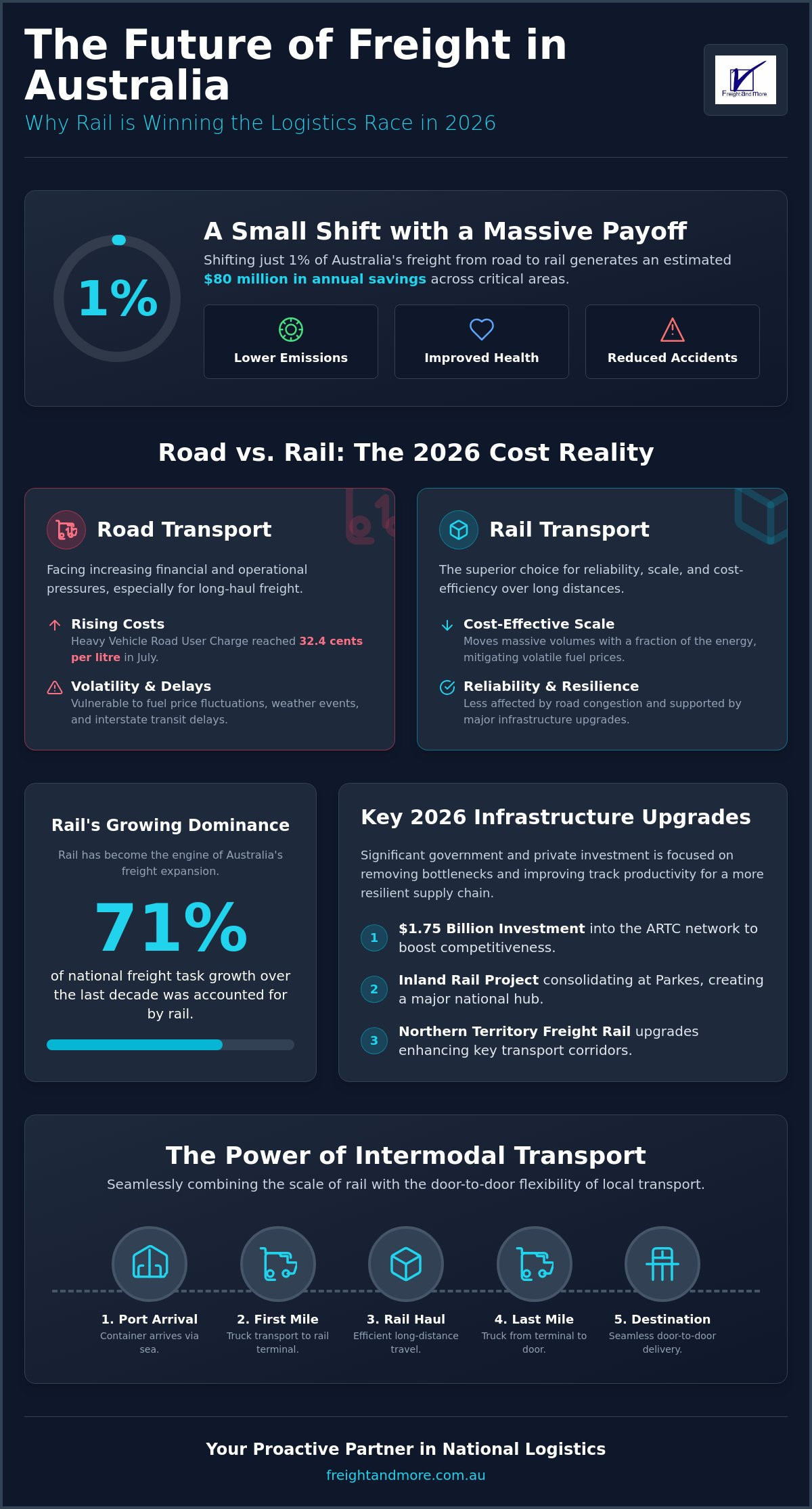
Did you know that shifting just 1% of Australia’s freight from road to rail can generate $80 million in annual savings across emissions, health, and accident costs? It’s a staggering figure that highlights why so many savvy businesses are re-evaluating their logistics strategy as we move through 2026. You’ve likely felt the sting of the Heavy Vehicle Road User Charge, which reached 32.4 cents per litre this July, alongside the persistent headache of interstate transit delays. Managing the complexity of a multi-modal supply chain is a heavy lift, but it doesn’t have to be a source of constant stress for your operations team. Integrating rail and transport networks offers a proven path to reliability and scale.
We understand that you need more than just a carrier; you need a proactive partner to simplify the journey from port to door. This guide will show you how to optimise your national supply chain by leveraging the efficiency of rail networks across Australia. You’ll learn how to lower freight costs for bulk shipments while building a more sustainable transport profile that meets modern environmental standards. We’ll walk through the latest 2026 infrastructure updates and terminal efficiencies to help you achieve seamless, door-to-door delivery for every container. Let’s build a more resilient future for your freight together.
Key Takeaways
- Learn why national networks are the superior choice for long-haul logistics in 2026 to help you navigate rising road costs and fuel levies.
- Discover how to streamline the journey of your containers from port to terminal by mastering the coordination between rail and transport operators.
- Identify the specific “break-even” distance where rail becomes significantly more economical than traditional road freight for your interstate shipments.
- Explore how integrating professional warehouse management and multi-modal strategies can remove the complexity from your door-to-door delivery process.
- Uncover the benefits of a proactive logistics partnership that simplifies customs and interstate transit to ensure your cargo moves reliably across every major hub.
Navigating the Australian Rail and Transport Landscape in 2026
The Australian Rail and Transport Landscape has undergone a massive strategic shift as we move through 2026. While many historically viewed rail as a tool reserved for moving iron ore or coal, today’s savvy businesses use it as a sophisticated lever for general cargo and containerised goods. This evolution is driven by the need for greater resilience in supply chains that have been battered by rising road costs and unpredictable weather events. By choosing rail, you’re tapping into a network that has accounted for 71% of national freight task growth over the last decade. It’s about more than just moving boxes; it’s about securing a competitive edge in a market where efficiency is the primary currency.
To better understand the strategic importance of rail in a national logistics framework, watch this insightful explanation:
National rail networks are now the preferred choice for long-haul logistics because they offer a level of stability that road transport simply cannot match. With the Inland Rail project consolidating at Parkes and significant upgrades to the Northern Territory freight rail, the 2026 infrastructure priority list is focused on removing bottlenecks that previously caused interstate delays. These investments, including a $1.75 billion injection into the ARTC network, are specifically designed to improve the productivity and competitiveness of our tracks. If you are looking to scale your operations across state lines, then leveraging these upgraded corridors is the most reliable way to ensure your cargo arrives on time.
The Economic Impact of Rail on National Logistics
Understanding the Intermodal Network
Modern logistics relies on the synergy between different modes to ensure your cargo reaches its final destination without a hitch. Intermodal transport is the seamless movement of cargo using multiple modes without handling the freight itself. This matters for your business because it combines the massive scale of rail with the precise, door-to-door flexibility of local transport. The magic happens at the intermodal terminals, where containers are efficiently transferred between trains and trucks to keep the supply chain moving. By integrating these rail and transport solutions, you remove the complexity of managing separate legs of the journey. Trust a partner who understands how to navigate these hubs to ensure your goods are never left sitting on a siding!
The Mechanics of National Rail Freight Services
Understanding the internal machinery of rail and transport is essential for any business looking to scale its national footprint. While the physical tracks provide the path, the true efficiency of the system lies in the meticulous coordination between freight forwarders and national rail operators. We act as the central conductor, managing the complex hand-offs between local trucking fleets and the massive line-haul trains that traverse the continent. This process begins long before the cargo reaches the terminal. It starts with strategic booking and precise timing to ensure your goods aren’t left idling on a loading dock while a scheduled service departs.
The journey of a container typically follows a structured path from your warehouse or a busy port to a strategic rail hub. Once your cargo is packed and secured, a local carrier transports it to the intermodal terminal where specialised reach stackers or gantry cranes lift the container onto a dedicated rail wagon. This transition is a critical point where terminal efficiency determines your overall supply chain velocity. If you have questions about how these movements fit into your specific schedule, you can always reach out for a tailored logistics assessment to see where time savings can be found.
Choosing between Full Container Load (FCL) and Less-than-Container Load (LCL) is another vital strategic decision. FCL offers the highest level of security and speed, as the container remains sealed from origin to destination. However, if you don’t have enough volume to fill a 20ft or 40ft unit, LCL rail services allow you to share space with other shippers. We manage the consolidation process at our national hubs, ensuring your smaller shipments still benefit from the cost-efficiencies of the rail network without the need for massive inventory volumes.
Container Types and Rail Capabilities
The national rail network is built around the versatility of standard 20ft and 40ft containers, but its capabilities extend far beyond the basics. For businesses moving temperature-sensitive goods or oversized machinery, specialised equipment like refrigerated containers (reefers) and flat racks are readily available. It’s vital to remember that rail transport involves unique lateral forces and vibrations. You must ensure your cargo is professionally braced and blocked within the container to withstand the movement of a long-haul journey. This attention to detail prevents damage and ensures a smooth arrival.
Scheduling and Transit Expectations
Success in rail logistics requires a more proactive planning mindset than traditional road freight. National rail freight schedules are highly structured, and missing a “cut-off” time at the terminal can result in a 24-hour delay for the next available service. These schedules are influenced by the National Freight and Supply Chain Strategy, which prioritises the movement of essential goods across state lines. While rail is incredibly reliable, you should always account for potential maintenance windows or extreme weather events that can impact interstate corridors. By building a small buffer into your lead times, you can enjoy the significant cost savings of rail while maintaining total reliability for your customers.
Road vs. Rail: Choosing the Right Transport Mode for Your Cargo
If you’re unsure which mode fits your current shipment, we can help you analyze your requirements. Our team takes a proactive approach to logistics, ensuring you don’t overpay for speed when rail can offer a more stable and cost-effective alternative. By integrating rail and transport solutions into a single, cohesive plan, you gain the flexibility of a truck with the massive scale of a train. It’s about working smarter, not just harder, to keep your goods moving across the national network.
Cost Analysis and Fuel Levies
Cost stability is a primary driver for the shift toward rail in the current economic climate. Road transport margins are increasingly sensitive to the Heavy Vehicle Road User Charge, which reached 32.4 cents per litre in July 2026, creating significant price volatility for long-distance trucking. In contrast, rail freight typically consumes 75% less fuel than road transport per tonne-kilometre. This massive efficiency gap is a core pillar of the National Freight and Supply Chain Strategy, which focuses on enhancing productivity by moving high-volume freight onto more energy-efficient corridors. By shifting your bulkier shipments to the tracks, you protect your budget from the sudden fuel price spikes that often plague road-only operators.
Reliability and Flexibility Comparison
Road freight offers the undeniable advantage of direct delivery without the need for transshipment at a terminal, which is perfect for high-frequency small shipments. However, rail provides a distinct level of reliability by bypassing highway congestion and the inherent risks of road-related accidents. If you are managing bulk commodities or large-scale inventory replenishment, the consistency of scheduled rail services is a major asset. We specialise in coordinating these local transport links to ensure that even when your goods travel by rail, the transition back to the road for final delivery is handled with meticulous care and personal attention. Choose based on your volume: use the road for agility and rail for the heavy-duty interstate tasks!
Optimising Your Supply Chain with Multi-Modal Transport Solutions
Transitioning from a road-only strategy to a multi-modal model requires more than just a change in carrier; it demands a fundamental shift in how you view your entire supply chain. Many businesses hit a wall when they try to bridge the “last mile” gap between a massive rail terminal and their customer’s doorstep. This transition is where the most significant bottlenecks occur, often due to poor coordination between the train’s arrival and the availability of local trucking. By partnering with a logistics expert who understands the nuances of rail and transport, you can turn these potential hurdles into a seamless flow of goods. We take pride in managing these complex hand-offs with meticulous care, ensuring your cargo never sits idle at a terminal.
Professional warehouse management plays a pivotal role in this integrated approach. Think of your 3PL provider as the heart of a rail-centric supply chain, acting as a buffer that absorbs the massive scale of rail deliveries and breaks them down for local distribution. This strategy allows you to hold inventory closer to your national hubs, reducing your reliance on long-distance road haulage and protecting your operations from highway delays. If you’re ready to modernise your network, request a consultation today to identify exactly where a multi-modal shift can save you money and improve your service levels.
The Role of Customs and Compliance
When you’re moving imported goods interstate via the rail network, synchronisation is everything. You must ensure that your customs clearance services are fully aligned with rail arrival times to avoid costly storage fees at the terminal. Documentation requirements for interstate movement can be complex, especially when dealing with bonded cargo or specific biosecurity regulations. We handle the heavy lifting of compliance, providing you with the peace of mind that your documentation is always in order before the train even pulls into the station. It’s about being proactive rather than reactive to keep your supply chain moving without legal hitches.
Technology and Tracking in 2026
In 2026, visibility is the primary currency of a successful logistics strategy. We utilise advanced GPS and IoT sensors to track containers across the national rail network, providing you with real-time data that is essential for modern inventory management. This level of transparency allows you to predict arrival times with precision and adjust your local distribution schedules accordingly. Our approach to the freight forwarding process integrates diverse transport data into a single, easy-to-read stream. By leveraging these digital tools, you gain total control over your multi-modal movements, ensuring that every leg of the journey is as visible and accountable as the last. Don’t leave your cargo’s location to guesswork when you can have total certainty!
Seamless National Logistics with Freight and More
Partnering with a dedicated national freight forwarder like Freight and More transforms the way you approach rail and transport. We don’t just book space on a train; we orchestrate a symphony of movements that bridge the gap between states and oceans. You’ve seen the rising costs and the infrastructure shifts mentioned earlier. Now, it’s time to put a proactive team in your corner to manage them. Having a single point of contact for your road, rail, sea, and air needs means you spend less time chasing updates and more time growing your business. We take pride in removing every obstacle from your path.
We understand that every business operates on a unique pulse. That’s why we never offer a “one size fits all” solution. Instead, we listen to your specific requirements to build a strategy that respects both your budget and your timeline. Whether you’re managing a complex international sea freight shipment that needs to transition to the national rail network or a local delivery requiring immediate attention, our team provides a level of meticulous care that builds immediate trust. We’re bold overachievers who go beyond industry norms to ensure your cargo arrives exactly when and where it’s needed. You can depend on our transparency and our highly motivated experts to keep your supply chain resilient.
Our National Reach and Local Expertise
Our network isn’t just a map of dots; it’s a series of active offices in every major national hub. This allows us to provide reliable local transport at every rail head, ensuring your cargo’s journey is managed with personal attention from start to finish. If you’re looking for expert advice on national interstate transport, we can provide the strategic insights needed to navigate 2026’s unique challenges. We combine a global mindset with local attention to detail, giving you the best of both worlds. Discover our services today and see how we support Australian businesses with premium logistics solutions.
Getting Started with Your Freight Strategy
Getting started is a straightforward process designed to give you total confidence. When you’re ready to request a comprehensive quote for multi-modal transport, simply provide us with your cargo dimensions, weight, preferred timeline, and pick-up locations. This information allows us to conduct an accurate logistics assessment and build a solution that fits your specific business goals. We’re a seasoned veteran of this field, and we remain eager to solve problems for our clients every single day. Don’t let logistics complexity hold your growth back. Contact us for a tailored logistics enquiry and let’s get your freight moving with precision!
Secure Your Supply Chain for 2026 and Beyond
Navigating the complexities of national logistics requires a blend of strategic foresight and operational precision. You’ve discovered how integrating rail and transport networks can significantly lower your freight costs while insulating your business from the volatility of road fuel levies. By bridging the gap between terminals and your customers with a multi-modal approach, you ensure that every shipment moves with maximum efficiency and minimal environmental impact.
Freight and More has been a leader in expert national freight forwarding since 2009, offering comprehensive door-to-door management that simplifies even the most intricate interstate journeys. We pride ourselves on proactive communication and reliable delivery, ensuring you’re always informed and your customers stay satisfied. If you’re ready to transform your logistics into a genuine competitive advantage, our team is standing by to assist. Get a Professional Rail and Transport Quote Today and let’s start building a more resilient, cost-effective future for your freight together!
Frequently Asked Questions
Is rail freight cheaper than road transport for interstate shipments?
Rail freight is often significantly more economical for long-haul interstate routes, especially those exceeding 800 kilometres. With the Heavy Vehicle Road User Charge reaching 32.4 cents per litre in July 2026, road transport margins are under constant pressure. Rail’s massive fuel efficiency allows you to move larger volumes at a lower cost per tonne. It’s a strategic way to protect your budget from the volatility of traditional trucking costs while maintaining a steady flow of goods across the country!
How long does it take to move freight by rail between major Australian cities?
Transit times vary by corridor, but you can generally expect 2 to 3 days for routes like Melbourne to Brisbane and 4 to 5 days for transcontinental hauls to Perth. These timelines have become more reliable thanks to the $1.75 billion investment in the ARTC network. While rail requires more proactive planning than immediate road dispatch, the consistency of scheduled services allows you to manage your inventory with total confidence.
Do I need a special warehouse to use rail and transport services?
You don’t need a dedicated rail-siding or a specialised facility to benefit from rail and transport networks. Most modern businesses use intermodal solutions where cargo is collected from a standard warehouse by truck and then transferred to a rail terminal. We manage this entire transition for you, using our warehouse management expertise to ensure your goods move seamlessly between different modes without any extra infrastructure investment on your part.
What types of cargo are best suited for rail transport?
While rail has a long history of moving bulk commodities like grain and minerals, it’s now perfectly suited for almost any containerised general cargo. From retail goods and electronics to heavy machinery and temperature-sensitive food, the versatility of standard 20ft and 40ft units makes it an ideal choice. If your shipments are high-volume or heavy, rail provides the scale and stability you need to keep your national supply chain running smoothly.
Can rail freight handle Less-than-Container Load (LCL) shipments?
Yes, rail freight is an excellent option for Less-than-Container Load (LCL) shipments through a process called consolidation. We collect smaller batches of cargo from multiple clients and pack them into a single container at our national hubs. This allows you to enjoy the cost benefits of the rail network without needing to wait until you have enough volume for a full container. It’s a flexible and smart way to manage smaller interstate deliveries.
How does rail transport contribute to a business’s sustainability goals?
Shifting your freight to rail is one of the most effective ways to reduce your corporate carbon footprint. Rail freight typically consumes 75% less fuel than road transport per tonne-kilometre, directly lowering your greenhouse gas emissions. In fact, even a small 1% shift from road to rail generates roughly $80 million in annual social and environmental savings. It’s a proactive step that aligns your logistics with modern sustainability standards and environmental regulations.
What happens to my cargo when it reaches the rail terminal?
Once your cargo arrives at the destination terminal, it’s efficiently transferred to a local transport vehicle for the final “last mile” delivery. Specialised gantry cranes or reach stackers lift the container directly from the train wagon onto a waiting truck. This process is a critical part of the rail and transport cycle, and we coordinate every second of it to ensure your goods don’t sit idle. Your cargo stays in the same sealed unit for maximum security.
Is rail freight as secure as road transport for valuable goods?
Rail is incredibly secure for valuable goods because the containers remain sealed and locked from the moment they leave your warehouse until they reach their final destination. There are fewer stops and less manual handling compared to road transport, which significantly reduces the risk of damage or theft. With the advanced IoT and GPS tracking tools available in 2026, you can monitor your shipment’s location in real-time, providing total peace of mind throughout the journey.
