The Essential Checklist for Inventory Management and Distribution in 2026

What if the "just-in-time" inventory model you’ve relied on for years is actually the primary reason your Australian distribution costs are spiralling out of control? It’s a frustrating reality for many businesses in 2026, where the pressure to maintain lean operations often results in high carrying costs for unsold stock or, even worse, frequent stockouts during peak demand periods. You likely feel the strain of fragmented communication between your warehouses and transport providers, making it difficult to maintain a seamless flow of inventory management and distribution when e-commerce household penetration has reached over 82%.
We understand that managing a modern supply chain requires more than just spreadsheets; it demands a proactive, integrated approach. This guide will help you master these complexities by providing a comprehensive checklist to synchronise your stock levels with your Australian distribution networks. If you’re struggling with fragmented communication between warehouses and transport providers, this scalable framework offers the clarity you need to handle everything from international imports to local stock movements with precision. We’ll show you how to reduce overheads, achieve faster delivery times across Australia, and build the resilient, tech-driven supply chain your business deserves!
Key Takeaways
- Discover how real-time synchronisation between storage and transport creates a fluid cycle that transforms stagnant stock into active revenue.
- Master essential control techniques like ABC Analysis to prioritise high-value stock and determine whether a Just-In-Time or Just-In-Case model suits your specific Australian operations.
- Evaluate the strategic benefits of centralised versus decentralised networks to ensure your distribution framework scales seamlessly alongside your business growth.
- Implement a comprehensive framework for inventory management and distribution that includes auditing for dead stock and accounting for complex international transit times.
- Learn how to leverage integrated 3PL and freight forwarding expertise to streamline your customs clearance, warehouse management, and local transport needs.
Table of Contents
-
Understanding the Synergy Between Inventory Management and Distribution
-
Essential Inventory Control Techniques for Australian Importers
-
The Master Checklist: Optimising Your Supply Chain Performance
-
Navigating Growth with Integrated 3PL and Freight Forwarding
Understanding the Synergy Between Inventory Management and Distribution
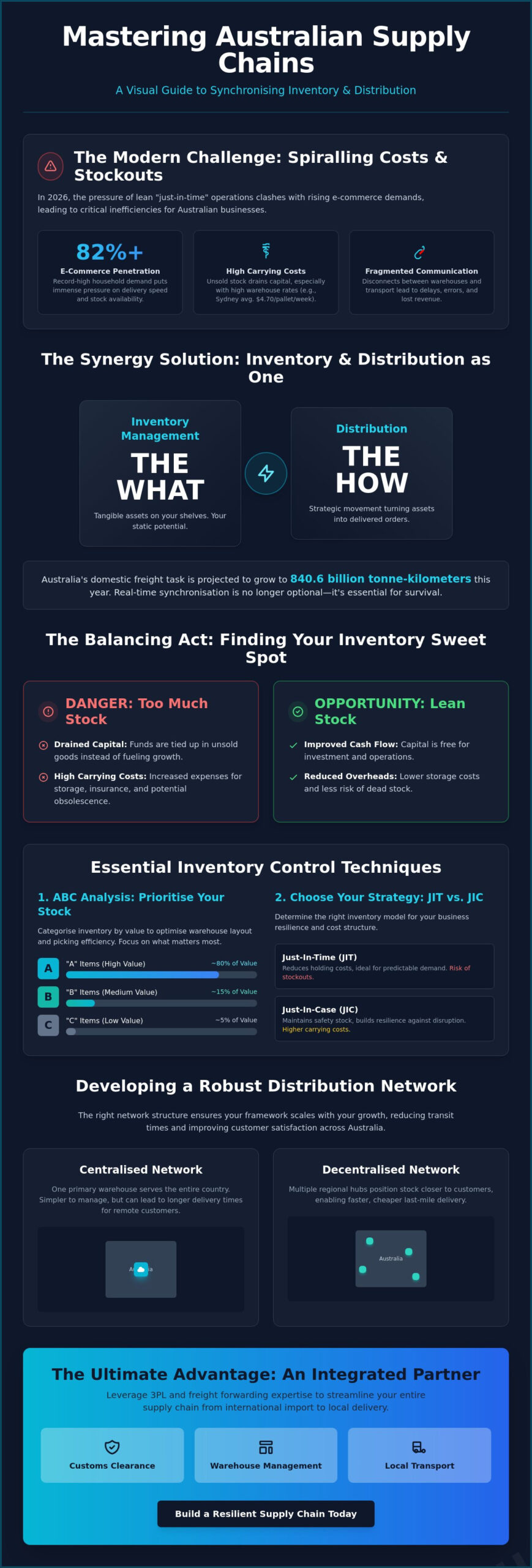
Successful logistics isn’t just about having products; it’s about moving them with purpose. In the complex trade environment of 2026, the lines between inventory management and distribution have blurred into a single, high-stakes operation. Think of your inventory as the "what" of your business, representing the tangible assets sitting on your warehouse shelves. Distribution, by contrast, is the "how", the strategic movement that transforms those static assets into delivered orders. To succeed today, you must treat these as two halves of one whole.
With Australia’s domestic freight task projected to grow to 840.6 billion tonne-kilometers this year, the demand for precision has never been higher. You can’t afford to treat your warehouse as a static box. It must function as a dynamic hub where storage and transport are perfectly synchronised in real time. When your warehouse management system talks to your transport providers, you eliminate the "dead time" that usually eats your margins. We’ve seen that businesses that master this synchronisation respond faster to market shifts and keep their customers much happier!
To better understand this concept, watch this helpful video:
International lead times play a massive role in how you plan your local Australian stockholding. If you’re importing from China or the USA, you’re dealing with transit times that can fluctuate based on global events. Freight and More bridges the gap between global arrival and local availability, ensuring that as soon as your cargo hits Australian soil, the transition from "transit" to "available stock" is seamless. We take pride in removing the obstacles that slow down your supply chain.
The Lifecycle of a Commercial Product
Every product begins its journey as a line item on a manufacturing manifest. It travels across oceans or through the skies, eventually reaching the critical bottleneck of the Australian border. This is where customs clearance becomes the pivot point for your entire strategy. If you lack visibility during this phase, your inventory management falls apart. You simply can’t promise delivery to a local customer if you don’t know when the Australian Border Force will release your containers.
Inventory vs. Distribution: A Balancing Act
Finding the "sweet spot" is a constant challenge for Australian importers. Holding too much stock in a Sydney warehouse, where weekly pallet rates can average $4.70, drains your capital through high carrying costs. Conversely, lean stock levels often lead to stockouts and lost sales during peak demand. Distribution efficiency is the secret weapon that allows for leaner inventory. If your local transport network is fast and reliable, you don’t need to overstock to feel secure. Distributed inventory management is a sophisticated strategy that involves decentralising your stock across multiple regional hubs to ensure rapid national reach and reduced transit times for every customer.
Essential Inventory Control Techniques for Australian Importers
Mastering inventory management and distribution requires a shift from passive observation to active control. You’ve established the synergy between stock and movement; now you must apply the specific techniques that keep your warehouse efficient. ABC Analysis remains a cornerstone of this process, allowing you to categorise stock by value and turnover rate. By placing your "A" items, those high-value, high-velocity goods, in the most accessible zones of your facility, you drastically reduce picking times and accelerate your local delivery speed. We take pride in helping you identify these priorities to keep your capital moving rather than sitting idle on a shelf.
The debate between Just-In-Time (JIT) and Just-In-Case (JIC) has taken a sharp turn in 2026. While lean JIT models were once the gold standard, the vast geography of Australia and recent global disruptions have made JIC more attractive for many importers. Holding buffer stock isn’t a sign of inefficiency anymore; it’s a strategic move for resilience. Cycle counting further supports this by allowing you to maintain high data accuracy through regular, small-scale audits. You don’t have to halt your entire operation to know exactly what’s on your shelves. It’s a proactive way to manage complex SKU counts without losing momentum.
Optimising Stock for the Australian Market
Australian importers face unique pressures, especially during significant seasonal shifts like the End of Financial Year (EOFY) or the intensive summer retail peak. Managing these surges requires a sophisticated understanding of lead times. When your business relies on sea freight services, the "safety stock" calculation becomes your most important metric. You must account for the transit volatility inherent in international shipping to ensure your reorder points never leave you with empty shelves when demand spikes. We’re here to help you navigate these fluctuations with meticulous care.
Technology and Labelling Standards
Manual logs are a relic of the past. In 2026, the transition to RFID and barcode scanning is essential for any business serious about growth. Ensuring your products comply with Australian GS1 labelling standards isn’t just about following rules; it’s about making your distribution seamless across various retail and transport networks. Real-time data serves as the foundation of modern warehouse management, giving you the visibility needed to make bold, informed decisions. If you’re feeling overwhelmed by the complexity of your current SKU counts, reach out to our team to see how we can simplify your operations and remove those daily obstacles.
Developing a Robust Distribution Network Across Australia
Building a physical network across Australia requires more than just a digital dashboard. It demands a deep understanding of our unique geography. When you’re looking to scale, the first question is whether a centralised or decentralised model fits your volume. A centralised warehouse might keep your overheads low, but a decentralised network with hubs in Sydney, Melbourne, and Brisbane puts your stock closer to the customer. This physical proximity is what makes inventory management and distribution truly effective in a market where e-commerce penetration has soared past 82%.
Moving goods across a vast continent involves navigating complex logistics hurdles. Last-mile delivery remains the final, most critical hurdle in your customer’s journey. It’s the moment your brand promise is either kept or broken. To streamline this, many bold overachievers are turning to cross-docking. This technique moves goods directly from receiving to shipping with minimal storage time. It’s a proactive way to keep your stock moving and your storage costs down, especially in high-demand hubs where warehouse space is at a premium!
National Transport Infrastructure
Utilising the right mix of road and rail is essential for cost-effective interstate movement. While road freight is the standard for flexibility, rail freight offers a powerful alternative for long-haul routes. For example, moving non-bulk freight from the Eastern States to Perth via rail costs approximately 4 cents per net tonne-kilometer, compared to roughly 9 cents for road. Our port-to-door delivery services take the stress out of this initial phase, ensuring your cargo transitions smoothly from the wharf to your regional hubs. For those looking for local expertise, exploring our 3PL Warehouse Melbourne Solutions provides a strategic anchor for your Victorian operations.
Choosing Your Distribution Channels
Your distribution strategy must adapt to your sales channel, whether you’re focused on direct-to-consumer (DTC) speed or wholesale volume. Wholesale requires meticulous pallet-level management, while DTC demands high-velocity pick-and-pack precision. Freight and More excels at managing these multi-channel requirements, providing a seamless link between your global imports and local customers. Effective distribution management is the strategic engine that allows a business to scale nationally by ensuring products are always in the right place at exactly the right time. We’re here to help you navigate these choices with professional confidence and a dedicated, partner-led approach.
The Master Checklist: Optimising Your Supply Chain Performance
Turning a complex logistics operation into a high-performance engine requires more than just high-level strategy; it demands a practical, actionable roadmap. To truly master inventory management and distribution, you must begin with a ruthless audit of your current stock. Identify your "dead stock" immediately. These are the items that have sat idle for over six months, consuming valuable warehouse space and draining your capital. By contrasting these with your high-velocity items, those products that fly off the shelves, you can reallocate your resources where they generate the most profit. We take pride in helping you identify these opportunities for growth!
Your checklist must also account for the physical realities of the warehouse floor. Assess your layout to minimise "travel time" for your pick-and-pack teams. If your most popular items are located at the back of the facility, you’re losing money on every single order. You must also review your lead times by accounting for international transit and customs processing. A delay at the port shouldn’t be a surprise; it should be a calculated risk in your planning. Finally, evaluate your transport partners regularly. Ask yourself if they’re providing the national coverage and reliability your brand deserves. Implementing a feedback loop that uses delivery data to adjust your stock levels ensures your supply chain remains agile and responsive.
Daily and Weekly Operational Checks
Consistency is the heartbeat of a successful warehouse. You should verify every inbound shipment against purchase orders immediately to catch discrepancies before they enter your system. Monitoring "Order-to-Delivery" timeframes weekly allows you to identify bottlenecks in real-time rather than waiting for a monthly report. For those seeking a truly seamless experience, our guide on Integrated Logistics Services Australia explains how end-to-end solutions remove these daily obstacles for you.
Strategic Quarterly Reviews
Every three months, take a step back to look at the bigger picture. Analysing your inventory turnover ratios is essential for freeing up working capital that could be better spent on expansion. This is also the perfect time to review your marine transit insurance coverage, especially if you’ve increased your volume of high-value inventory. Don’t settle for outdated agreements. Negotiate with your freight partners for better enquiries and rates to ensure your margins remain protected. If you want to see how a dedicated partner can refine your inventory management and distribution strategy, contact us today for a tailored consultation.
Navigating Growth with Integrated 3PL and Freight Forwarding
Scaling a business is a significant achievement, but it eventually brings you to a tipping point where in-house logistics become a bottleneck rather than an asset. When your team spends more time chasing missing pallets or reconciling disparate freight invoices than they do on core strategy, you’ve outgrown your current model. Mastering inventory management and distribution at scale requires a transition from fragmented providers to an integrated partner who can handle the physical reality of your goods. We take pride in being that dedicated partner, offering a seamless link between your global supply chain and your Australian customers.
The "Freight and More" advantage lies in our ability to function as a single-source provider for air freight, sea freight, customs clearance, and warehouse management. By outsourcing to a national 3PL network, you transform fixed overheads like warehouse leases and staff costs into a flexible, variable model that breathes with your business. This is how you future-proof your operations for 2026 and beyond. With the Australian supply chain management market projected to grow at a compound annual rate of 10.21% through 2034, having a resilient and tech-forward partner ensures you aren’t just keeping up; you’re leading the charge!
The Power of a Single-Source Provider
One of the biggest obstacles to efficiency is "siloed" data. When your freight forwarder doesn’t talk to your warehouse, you lose visibility and time. We eliminate this friction by providing a unified view of your cargo from the moment it leaves an international port until it arrives at a local doorstep. This door-to-door approach doesn’t just improve speed; it simplifies your entire inventory accounting process. You’ll find that our proactive, "can-do" attitude turns complex logistics hurdles into solved problems, allowing you to focus on what you do best. We treat your cargo with the meticulous care and personal attention it deserves.
Next Steps: From Planning to Execution
Moving from a fragmented system to a managed distribution model doesn’t have to be daunting. The process begins with a professional logistics audit to identify exactly where your current inventory management and distribution framework is leaking capital. We’ll help you analyse your lead times, transit risks, and storage requirements to build a bespoke strategy that fits your specific scale. Transitioning to a managed model gives you the confidence to pursue bold growth targets, knowing your infrastructure is ready to support you. If you’re ready to remove the obstacles holding your business back, contact Freight and More for a comprehensive logistics assessment today and let’s build a more resilient future together!
Secure Your Competitive Advantage for 2026
You’ve now seen how the perfect alignment of stock levels and delivery networks creates a powerful competitive advantage. Mastering inventory management and distribution in 2026 isn’t just about efficiency; it’s about building a resilient framework that can withstand global volatility. By adopting proactive techniques like ABC analysis and shifting toward a more robust "Just-In-Case" model, you ensure your Australian customers are never left waiting. It’s about moving from a state of reactive troubleshooting to proactive leadership.
Founded in 2009, Freight and More brings deep Australian expertise to every shipment, leveraging a global network of agents to ensure your international-to-local transitions are seamless. Our comprehensive services, including Customs Brokerage and 3PL, are designed to remove obstacles and protect your margins. We take pride in being more than just a service provider; we’re your dedicated partner in growth. We’re ready to handle your needs with meticulous care and professional confidence!
Streamline your supply chain with Freight and More today! We’re eager to help you navigate these complexities and build a scalable future for your business.
Frequently Asked Questions
What is the difference between inventory management and distribution?
Inventory management focuses on the internal control and tracking of your stock levels, whereas distribution encompasses the external logistics of moving those goods through your supply chain to the end consumer. One ensures you have the right products available; the other ensures they reach their destination efficiently. Mastering the synergy of inventory management and distribution is essential for maintaining a high-performance Australian business in 2026.
How much safety stock should an Australian importer keep?
The ideal safety stock level for an Australian importer typically covers the standard lead time plus a buffer for transit volatility. Since international sea freight can be unpredictable, many businesses now hold enough buffer stock to cover at least two to four weeks of unexpected delays. This proactive approach prevents stockouts during peak demand periods when global supply chains face sudden disruptions.
Can a freight forwarder also manage my warehouse inventory?
Yes, an integrated partner like Freight and More can manage your warehouse inventory alongside your international shipping needs. By combining freight forwarding with professional 3PL services, we eliminate the communication gaps that often occur between separate providers. This single-source model gives you total visibility over your goods from the moment they leave an overseas factory until they reach your Australian warehouse.
What are the main causes of distribution delays in Australia?
Geography is the primary challenge, as moving goods across the vast Australian continent requires meticulous planning. Port congestion and seasonal surges, such as the retail peak leading into December, also contribute significantly to transport bottlenecks. Using a mix of road and rail freight can help mitigate these delays by providing more flexible routing options when one network faces heavy pressure.
Is 3PL warehousing more cost-effective than managing my own facility?
For most scaling businesses, 3PL warehousing is significantly more cost-effective because it transforms fixed overheads into variable expenses. You only pay for the space and labor you actually use, rather than maintaining a large, half-empty facility during quiet periods. This flexibility allows you to reallocate capital toward marketing or product development while we handle the operational heavy lifting.
How does customs clearance affect my inventory replenishment cycle?
Customs clearance is the critical pivot point that determines when your transit cargo becomes available inventory. Any delay at the border immediately extends your replenishment cycle, potentially causing stockouts if your safety stock levels are too lean. Working with an expert broker ensures your documentation is precise, which minimizes the risk of Australian Border Force holds and keeps your stock moving.
What KPIs should I track for inventory and distribution success?
You should focus on three primary KPIs: inventory turnover ratio, order-to-delivery time, and order accuracy. Tracking your turnover ratio helps you identify "dead stock" that’s draining your capital, while monitoring delivery times reveals bottlenecks in your distribution network. High-performance inventory management and distribution relies on using this data to make proactive adjustments to your replenishment strategy.
Can Freight and More handle both LCL and FCL distribution?
We certainly can. Freight and More provides comprehensive distribution solutions for both Less than Container Load (LCL) and Full Container Load (FCL) shipments. Whether you’re moving a few pallets or multiple 40ft containers, our team handles the transition from the wharf to your warehouse or directly to your customers with professional precision and care.
