LCL Shipping Australia: A Strategic Guide to Less-than-Container Load Logistics

For shipments under 13 cubic meters, paying for a full container is often a costly mistake that drains your bottom line. You’re likely looking for a way to scale your imports without the overhead of a 20-foot box, yet the reality of unpredictable port handling charges and complex biosecurity regulations can feel like a logistical minefield. It’s frustrating when de-consolidation delays or sudden fuel surcharges, which have recently spiked as high as 54% in certain Australian states, disrupt your carefully planned schedule. We understand that you need reliability and precision to keep your business moving forward.
This guide empowers you to master lcl shipping australia by turning these common hurdles into a streamlined competitive advantage. You’ll learn how to optimize your global supply chain for maximum efficiency while maintaining total control over your landed costs. We will break down the latest 2026 regulatory fees, compare LCL against FCL to find your perfect break-even point, and provide a clear roadmap for clearing Australian customs and biosecurity without the sting of unexpected penalties. Let’s transform your small-volume logistics into a high-performance engine for growth.
Key Takeaways
- Identify the precise 15 CBM volume threshold where transitioning from shared space to a full container optimizes your shipping budget.
- Navigate the complexities of lcl shipping australia by understanding the difference between “All-In” and “Plus-Costs” quoting structures to protect your margins.
- Streamline your ocean transit phase with proactive monitoring techniques that keep your supply chain moving through international transshipment points.
- Secure your inventory with meticulous cargo handling strategies at origin hubs to ensure your goods arrive in pristine condition every time.
- Leverage the expertise of a personalized Australian forwarder to manage de-consolidation and local transport without the typical delays of large-scale logistics firms.
Understanding LCL Shipping in the Australian Context
Agility is the currency of the modern Australian importer. For many businesses, waiting to fill an entire 20-foot container isn’t just impractical; it’s a barrier to growth. This is where Less-than-container load (LCL) shipping becomes a transformative solution. By definition, LCL is a consolidated shipping method where multiple shippers share space within a single ocean container. It serves as the strategic backbone for lcl shipping australia, allowing small-to-medium enterprises (SMEs) to move smaller volumes frequently without the steep overhead of a full container.
Your freight forwarder acts as a meticulous architect in this process. They don’t just move boxes; they manage a complex puzzle of International Sea Freight, ensuring that your cargo is grouped with compatible shipments to maximize space and minimize costs. This approach directly supports a “just-in-time” supply chain model. Instead of tying up capital in massive inventory stockpiles, you can import exactly what you need, when you need it, and move it swiftly through Local Transport networks once it clears the wharf.
The Mechanics of Cargo Consolidation
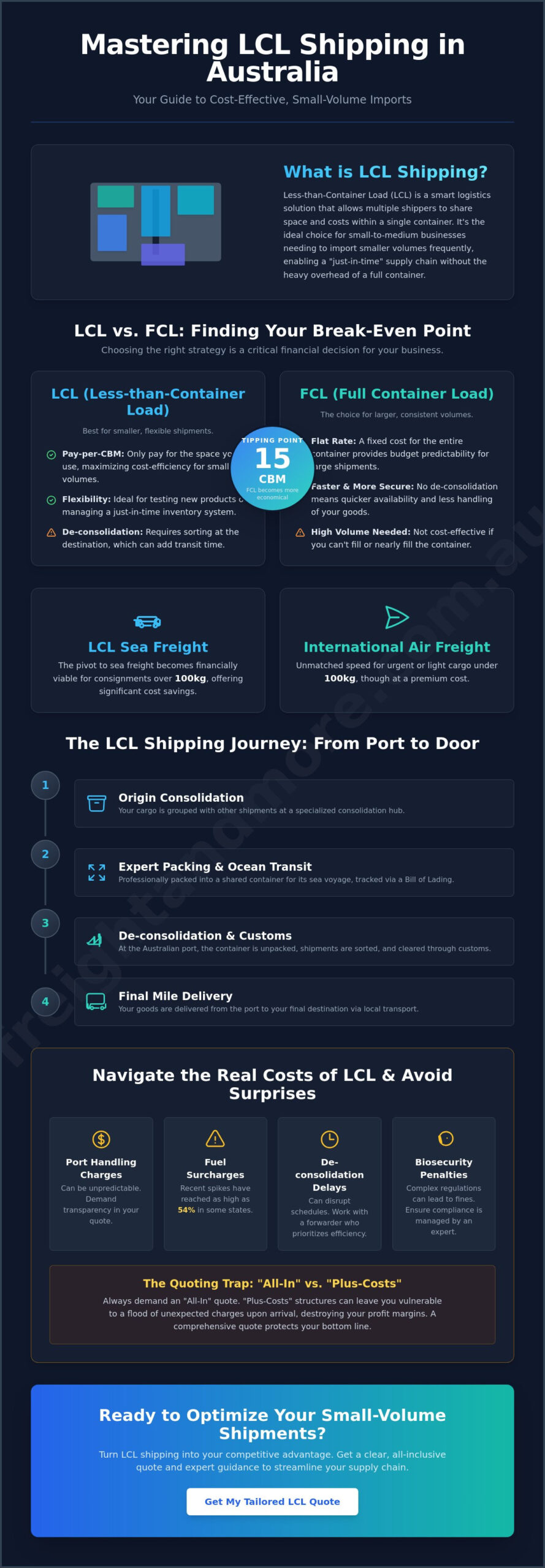
The journey begins at a consolidation hub where various shipments are expertly packed into a single 20ft or 40ft container. This isn’t a random process. It requires professional packing at the origin port to maintain cargo integrity and prevent damage during the long ocean transit. For those preparing items for transport or needing professional assistance with a move, you can visit Move&Haul to explore expert moving and removal services. Each individual shipment is tracked via its own Bill of Lading, which serves as your essential document of title and a contract of carriage. This meticulous level of detail ensures that even though you’re sharing space, your specific goods remain legally and operationally distinct throughout the voyage.
LCL vs. International Air Freight
Choosing between sea and air requires a clear-eyed look at your margins and deadlines. While International Air Freight offers unmatched speed for urgent restocks, the cost can be prohibitive for larger or heavier items. LCL provides a middle ground, offering significant savings for those who can plan ahead. It’s often the most balanced strategic decision for lcl shipping australia when you need to manage costs without sacrificing regular delivery schedules. The strategic pivot point where sea freight typically becomes more financially viable than air freight is generally reached when a consignment exceeds a weight of 100 kilograms.
LCL vs. FCL: A Comparison Framework for Importers
Choosing the right container strategy is a fundamental financial lever for your operations. While FCL involves a flat fee for the entire space, LCL operates on a per-Cubic Metre (CBM) basis, creating a distinct financial boundary for lcl shipping australia. Generally, once your cargo volume reaches 15 CBM, the flat rate of a 20-foot container often becomes more economical than paying for individual units of space. It’s about finding that sweet spot where your volume justifies the cost of exclusivity.
Speed and risk profiles also diverge significantly between these two methods. FCL is typically faster because your goods stay in the same container from the factory to your warehouse. In contrast, LCL requires a de-consolidation process at the destination port, which can introduce transit delays while shipments are sorted. When weighing the Benefits and disadvantages of LCL, you must consider whether the significant cost savings on smaller loads outweigh the potential for a slightly longer arrival window. If you’re uncertain which path fits your current shipment, our team at Freight and More Pty Ltd can provide a side-by-side cost analysis to clear up the confusion.
When to Stick with LCL Shipping
Startups and businesses launching new product lines find LCL indispensable. It allows you to test the Australian market without committing to massive inventory levels that might sit stagnant. By shipping smaller quantities, you avoid overwhelming your Warehouse Management systems and keep your storage costs lean. This “ship as you go” approach preserves your liquid capital; it’s a vital strategy for maintaining a healthy cash flow during aggressive growth phases.
The Transition to Full Container Load (FCL)
As your business scales, you’ll notice clear signs that it’s time to move toward FCL. If you’re consistently hitting that 15 CBM mark, or if you’re importing high-value, fragile goods that benefit from minimal handling, a dedicated container is the superior choice. Calculating the break-even point is straightforward: compare the total CBM cost of your lcl shipping australia against the current flat rate for a 20ft container. Once those numbers align, the added security and speed of FCL become a clear victory for your supply chain efficiency. For businesses operating through Australia’s busiest port, our detailed guide to container shipping Melbourne walks you through every step of managing full container logistics with confidence.
Navigating the LCL Journey: From Global Port to Australian Door
Successful lcl shipping australia depends on a high-precision sequence of events that begins long before a ship ever leaves the dock. Your journey starts at an international consolidation hub, where your goods are expertly crated and packed into a shared container. This origin phase is where cargo integrity is won or lost; professional crating is essential to withstand the rigors of ocean transit. We monitor every vessel movement and transshipment point with a proactive eye, ensuring your International Sea Freight remains on a predictable path toward the Australian coastline.
For those managing the first leg of a relocation or commercial move from the UK, utilizing professional removals worcester ensures your cargo is properly prepared and safely transported to the initial hub for consolidation.
When the vessel finally berths at one of Australia’s major ports, the container is moved to a Container Freight Station (CFS) for de-consolidation. This is a meticulous process where the shared container is opened, and each individual shipment is separated for its final destination. Unlike a full container that might be delivered directly to a site, LCL cargo requires this extra step of careful handling. It’s a critical transition point where local expertise ensures your goods are sorted quickly and accurately, setting the stage for a seamless handover to domestic logistics networks.
Australian Customs and Biosecurity Compliance
Australian Border Force (ABF) and the Department of Agriculture, Fisheries and Forestry (DAFF) maintain some of the most rigorous standards on the planet. For lcl shipping australia, biosecurity inspections are often more frequent because you’re sharing a container with other shippers. If one item in that container contains untreated timber or organic contaminants, the entire unit may be flagged for a DAFF inspection. We eliminate the “paperwork trap” by ensuring your Customs Clearance documentation is flawless before the ship arrives. This proactive approach prevents the mounting port storage fees that often catch unprepared importers by surprise.
National Distribution and the Last Mile
Once your cargo clears the CFS, the final leg of the journey begins. This is where a robust Local Transport network becomes the hero of your supply chain. Whether your inventory is destined for a metropolitan storefront or a regional warehouse, we coordinate the transition to road or rail freight with meticulous care. For importers who also need to manage specialized vehicle or heavy machinery relocation, you can discover Done Wright Towing & Transport for expert handling within the domestic leg. You shouldn’t have to guess where your stock is during this phase. Integrated logistics management provides the door-to-door transparency you need to manage your inventory levels and meet your customers’ expectations with total confidence.
The Real Cost of LCL: Avoiding Hidden Fees and Delays
Precision is paramount when calculating your landed costs. While the initial ocean freight rate might look attractive, the true financial picture of lcl shipping australia only emerges when you account for destination charges. Destination Terminal Handling Charges (DTHC) are a frequent source of sticker shock for unprepared importers. These fees cover the cost of handling your cargo at the Australian port and its transfer to a de-consolidation warehouse. If these aren’t clearly outlined in your initial quote, your profit margins can disappear before the goods even reach your door. Importers routing cargo through Victoria should be aware that terminal access charges for imports surged to $239.44 per container in early 2026, making it essential to understand the full scope of container shipping Melbourne costs before committing to a logistics strategy.
You’ll typically encounter two quoting methods: “All-In” and “Plus-Costs.” An “All-In” quote provides a comprehensive figure, including most port and handling fees, which offers much-needed predictability for your budget. Conversely, “Plus-Costs” quotes only show the base freight, leaving you responsible for a list of surcharges later. We always advocate for transparency to help you avoid these destination surprises. If you want a quote that reflects the real world, reach out to the experts at Freight and More Pty Ltd for a detailed breakdown of your specific requirements.
Regulatory fees also play a significant role in your final invoice. As of June 2026, the Import Processing Charge (IPC) for goods valued between AUD 1,000 and AUD 10,000 is a flat AUD 50, while shipments exceeding AUD 10,000 incur a charge of AUD 152. Additionally, sea imports valued above AUD 1,000 face a biosecurity cost recovery charge of AUD 63 per shipment. These are mandatory government costs, but they can be managed. By ensuring your paperwork is ready for immediate Customs Clearance, you can avoid port storage and demurrage fees, which accumulate rapidly if your cargo sits idle at the terminal.
Decoding the LCL Quote
Understanding Incoterms is vital because they define exactly who pays for each segment of the journey. Whether you’re shipping under FOB (Free On Board) or CIF (Cost, Insurance, and Freight), you must know where your financial responsibility begins. Your final price is also dictated by the “W/M” (Weight or Measurement) rule. This means the carrier calculates your rate based on whichever is higher between the gross weight in tonnes or the volume in cubic metres, ensuring they’re fairly compensated for the space or capacity your cargo occupies.
Mitigating Risk and Delay
Low-cost freight leads to high-cost headaches. “Cheap” rates often lack the proactive management needed to prevent customs holds or biosecurity delays. While we don’t underwrite policies directly, we strongly recommend securing marine insurance to protect your investment during the consolidation and transit phases. A dedicated forwarder monitors current surcharges, such as the lcl shipping australia ocean freight fuel surcharge which ranges from USD 6.00 to USD 12.00 per CBM, and the domestic trucking fuel surcharges that currently sit between 35% and 54% across Australia. Staying informed about these shifting costs is the only way to maintain a truly efficient supply chain.
Streamlining Your LCL Strategy with Freight and More Pty Ltd
Global logistics giants often treat your cargo as just another number in a spreadsheet, but we believe your business deserves a higher level of personal attention and professional confidence. When you choose Freight and More Pty Ltd as your dedicated partner for lcl shipping australia, you benefit from an industry-literate global agent network that provides seamless, origin-to-destination control over every cubic metre. We take immense pride in our meticulous cargo handling, ensuring that your shipments are managed with the same care we would give our own inventory; it’s about combining that massive global reach with the proactive, detail-oriented nature of a local expert who truly understands your specific market needs. Our team functions as a seasoned veteran of the field, remaining eager to solve problems and remove the obstacles that typically slow down smaller importers.
Our National Expertise and Global Reach
We manage International Sea Freight with a level of precision that eliminates the guesswork from your supply chain, providing you with total confidence in your transit times. Our integrated Customs Clearance services are designed to speed up your LCL clearance by navigating the complex Australian regulatory environment before your cargo even hits the water. We recently assisted an Australian retailer who was struggling with unpredictable port fees and biosecurity delays. By optimizing their lcl shipping australia strategy and ensuring flawless documentation, we helped them scale their import volume from 4 CBM to a consistent 12 CBM monthly, significantly lowering their per-unit landed costs without the risk of penalties or warehouse bottlenecks.
Taking the Next Step in Your Logistics Journey
Your path to a more efficient supply chain starts with total transparency and a partner who removes obstacles before they arise. We offer a comprehensive, no-surprise LCL quote that accounts for the current market realities, including shifting fuel surcharges and mandatory port fees. Beyond the wharf, our door-to-door national delivery network utilizes reliable Local Transport to ensure your goods move swiftly from the CFS to your warehouse or storefront. If you’re ready to experience a premium level of service that prioritizes your growth and protects your margins, we invite you to partner with Freight and More Pty Ltd for your next LCL shipment and discover the difference that dedicated logistics management makes to your bottom line.
Master Your Australian Supply Chain Today!
Elevating your business through lcl shipping australia requires a blend of strategic volume analysis and rigorous regulatory compliance. You’ve learned how to identify the financial sweet spot between shared and full containers while navigating the specific biosecurity hurdles that define the Australian market. By accounting for destination terminal charges and utilizing transparent quoting methods, you can protect your margins and ensure your inventory arrives exactly when it’s needed. Success in global trade isn’t just about moving goods; it’s about the precision and reliability of the partners you choose.
Since 2009, we’ve combined deep Australian port expertise with a vast global agent network to offer national coverage that feels personal. We specialize in solving the most complex customs clearance and biosecurity challenges, removing the obstacles that slow your growth. Take control of your logistics and request a tailored LCL shipping quote today. We’re ready to help you build a more resilient and efficient supply chain that drives your business forward with absolute confidence!
Frequently Asked Questions
What is the difference between LCL and FCL shipping?
LCL involves sharing container space with other shippers, while FCL gives you exclusive use of the entire 20-foot or 40-foot container. You only pay for the specific cubic volume your goods occupy in an LCL shipment, which makes it a highly cost-effective choice for smaller volumes. FCL typically offers slightly faster transit times because it avoids the consolidation and de-consolidation stages required for shared loads.
How is the cost of LCL shipping calculated in Australia?
Costs are primarily determined by the Weight or Measurement (W/M) of your cargo, where the carrier charges based on whichever value is higher. For lcl shipping australia, your final invoice will also include mandatory government fees like the Import Processing Charge and biosecurity cost recovery fees. You should also account for domestic trucking fuel surcharges, which currently range between 35% and 54% depending on the specific Australian state of delivery.
How long does LCL shipping take to reach Australia from major global ports?
Transit times vary by origin, generally taking 12 to 25 days from major Asian hubs like Shanghai or Singapore and 40 to 55 days from European or North American ports. You should allow an additional 5 to 7 days for the de-consolidation process at the Australian Container Freight Station. Peak seasons, which typically run from September to January, can also impact vessel availability and overall transit schedules.
Are there hidden fees when shipping LCL to Australia?
Hidden fees often arise from Destination Terminal Handling Charges (DTHC) or port storage if your documentation isn’t submitted promptly. Importers are sometimes surprised by biosecurity document assessment fees or emergency fuel surcharges, which currently range from USD 6.00 to USD 12.00 per CBM for ocean freight. We prioritize transparency by providing detailed quotes that outline these potential costs before your shipment departs the origin port.
Do I need a customs broker for LCL shipments?
While you can legally manage your own filings, engaging a specialist for Customs Clearance is the most reliable way to navigate complex Australian Border Force requirements. Professional brokers ensure your goods are correctly classified to prevent overpaying duties or incurring penalties. They also manage the payment of GST and the IPC, which is currently AUD 152 for shipments valued at AUD 10,000 or more, ensuring a smooth release.
What happens if my LCL cargo is damaged during consolidation?
Liability for damage is usually governed by the agreed Incoterms and the conditions stated on the Bill of Lading. Because lcl shipping australia involves more frequent handling than full containers, professional packing and crating at the origin are vital for protection. We strongly recommend securing marine insurance through a qualified provider to ensure your investment is fully protected against any unforeseen handling mishaps during the consolidation process.
Can I ship hazardous materials via LCL to Australia?
Hazardous materials can be shipped via LCL, but they require strict adherence to International Maritime Dangerous Goods (IMDG) regulations and specific carrier approval. You must provide a comprehensive Material Safety Data Sheet (MSDS) and ensure your goods are expertly labeled and packed. Many consolidators have restrictions on certain classes of dangerous goods in shared containers, so it’s essential to declare these items during the quoting stage.
How does Australian Biosecurity affect LCL transit times?
Biosecurity requirements can lead to delays if the Department of Agriculture, Fisheries and Forestry (DAFF) flags the shared container for an inspection. In an LCL environment, a single non-compliant shipment can hold up the release of every other order within that container. Ensuring your cargo is free from organic contaminants and that all biosecurity cost recovery charges are paid promptly is the best strategy for maintaining predictable delivery windows.
