Understanding Import Costs in Australia: A Complete Guide for 2026

What if a minor oversight in the 2026 Federal Budget was the only thing standing between your business and a successful quarter? For many ambitious importers, understanding import costs australia feels like navigating a labyrinth of shifting regulations, especially as duty rates for furniture increase to 7.5% and consumer electronics move to 2.5%. You’ve likely experienced the stress of unpredictable customs delays or the confusion of calculating GST on the full Value of Taxable Imports while hidden port charges eat into your margins.
It’s true that the Australian customs landscape is sophisticated, but you don’t have to tackle it alone. This comprehensive guide promises to transform your approach to international trade, helping you master duty calculations and government fees to forecast your landed costs with absolute confidence. We’re going to break down the latest A$50.70 Import Processing Charges, show you how to access the new SME Duty Deferral Program, and identify exactly how Trade Agreements can slash your overheads to keep your business moving forward with professional precision.
Key Takeaways
- Navigate the A$1,000 threshold with confidence to ensure your commercial shipments are correctly classified for formal customs entry.
- Master the Value of Taxable Importation (VOTI) formula to achieve total transparency when understanding import costs australia and forecasting your landed expenses.
- Identify strategic opportunities to slash or eliminate customs duties by correctly leveraging Free Trade Agreements with major partners like China and the UK.
- Protect your profit margins by uncovering hidden terminal and port service charges before they appear on your final invoice.
- Streamline your entire supply chain by integrating professional customs clearance with expert international air and sea freight management.
The Fundamentals of Australian Import Costs in 2026
Success in the Australian market relies on more than just a great product; it requires a granular grasp of the regulatory framework managed by the Australian Border Force (ABF). As we move through 2026, the ABF remains the primary gatekeeper for valuation and compliance, ensuring that every shipment entering the country meets strict legal standards. For any business owner, understanding import costs australia starts with recognizing that the government views your cargo through the lens of risk and revenue. If you miscalculate your obligations, you risk costly delays at the wharf or unexpected bills that can quickly erode your profit margins. Precise forecasting is now a competitive necessity as global supply chains face tighter margins and shifting duty rates.
Formal vs. Informal Entry Requirements
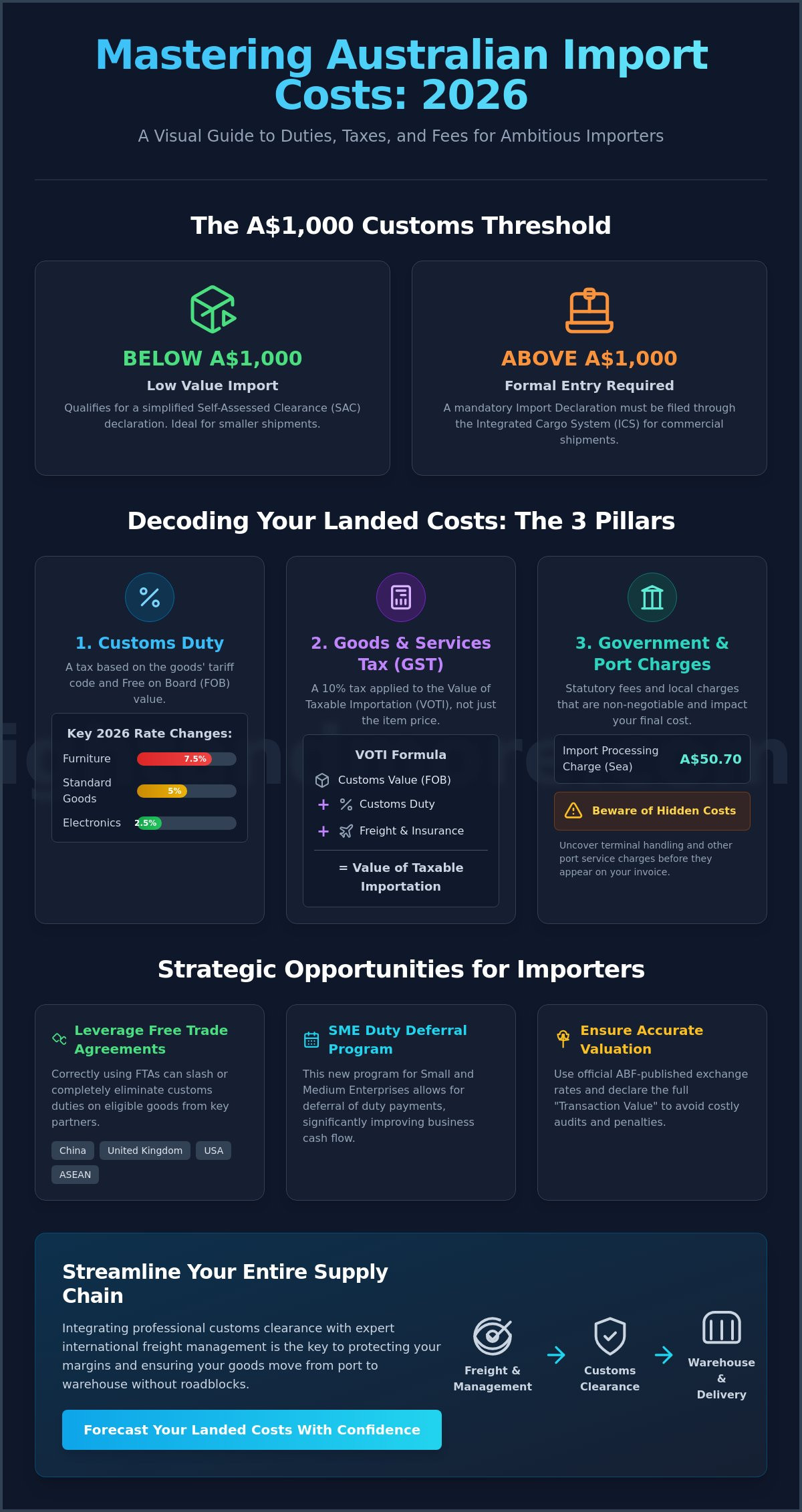
Most importers begin by looking at the value of their goods. If your consignment is valued at or below A$1,000, it generally qualifies as a “Low Value” import, which allows for a simplified Self-Assessed Clearance (SAC) declaration. However, the moment your commercial shipment exceeds that A$1,000 threshold, a formal Import Declaration becomes mandatory. This isn’t just a paperwork exercise. Formal entries require detailed reporting through the Integrated Cargo System (ICS), which directly impacts your processing speed and visibility. While the ICS streamlines data flow, any errors in your submission can trigger manual reviews. It’s why many enterprises partner with a dedicated Customs Clearance specialist to ensure every digit is correct before the ship even docks. Getting this right ensures your goods move from the port to your Warehouse Management facility without hitting a bureaucratic roadblock.
Primary Cost Components Overview
Your total landed cost is built on three primary pillars. First is the Customs Duty, which is a tax based on specific tariff codes. While many manufactured goods sit at a standard 5% rate, the 2026 Federal Budget introduced increases for certain sectors, such as furniture rising to 7.5% and consumer electronics moving to 2.5%. Second is the Goods and Services Tax (GST). It’s a common mistake to think GST applies only to the purchase price. In reality, it’s 10% of the “Value of Taxable Importation,” which includes the goods’ value, the duty, and the cost of international freight and insurance. This layered approach is a core part of Taxation in Australia and requires careful calculation to avoid underpayment. Finally, you must account for statutory fees, such as the A$50.70 Import Processing Charge (IPC) for sea cargo. Whether you’re utilizing International Air Freight or International Sea Freight, these fixed government charges are non-negotiable and must be factored into your initial budget to maintain a healthy cash flow.
Decoding the Customs Value: The VOTI Formula
Precision is paramount when you’re calculating the financial impact of your supply chain. While the concept of an invoice price seems straightforward, the Australian Border Force requires a much more comprehensive calculation to determine the final tax base for your goods. This is where understanding import costs australia becomes a technical exercise in valuation. The foundation of this process is the “Transaction Value” method, which is the price actually paid or payable for the goods when sold for export to Australia. It’s not just the sticker price; you must also account for adjustments such as foreign inland freight, packing costs, and even certain royalties or commissions that might be part of the deal. If you fail to include these, you risk non-compliance and potential penalties during an audit.
Accuracy in valuation also hinges on the exchange rate used at the time of export. Since most international transactions occur in foreign currencies, you must use the specific exchange rates published by the ABF to convert your costs into Australian Dollars. A common mistake is using a generic bank rate or the rate on the day of payment, which can lead to overpayment of GST or, worse, an under-declaration that triggers a red flag. For businesses looking for a proactive approach, partnering with a specialist in Customs Clearance can ensure these technical nuances are handled with meticulous care, protecting your bottom line from avoidable errors.
FOB vs. CIF: How Incoterms Change Your Tax
The Incoterms you negotiate with your supplier don’t just dictate who pays for the shipping; they fundamentally change your tax base. In Australia, Customs Duty is typically calculated on the “Free on Board” (FOB) value, which represents the value of the goods at the port of origin. However, the Goods and Services Tax (GST) is applied to a much larger figure. If you import under “Cost, Insurance, and Freight” (CIF) terms, those international shipping and insurance costs are already bundled in, which can simplify your initial quote but may complicate how you separate costs for duty purposes. Choosing the right Incoterm allows for cleaner internal accounting and ensures you aren’t paying duty on the shipping component of your invoice.
Calculating the Landed Value
To reach your final landed cost, you must follow a methodical step-by-step process that builds from the base invoice price to the final taxable amount. Start with your Customs Value (the FOB price in AUD), then apply the relevant duty rate, which may be reduced if you utilize Australia’s free trade agreements for qualifying cargo. Once you have the duty amount, you must add the cost of international air or sea freight and transport insurance to the total. The Value of the Taxable Importation (VOTI) is defined as the sum of the Customs Value, the duty payable, and the costs of international transport and insurance. Finally, apply the 10% GST to this VOTI figure to determine your total tax obligation. This sequence ensures that your budget remains predictable and your business stays fully compliant with Australian regulations.
Calculating Duty, GST, and Government Charges
Once you’ve established your customs value, the next step in understanding import costs australia involves calculating the specific taxes and government fees that apply to your shipment. For most manufactured goods, the standard duty rate remains at 5%, though the 2026 Federal Budget introduced targeted adjustments you must account for. If you’re importing lighting equipment, you’ll now face a 4% duty rate, while furniture imports have risen to 7.5% as of July 1, 2026. It’s also vital to consider specialized taxes like the Luxury Car Tax (LCT). For the 2025-2026 financial year, the LCT threshold is set at A$91,387 for fuel-efficient vehicles and A$80,567 for other vehicles, with a 33% tax levied on the value exceeding these amounts. If your business deals in alcohol, the Wine Equalisation Tax (WET) adds another layer of complexity that requires meticulous attention during the valuation process.
The 10% Goods and Services Tax (GST) is the most consistent element of your budget, yet it’s often the most misunderstood. As established in the previous section, GST isn’t just 10% of your invoice price; it applies to the total sum of the customs value, the duty paid, and the international transport and insurance costs. This compounding effect means that any increase in freight rates or duty percentages automatically inflates your GST liability. For a definitive list of current rates and potential exemptions, referring to the Australian Border Force guide to import costs is a proactive way to ensure your calculations remain accurate and compliant with the latest 2026 regulations.
The Import Processing Charge (IPC) Breakdown
Every formal import declaration attracts an Import Processing Charge, which is a non-negotiable government fee for cargo screening and clearance. In 2026, these charges are tiered based on the value of your goods and the mode of transport. For sea cargo consignments with a self-assessed clearance, the charge is A$50.70, but formal entries over A$10,000 incur significantly higher fees. Air freight generally attracts different IPC rates due to the faster processing times and smaller scale of typical consignments. These fees are fixed statutory requirements, meaning they won’t change regardless of which Customs Clearance provider you select, making them a predictable line item for your budget.
GST Exemptions and Deferral Schemes
While most goods attract GST, specific categories like certain medical supplies and basic food items may be GST-free. However, for most commercial importers, the real advantage lies in the GST Deferral Scheme. If your business is registered for GST and has a clean compliance record, you can defer payment until you lodge your next Business Activity Statement (BAS). This is a powerful tool for maintaining liquidity. Instead of paying the 10% at the wharf, you keep those funds in your business longer, effectively improving your cash flow. If you’re an SME with an annual import value under A$2 million, you might also qualify for the 2026 duty deferral program, allowing for quarterly rather than per-shipment payments. To ensure you’re meeting every obligation correctly, reviewing a comprehensive import customs clearance australia checklist for 2026 can help you stay fully compliant and avoid costly oversights.
Leveraging Free Trade Agreements to Reduce Costs
Strategic cost management often comes down to how effectively you utilize international treaties. For businesses focused on understanding import costs australia, Free Trade Agreements (FTAs) represent the most powerful tool for eliminating unnecessary overheads. In 2026, Australia’s network of agreements with partners like China, the USA, the UK, and the Comprehensive and Progressive Agreement for Trans-Pacific Partnership (CPTPP) provides a pathway to zero-out customs duties on a vast range of products. For instance, under ChAFTA, over 95% of Australian tariff lines for Chinese imports now sit at zero duty. However, these savings aren’t automatic. You must proactively claim them by proving your goods meet the specific “Rules of Origin” outlined in each treaty. It’s not enough for a product to ship from a partner nation; it must be substantially transformed or wholly produced there to qualify for preferential treatment.
Missing the opportunity to apply an FTA at the time of entry is a costly mistake that is difficult to rectify. While some provisions allow for retroactive claims, the administrative burden and Australian Border Force scrutiny involved often make it a logistical nightmare. If you don’t have the correct paperwork ready when your cargo hits the wharf, you’ll likely be forced to pay the standard duty rate to avoid mounting storage fees. This is why meticulous preparation and a proactive approach are non-negotiable for modern importers who want to maintain a lean and competitive supply chain.
The Certificate of Origin Requirement
The Certificate of Origin (CoO) is the golden ticket to duty-free entry, but it must be executed with absolute precision. Each FTA has its own specific format and data requirements; a document valid for the UK-Australia FTA will not work for a shipment from the United States. Common errors, such as incorrect HS codes, missing signatures, or discrepancies between the invoice and the CoO, can lead to immediate rejection by the ABF. You should establish a clear line of communication with your global suppliers to ensure they understand exactly what documentation you require before the goods leave the factory. A proactive check of these documents can prevent your shipment from being sidelined during the Customs Clearance process.
Strategic Sourcing for Duty Savings
When you’re evaluating new suppliers, the presence of an FTA should be a primary factor in your decision-making process. A 5% duty saving might seem small on paper, but when applied to high-volume shipments, it directly inflates your net profit margins and provides more room to absorb fluctuating freight costs. Comparing the total landed cost between an FTA partner and a non-FTA country often reveals that the “cheaper” unit price is actually more expensive once duties are added. Navigating these complexities is where professional expertise becomes invaluable; understanding Australian customs brokerage fees is a wise investment when you consider the thousands of dollars in duty savings that a compliant FTA claim can secure. To ensure your next shipment is fully optimized for duty savings, reach out to our expert team for a tailored customs strategy.
Beyond the Calculator: Managing End-to-End Logistics
Mastering government duties and taxes is a significant milestone for any business, but understanding import costs australia requires looking past the official tax base at the border. The logistics chain is filled with variable expenses that can disrupt a budget if they aren’t managed with meticulous care and foresight. Terminal Security Charges and Port Service Charges are often the most surprising additions to a final invoice for new importers. These aren’t government taxes; they are fees charged by port operators and stevedores for the physical handling of your cargo at the point of entry. If your goods aren’t cleared promptly, you’ll also encounter demurrage or detention charges. These are daily penalties for keeping containers or occupying port space beyond the allowed “free time,” and they can escalate into thousands of dollars if a shipment is held up by documentation errors or slow processing.
Expert handling is your best defense against these mounting costs. Engaging a professional air freight forwarding company ensures that your documentation is submitted well before the aircraft touches down, which effectively eliminates the risk of airport storage fees. For sea freight, the process is even more involved. A seasoned customs broker doesn’t just lodge paperwork; they coordinate the release with terminals and transport providers to ensure a seamless transition from the wharf to your facility. This proactive management concludes with local transport and cartage, providing the final link in a truly predictable and transparent budget that accounts for every cent of your investment.
Port and Terminal Handling Charges
Sea freight typically involves a more complex web of local fees compared to air freight. If you’re importing a Less-than-Container Load (LCL), your goods must be unpacked at a Container Freight Station once they leave the vessel. This process triggers specific warehouse handling and “de-vanning” fees based on the volume and weight of your cargo. To avoid the heavy financial hit of demurrage, your logistics partner must ensure that all import customs clearance australia requirements are finalized before the ship actually arrives. Efficient clearance is the only way to bypass these avoidable expenses. Speed is safety in the world of international trade.
The Value of a Bespoke Logistics Partner
At Freight and More Pty Ltd, we pride ourselves on being a dedicated partner that manages the entire cost chain with professional confidence. We don’t just move boxes; we provide bespoke advice that simplifies the complexities of International Sea Freight, Warehouse Management, and Local Transport. By offering total door-to-door visibility, we give you the data needed for absolute budget accuracy. You’ll never have to guess about a hidden fee or a surprise transport surcharge because we prioritize transparency at every stage of the journey. We’re ready to help you navigate the 2026 landscape with ease. Contact our expert team for a comprehensive quote today!
Take Command of Your Global Supply Chain Today
Mastering the complexities of international trade is about more than just crunching numbers; it’s about gaining the clarity needed to scale your business with total confidence. By accurately applying the VOTI formula and staying ahead of the 2026 duty adjustments for electronics and furniture, you’ve already taken the first step toward a more predictable budget. Whether you’re navigating the technical nuances of Free Trade Agreements or identifying hidden port charges before they impact your bottom line, understanding import costs australia remains the cornerstone of a successful commercial strategy.
At Freight and More Pty Ltd, we’ve been refining this process since 2009. We combine deep Australian expertise with a robust national presence and an extensive global agent network to handle your cargo with meticulous care. As specialists in both FCL and LCL customs clearance, we’re dedicated to removing every obstacle between the port and your warehouse. If you’re ready to secure your margins and streamline your operations, we invite you to Get a Precise Import Cost Estimate for Your Next Shipment. Your success in the Australian market is within reach, and we’re here to ensure your logistics journey is smooth, transparent, and highly rewarding!
Frequently Asked Questions
How much is import duty in Australia in 2026?
The standard duty rate for most manufactured goods is 5%, but the 2026 Federal Budget introduced specific increases for several categories. For instance, furniture imports now attract a 7.5% duty rate, while lighting equipment has moved to 4% and consumer electronics to 2.5%. You should always verify your specific HS code, as many items may qualify for a 0% rate under a Free Trade Agreement.
Do I have to pay GST on all imported goods?
Most commercial goods attract a 10% Goods and Services Tax (GST) unless they qualify for specific exemptions like certain medical supplies or basic food items. It’s a common mistake to calculate this only on the purchase price; in reality, GST applies to the total Value of Taxable Importation (VOTI). This includes the customs value of the goods, any duty paid, and the total cost of international freight and insurance.
What is the A$1,000 threshold for Australian imports?
The A$1,000 threshold is the dividing line between a simplified entry process and a mandatory formal declaration. Shipments valued at or below A$1,000 generally enter duty-free and GST-free via a Self-Assessed Clearance (SAC) declaration. Once a commercial consignment exceeds this value, you must lodge a formal Import Declaration and pay all relevant duties, GST, and government processing fees.
Can I calculate my own import costs without a broker?
You can certainly estimate your expenses using the standard formulas, but understanding import costs australia with professional precision is difficult without expert guidance. Small errors in tariff classification or currency conversion can lead to significant underpayments or expensive delays. Partnering with a specialist in Customs Clearance provides the reassurance that your calculations are compliant and your budget is protected from unexpected statutory hits.
What happens if I undervalue my goods on the customs declaration?
Undervaluing goods is a serious breach of compliance that can lead to heavy financial penalties, the seizure of your cargo, and ongoing audits from the Australian Border Force. The ABF uses sophisticated data-matching technology to compare your declared values against global market benchmarks. It’s always more cost-effective to be transparent and accurate than to risk the long-term reputation of your business.
How do I know if my goods are covered by a Free Trade Agreement?
Eligibility depends on your product’s specific tariff classification and whether it meets the “Rules of Origin” defined in the relevant treaty. You must confirm that the goods were substantially manufactured in the partner country, such as China or the UK, and obtain a valid Certificate of Origin from your supplier. Without this proactive documentation, the ABF will apply the standard 5% duty rate by default.
What are the government fees for air freight imports vs. sea freight?
The primary government fee is the Import Processing Charge (IPC), which varies based on the transport mode and the value of the cargo. In 2026, sea cargo consignments with a self-assessed clearance attract a fee of A$50.70. Formal entries for air freight and high-value sea cargo over A$10,000 incur higher tiered charges to reflect the increased administrative and security screening required by the government.
Is freight insurance included in the customs duty calculation?
Freight insurance is excluded from the Customs Duty calculation but must be included when determining your GST liability. Duty is calculated on the “Free on Board” (FOB) value, which is the price of the goods at the port of origin. However, the GST is applied to the total landed value, which specifically includes the cost of the goods, the duty, the international freight, and the insurance premium.
