The Definitive Guide to Choosing an Air Freight Forwarding Company in 2026

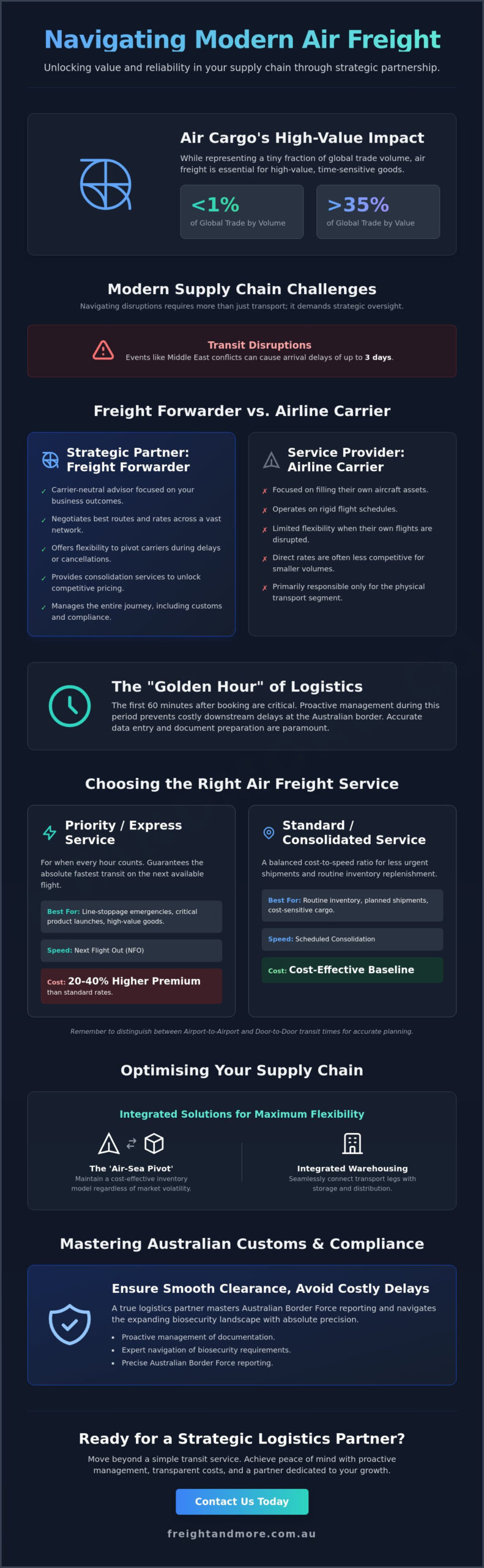
Did you know that while air cargo represents less than 1% of global trade by volume, it accounts for more than 35% of its total value? You’re likely feeling the weight of that value right now, especially as 2026 brings fresh challenges like Middle East transit disruptions that can delay arrivals by up to three days. It’s incredibly stressful to manage a supply chain when you’re dealing with unpredictable timelines, opaque billing, or a large air freight forwarding company that fails to provide the proactive updates you need to stay ahead.
We understand that you need more than just a service provider; you need a dedicated partner that views your logistics as a lever for growth. This guide will show you how to achieve total peace of mind through expert compliance management and transparent cost structures that eliminate nasty surprises. By the end of this article, you’ll know exactly how to identify a partner that masters Australian Border Force reporting requirements and navigates the expanding biosecurity landscape with absolute precision.
Key Takeaways
- Unlock the difference between simple transit and a strategic partnership with an air freight forwarding company that proactively manages every link in your supply chain.
- Learn how to choose between express and deferred services to protect your high-value commercial cargo while meeting critical delivery windows.
- Gain total peace of mind by mastering Australian Border Force compliance requirements to ensure your air shipments clear customs without costly delays.
- Discover how to leverage the ‘Air-Sea Pivot’ and integrated warehousing to maintain a flexible, cost-effective inventory model regardless of market volatility.
- Identify the essential qualities of a logistics partner that delivers global scale with the personal attention and ‘can-do’ attitude your business deserves.
Defining the Role of a Modern Air Freight Forwarding Company
In the high-stakes environment of 2026, moving goods by air requires much more than simply securing a spot in a cargo hold. While a direct airline provides the physical transport, a professional air freight forwarding company serves as the strategic architect of your entire international journey. This distinction is vital for Australian businesses that need to balance rapid transit times with the complexities of global disruptions and strict border regulations.
Freight Forwarder vs. Carrier: Why the Difference Matters
Carriers are the owners of the aircraft, focused primarily on filling their own planes and maintaining rigid flight schedules. In contrast, a freight forwarder acts as a carrier-neutral advisor that prioritizes your specific business outcomes over any single airline’s bottom line. To understand the foundational mechanics, you might ask: What is a Freight Forwarder? Essentially, they are the intermediaries who negotiate the best routes and rates across a vast network of providers. This neutrality allows them to pivot your cargo to a different airline if a flight is cancelled or delayed; this ensures your supply chain remains resilient. Forwarders also offer consolidation services, where they group smaller volumes from multiple clients into a single shipment to unlock more competitive pricing that would otherwise be reserved for industrial giants.
Why Business-Critical Cargo Requires Strategic Management
Modern logistics experts often talk about the “Golden Hour,” which refers to the first sixty minutes after a shipment is booked. This period is the most critical time for accurate data entry and document preparation, as any small error here can lead to massive delays at the Australian border later. A proactive air freight forwarding company monitors these early stages with meticulous care. They don’t just wait for a status update. Instead, they actively track terminal operations to ensure your cargo is prioritized for loading. Air Freight Forwarding is the expert coordination of global air assets. This model shifts the relationship from a simple transaction to a true partnership. By acting as your advocate within the global aviation network, a forwarder manages the “unseen” variables of transport, from fuel surcharge fluctuations to terminal handling bottlenecks, allowing you to focus on growing your business. For a broader understanding of how professional freight forwarding services can transform your entire international supply chain, it’s worth exploring the full scope of what a strategic logistics partner can deliver.
Evaluating Air Freight Services: Speed, Security, and Precision
Speed is the most obvious benefit of air cargo, but true value lies in the precision of the service level you choose. A seasoned air freight forwarding company helps you navigate a broad spectrum of options, ensuring you don’t overpay for speed you don’t actually need or compromise security for a lower rate. In 2026, the difference between a successful delivery and a supply chain bottleneck often comes down to how well your service level aligns with your specific cargo requirements.
Reliability in the air is underpinned by rigorous global International Air Transport Association (IATA) standards. These frameworks govern everything from dangerous goods handling to the structural integrity of unit load devices (ULDs). For Australian importers, adhering to these standards isn’t just about safety; it’s about ensuring your cargo moves through international hubs without compliance-related friction. If you’re moving high-value commercial goods or temperature-sensitive perishables, these protocols are your first line of defense against loss, spoilage, or damage.
Standard vs. Priority Air Cargo: Finding the Right Balance
Not every shipment requires “Next Flight Out” (NFO) status. While NFO guarantees the absolute fastest transit by placing your goods on the first available commercial or freighter flight, standard consolidated air freight often provides a more balanced cost-to-speed ratio for routine inventory replenishment. It’s vital to distinguish between airport-to-airport and door-to-door transit times. The former only accounts for the flight itself, while the latter includes the critical local transport from the terminal to your warehouse. In the current market, priority handling comes with a premium, often 20-40% higher than standard rates. You’ll want to reserve this for line-stoppage emergencies or high-stakes product launches where every hour counts.
Security Standards and Cargo Handling for High-Value Goods
Security is a multi-layered process that begins long before the aircraft takes off. Achieving “Known Shipper” status can significantly reduce your screening times at major Australian hubs. This status signals to authorities that you’ve met specific security criteria, allowing for faster processing through terminal checkpoints. Beyond screening, modern tracking technologies now offer real-time visibility into more than just location. You can monitor light exposure, tilt, and temperature to ensure your cargo’s condition remains pristine throughout the flight. When preparing goods for high-altitude transit, remember that air pressure changes require specialized packaging. Double-walled corrugated boxes and proper internal cushioning are essential to prevent damage during the rapid ascent and descent phases of the journey. If you’re unsure which service level fits your current inventory needs, exploring integrated air solutions can help clarify your best path forward.
Navigating Australian Customs Compliance for Air Cargo
Speed is the primary reason you choose air transport. However, that advantage evaporates if your cargo sits in a bonded warehouse for days due to paperwork errors. An experienced air freight forwarding company understands that air cargo customs clearance requires a much faster cadence than sea freight. While sea shipments might have days or weeks for document preparation, air cargo reporting deadlines are exceptionally tight. In fact, electronic cargo reports must be lodged with the Australian Border Force (ABF) at least two hours before the aircraft touches down at its first Australian airport. If this window is missed, your cargo won’t just be delayed; it may be subject to significant penalties.
The ABF maintains a constant, rigorous presence at air terminals. They aren’t just looking for prohibited items; they’re auditing data accuracy with increasing intensity. In 2026, the Department of Agriculture, Fisheries and Forestry (DAFF) has expanded its Air Cargo Compliance Verification (ACCV) program. This involves more frequent random inspections of even low-value goods to ensure total biosecurity compliance. If your descriptions are vague or your tariff classifications are incorrect, your shipment will be flagged for manual review. This doesn’t just cause delays. It leads to terminal storage fees that can quickly exceed the value of the goods themselves.
Essential Documentation for Seamless Border Clearance
The Air Waybill (AWB) is the heart of your shipment. It acts as the non-negotiable contract between the shipper and the carrier, detailing exactly what is on board and where it’s going. Beyond the AWB, your commercial invoices and packing lists must be pristine. Every detail is fed into the Integrated Cargo System (ICS), and any discrepancy between these documents can trigger a red flag. Working with a licensed Customs Broker who specializes in high-speed air processing ensures that your data is scrubbed and verified before the plane even leaves its origin. It’s about being proactive rather than reactive.
Managing Duties, Taxes, and GST to Avoid Hidden Costs
Calculating the ‘Value of the Goods’ (VOTG) for air-imports is a precise science. It’s important to remember that the threshold for a Self-Assessed Clearance (SAC) declaration remains A$1,000 or less. For anything above this value, you’ll need a formal Import Declaration. A proactive air freight forwarding company will identify applicable Free Trade Agreements (FTAs) early in the process. These agreements can slash your duty overheads significantly if the origin of the goods is correctly documented. By managing these financial elements before the plane touches down, you eliminate the “sticker shock” of unexpected GST or duty bills once the cargo arrives on Australian soil.
Optimising Your Supply Chain with Integrated Air Freight
Strategic air freight is more than a fallback for emergencies; it’s a sophisticated lever for supply chain optimization. A proactive air freight forwarding company works with you to implement an “Air-Sea Pivot” strategy. This involves using sea freight for your base inventory and air freight to respond rapidly to unexpected demand or seasonal spikes. By integrating these modes, you maintain high service levels without the massive capital investment required to hold months of safety stock in an Australian warehouse. It’s about being agile enough to capture market opportunities as they happen.
In 2026, balancing speed with sustainability is a key priority for corporate entities and entrepreneurs alike. While air transport has a higher carbon footprint, many airlines now offer “green surcharges” that contribute to Sustainable Aviation Fuel (SAF) programs. A strategic partner helps you calculate the environmental impact of your choices, allowing you to meet your corporate social responsibility goals without sacrificing the speed your customers expect. This holistic approach ensures your logistics are both fast and future-proof.
Cost-Benefit Analysis: When is Air Freight the Smarter Choice?
Choosing air over sea is a financial decision that goes beyond the freight invoice. You must calculate the cost of being “out-of-stock,” which includes lost sales, damaged brand reputation, and potentially lost shelf space. Faster transit times also mean your capital isn’t tied up in “floating inventory” for forty days. Instead, that cash is back in your business within a week. Use the comparison below to see how these modes impact your operations:
- Speed: Air (1-5 Days) vs. Sea (20-45 Days)
- Cost: Air (Premium/Per KG) vs. Sea (Economical/Per Cubic Metre)
- Reliability: Air (High/Daily Flights) vs. Sea (Moderate/Subject to Port Congestion)
- Capital Liquidity: Air (Fast Turnover) vs. Sea (Capital Tied Up in Transit)
Leveraging Warehousing and Local Transport for End-to-End Speed
The journey doesn’t end when the wheels touch the tarmac. To truly optimize your supply chain, you need seamless integration with warehouse management and local transport. Bonded warehousing is a particularly powerful tool for Australian importers. It allows you to store your goods near the market while deferring GST and duty payments until the items are actually sold. This “just-in-time” model, coordinated by a dedicated air freight forwarding company, ensures that the speed gained in the air isn’t lost on the ground during the final mile. For businesses routing cargo through Australia’s largest logistics hub, understanding the full scope of freight handling services in Sydney can help you eliminate costly ground-level delays. If you’re ready to refine your logistics strategy, contact our team for a tailored air freight quote today.
Partnering with Freight and More Pty Ltd for National Logistics Excellence
Choosing the right air freight forwarding company is ultimately about finding a partner that matches your own business ambition. At Freight and More Pty Ltd, we pride ourselves on a “can-do” attitude that transforms complex global logistics into streamlined, predictable workflows. We recognize that while our network spans the globe, your focus is firmly on the Australian market. This unique perspective allows us to provide the massive scale of an international network while maintaining the meticulous, personal attention that only a locally focused expert can offer. We don’t just move boxes; we manage your reputation by ensuring your promises to your customers are kept every single time.
Reliability is built on a foundation of transparent communication. You’ll never find yourself chasing updates or wondering where your cargo is held up. Instead, we provide proactive insights that keep you ahead of the curve. Whether you are a high-level corporate entity or a growing entrepreneur, the team at Freight and More Pty Ltd treats your cargo with the same level of professional care and urgency. We thrive on solving the “impossible” and take immense pride in our ability to navigate the shifting sands of the global aviation landscape with confidence and poise.
Our Proactive Approach to Logistics Management
We don’t wait for a delay to happen before we start looking for a solution. Our proactive management style means we are constantly monitoring flight schedules, terminal congestion at major Australian hubs, and evolving border regulations to intercept potential issues before they impact your timeline. Because efficient movement around these hubs is essential for timely delivery, we invite you to discover ML Traffic Engineers Australia and their specialized transport planning services. When you partner with us, you are assigned a dedicated account manager who takes the time to understand your specific business goals and inventory cycles. This personal connection is the difference-maker. For example, when a client recently faced a critical shortage of specialized medical equipment during a period of peak transit disruptions, our team didn’t just report the delay. We immediately secured space on a dedicated freighter through an alternative regional hub, ensuring the shipment arrived in time for a hospital opening and avoiding significant operational setbacks.
Moving Forward with a Bespoke Air Freight Strategy
Every business has a unique rhythm, and your logistics strategy should reflect that. Our process begins with a comprehensive supply chain audit where we identify opportunities to improve speed and reduce your total landed costs. We believe in total transparency, which is why our quoting process is clear and all-inclusive. You won’t find hidden terminal fees or surprise surcharges in our documentation. We provide you with the data and the expert advice you need to make informed decisions about your international logistics. It’s time to experience a level of service that goes beyond industry norms. Contact our expert team to discuss your air freight requirements today and discover how a strategic partnership with an experienced air freight forwarding company can accelerate your global growth.
Take Control of Your Global Logistics Strategy
You’ve discovered how the right air freight forwarding company functions as much more than a simple service provider; they are the strategic architects of your international success. By mastering the nuances of Australian Border Force compliance and balancing the “Air-Sea Pivot” strategy, you can turn your logistics into a significant competitive advantage. We’ve explored the importance of proactive communication and the peace of mind that comes from transparent, end-to-end cost structures that eliminate hidden terminal surprises.
Since 2009, Freight and More Pty Ltd has built a reputation for excellence by combining deep industry expertise with a robust global network of agents for total door-to-door reliability. Our in-house, licensed Australian Customs Brokerage services ensure your cargo bypasses common terminal bottlenecks with absolute precision. We’re here to remove the obstacles from your path and help your business thrive on the global stage with confidence and scale.
Ready to accelerate your supply chain? Get a tailored air freight quote today!
We look forward to becoming your dedicated partner and solving your most complex shipping challenges with our signature “can-do” energy and professional care!
Frequently Asked Questions
What is the difference between an air freight forwarder and a courier?
An air freight forwarder manages large scale commercial shipments and complex logistics strategies, while a courier typically focuses on small parcel delivery for retail or individual needs. Forwarders act as strategic partners that negotiate with multiple airlines to find the best routes for bulk cargo. If you are moving heavy machinery, palletised stock, or high value commercial goods, a forwarder provides the professional scale and customs expertise you need.
How are air freight charges calculated (Actual vs. Volumetric weight)?
Airlines calculate costs based on “chargeable weight,” which is whichever is higher between the actual physical weight and the volumetric weight. You find the volumetric weight by multiplying the length, width, and height of your cargo in centimetres and dividing by 6,000. This ensures that bulky but light items, such as large foam components, are priced fairly based on the significant space they occupy in the aircraft hold.
Do I need a customs broker for my international air freight shipments?
Yes, engaging a licensed customs broker is vital for ensuring your commercial goods comply with Australian Border Force (ABF) regulations and avoid costly terminal delays. They handle the complex task of tariff classification and duty management to protect your business from penalties. A professional air freight forwarding company often provides these brokerage services in-house to ensure your cargo moves seamlessly from the tarmac to the warehouse.
What are the standard transit times for international air freight to Australia?
Standard transit times generally range from 1 to 5 days depending on the origin and the specific service level you select. Priority “Next Flight Out” options can reach Australian terminals in as little as 24 to 48 hours, whereas consolidated services offer a more economical path over 4 to 5 days. You should always account for an additional 1 to 2 days for local transport and customs clearance once the aircraft lands.
Can an air freight forwarding company handle dangerous goods or perishables?
Specialised forwarders are fully equipped to handle dangerous goods, chemicals, and temperature sensitive perishables by following strict IATA safety protocols. These shipments require expert packaging and precise documentation to ensure they remain stable and compliant throughout the flight. If your cargo includes lithium batteries or fresh produce, your partner will coordinate the specific cold chain or safety requirements needed for a successful arrival.
How can I reduce the costs of my business’s air freight shipments?
You can lower your expenses by consolidating multiple small shipments into a single larger one or by opting for deferred air services when your timeline allows. Optimising your packaging to eliminate dead space will also reduce your volumetric weight and lead to lower chargeable costs; for example, leveraging custom packaging solutions from Micro Printing can help ensure your items are packed efficiently and securely for international transit. A proactive air freight forwarding company will audit your shipping patterns to identify these savings while maintaining the speed your supply chain requires.
What documents are required for importing goods via air into Australia?
The essential documents include the Air Waybill (AWB), a detailed commercial invoice, and a comprehensive packing list that matches your cargo exactly. You may also need a Certificate of Origin to access duty concessions under various Free Trade Agreements or specific biosecurity permits for certain goods. Accuracy is critical here, as any discrepancy between these documents can lead to the ABF holding your shipment for manual inspection.
Is air freight insurance necessary for my commercial cargo?
Cargo insurance is highly recommended because carrier liability is strictly limited by international treaties and rarely covers the full commercial value of your goods. If a shipment is lost or damaged during transit, standard airline compensation may only cover a fraction of your actual financial loss. Securing comprehensive insurance ensures your business capital is protected and gives you total peace of mind throughout the global shipping process.
