Import Customs Clearance Australia: The 2026 Essential Business Checklist

Did you know that over 95% of Chinese imports now enter the country duty-free under ChAFTA, yet many businesses still lose thousands to avoidable storage fees and classification errors? It’s incredibly frustrating to watch your cargo sit idle at the wharf while costs mount, especially when you’re trying to decipher complex government acronyms like ICS or SAC. You deserve a partner who turns the daunting task of import customs clearance australia into a streamlined, predictable part of your supply chain. We understand that the fear of biosecurity holds or unexpected GST calculations can disrupt even the most meticulous business plans!
If you’ve ever felt overwhelmed by shifting regulations or the intricacies of the 2026 Federal Budget, you’re certainly not alone. This guide provides the ultimate roadmap to mastering Australian border regulations with a comprehensive checklist designed for absolute compliance. We’ll walk you through the July 1 tariff adjustments for electronics and machinery, explain the latest biosecurity screening fees, and show you exactly how to ensure your cargo clears customs without a single day of delay.
Key Takeaways
- Identify the critical roles of the Australian Border Force and biosecurity officials to ensure your cargo meets all security and health standards before arrival.
- Determine if your shipment exceeds the A$1,000 threshold to choose the correct import customs clearance australia pathway and avoid unnecessary administrative penalties.
- Prepare meticulous pre-shipment documentation, including currency-specific invoices and detailed packing lists, to satisfy the Department of Agriculture, Fisheries and Forestry.
- Accurately calculate your 10% GST and standard 5% customs duties to maintain total control over your import budget and avoid surprise costs at the wharf.
- Leverage the expertise of a licensed customs broker to manage complex classifications and shift the burden of legal compliance away from your internal team.
Navigating the Australian Import Landscape: Why Compliance is Your Best Strategy
Success in the Australian market starts long before your vessel docks at an Australian port. Achieving seamless import customs clearance australia is effectively your legal green light to enter the local economy. It’s a sophisticated process where your cargo is vetted against strict national standards to ensure every item is accounted for and every cent of tax is paid. By viewing compliance as a proactive business strategy rather than a bureaucratic hurdle, you protect your bottom line from the very start. It’s about being prepared, being precise, and being professional.
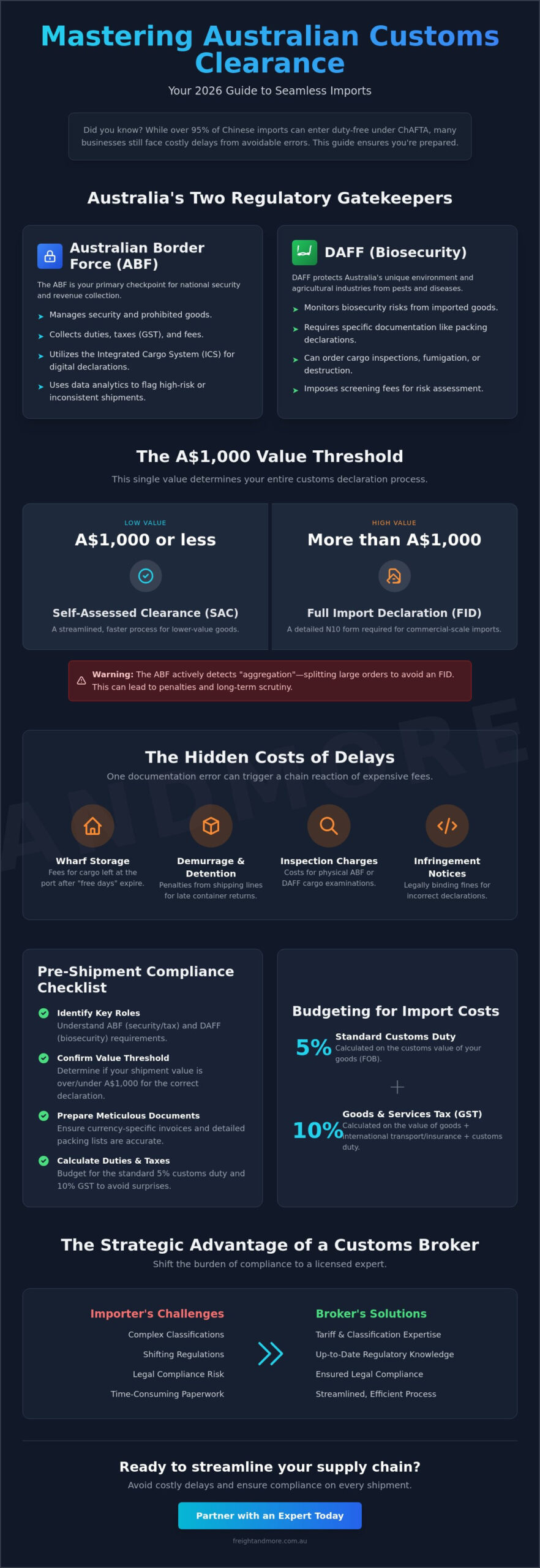
The regulatory environment in 2026 is defined by a dual-gatekeeper system that demands your attention. On one side, the Australian Border Force (ABF) manages revenue collection and national security. On the other, the Department of Agriculture, Fisheries and Forestry (DAFF) monitors biosecurity risks to protect our unique environment. This year, the move toward digitized, automated reporting has accelerated. While this means the process is faster for compliant businesses, the margin for error has narrowed significantly. Modern systems catch mistakes that manual reviews used to miss.
The Role of the Australian Border Force (ABF)
The ABF acts as the primary shield against prohibited goods and trade mark infringements. Their objective is to ensure every shipment pays its fair share of duties and taxes while keeping our borders secure. To manage the massive volume of trade, they rely heavily on the Integrated Cargo System (ICS), which serves as the digital backbone of Australian trade. “In 2026, the ABF utilizes advanced data analytics to flag high-risk consignments before they even reach Australian waters.” If your data is inconsistent, the system identifies it instantly. Precision in your reporting isn’t just helpful; it’s a requirement for staying off the radar of manual auditors.
The Hidden Cost of Customs Delays
Poor preparation leads to expensive consequences that can quickly erode your profit margins. When paperwork contains errors or missing information, it triggers a chain reaction of costs. You might face wharf storage fees, which kick in after your “free days” expire; these daily rates escalate rapidly. Then there are demurrage and detention fees paid to the shipping line for the late return of containers. If the ABF or DAFF flags your cargo for a physical check or X-ray, you’ll also be billed for those inspection charges. Avoiding these traps requires understanding import costs in Australia before you ship. Infringement notices for incorrect declarations are legally binding and can lead to long-term scrutiny of your future shipments. We’re here to ensure your documentation is bulletproof so you never have to deal with these avoidable drains on your resources.
The High-Stakes Threshold: Understanding SAC vs. Full Import Declarations
In the world of logistics, a single dollar can change your entire administrative workload. The A$1,000 threshold represents the most significant line in the sand for any business managing import customs clearance australia. If your consignment’s value sits at or below this amount, you typically utilize a Self-Assessed Clearance (SAC) declaration. It’s a streamlined, efficient process designed for lower-value trade. However, once your goods exceed that A$1,000 mark, you must lodge an N10 Full Import Declaration (FID). Don’t try to bypass this requirement by splitting one large order into multiple small packages from the same supplier; the ABF is highly vigilant about “aggregation” and will combine these shipments to apply the correct duties and taxes.
Choosing the right declaration type isn’t just about the value; it’s about the nature of the goods themselves. While a SAC is often faster, it doesn’t offer the same level of detail as a full FID, which is required for the ABF to accurately assess risks and collect revenue on commercial-scale imports. Staying compliant means understanding exactly which category your shipment falls into before it leaves the origin port. If you’re unsure about your cargo’s classification, speaking with an expert in customs clearance can prevent a simple filing error from becoming a major border delay.
When a SAC Declaration is Not Enough
Even if your shipment is worth only A$200, some items never qualify for the simplified SAC process. These are known as “excisable goods,” specifically alcohol and tobacco products. These items require a full FID regardless of their monetary value to ensure all heavy excise duties are captured. Meeting all Importer requirements is essential here to avoid costly legal complications. Attempting to undervalue your cargo to slip under the A$1,000 limit is a serious offense that leads to heavy fines and increased scrutiny. For sea cargo in 2026, the Import Processing Charge (IPC) is A$50.70 per consignment, a standard cost of doing business that ensures your goods are processed legally and safely.
Declarations for Licensed Warehouses (N20)
For businesses with high inventory turnover or those waiting for the right market conditions, the N20 Warehouse Declaration is a powerful strategic tool. This specific declaration allows you to move goods into a licensed “bonded” warehouse without paying GST or duty immediately. You only settle these costs when the goods are “ex-warehoused” for local sale or distribution. This strategy is a cornerstone of smart warehouse management, allowing you to preserve cash flow while keeping stock ready on Australian soil. It’s an excellent way to scale your operations and manage your tax liabilities more effectively as you grow.
The Essential Pre-Shipment Documentation Checklist for Australian Importers
Precision in your paperwork is the single most effective way to guarantee a smooth transition through the border. Think of your documentation as the digital passport for your cargo; if the details are fuzzy, the journey stops. To master import customs clearance australia, you must ensure every document in your pre-shipment file is accurate, consistent, and ready for inspection. Incomplete records are the leading cause of avoidable delays and unexpected costs at the wharf. We’ve compiled this essential checklist to help you verify your file before your goods even leave the origin port.
- The Commercial Invoice: This is your primary transaction record. It must clearly state the currency (e.g., AUD), the agreed Incoterms, and a precise description of every item.
- The Packing List: This document is vital for DAFF. It allows biosecurity officers to identify exactly which pallets or containers hold specific materials, especially those containing high-risk items.
- Bill of Lading (B/L) or Air Waybill (AWB): These serve as both your contract of carriage and your proof of ownership. Without the original or a telex release, your cargo stays locked at the terminal.
- Packing Declarations: If you’re using sea freight, this is a mandatory requirement. You must declare whether timber, straw, or other organic packing materials were used to satisfy Australia’s strict biosecurity laws.
Commercial Invoice Requirements for 2026
Vague descriptions are a major red flag for the ABF. In 2026, labelling commercial shipments as “Samples” or “Gifts” simply won’t work for business imports; it triggers immediate manual audits. You must include the correct Harmonized Tariff Schedule (HTS) codes for every product line. Ensure your supplier separates the actual cost of goods from freight and insurance charges. This separation is critical for an accurate valuation, as GST is calculated on the total Value of the Taxable Importation (VoTI).
Certificates of Origin and Preference
Capturing the benefits of Australia’s various Free Trade Agreements (FTAs) requires a valid Certificate of Origin. For example, with over 95% of Chinese imports carrying zero duty under ChAFTA, missing this document means you’re literally leaving money on the table. It’s important to distinguish between a standard certificate and a “Preferential” certificate, as only the latter unlocks specific duty-free rates. Managing these technicalities is a core part of professional Australian customs brokerage fees, ensuring you pay the lowest legal amount of duty possible. We take pride in helping you navigate these nuances so your business remains competitive and compliant.
Beyond Paperwork: Managing Duties, Taxes, and Biosecurity Requirements
Managing the financial and biological gatekeepers of the border is where your logistics strategy truly pays off. Once your documentation is in order, the focus shifts to the accurate calculation of government revenue and the protection of Australia’s unique ecosystem. The standard 10% GST is calculated on the Value of the Taxable Importation (VoTI), which encompasses the customs value of your goods, any customs duty payable, and the total cost of transport and insurance. While a general 5% customs duty applies to many manufactured goods, this rate varies significantly by product category. It’s vital to remember that biosecurity is often the most overlooked part of import customs clearance australia, yet it causes the most significant delays if handled incorrectly.
Many importers are caught off guard when their wood or bamboo products are held by the Department of Agriculture, Fisheries and Forestry (DAFF). These organic materials are high-risk for pests like the Brown Marmorated Stink Bug, requiring specific treatment certificates or physical inspections to protect local industry. Beyond duties, you must also budget for the Biosecurity Protection Levy and other DAFF-related charges, such as document assessment fees and physical inspection costs. These fees are a small price to pay for environmental safety, but they must be factored into your landed cost calculations to maintain accurate budgeting.
Minimising Costs via Free Trade Agreements (FTAs)
Australia’s extensive network of Free Trade Agreements offers a massive competitive advantage for proactive businesses. Currently, agreements like ChAFTA, AUKFTA, and the CPTPP allow for reduced or eliminated duty rates on a vast array of goods. If your product doesn’t have an Australian-made equivalent, a professional broker can also identify “Tariff Concession Orders” (TCOs) to further lower your costs. “Utilising a valid FTA can reduce your customs duty from 5% to 0%, significantly impacting your bottom-line profitability.” We pride ourselves on identifying these savings early in the process to ensure you never pay more than necessary.
DAFF and the Biosecurity Integrated Cargo System
The DAFF oversight process is rigorous and highly methodical. For machinery and vehicles, “Cleanliness Declarations” are mandatory to prove the cargo is free of soil and organic debris. Many containers undergo “Tailgate Inspections,” where officers open the doors to check for signs of infestation or prohibited packing materials. If a risk is identified, your cargo may require immediate treatment, such as fumigation or heat treatment, at a licensed facility. If you want to ensure your cargo meets every biosecurity requirement without the stress, our expert team is ready to manage your customs clearance with total precision.
Streamlining Your Supply Chain: The Strategic Advantage of Professional Customs Brokerage
While some businesses attempt a “DIY” approach to save on upfront costs, the reality is that import customs clearance australia is a high-stakes legal environment where a single misclassification can lead to significant fines. When you partner with a licensed customs broker, you aren’t just hiring a service provider; you’re strategically transferring the legal liability for accurate classification under the Customs Act. This shift provides immense peace of mind, as the responsibility for navigating the thousands of tariff lines and complex concession orders rests with an expert. We bring a proactive “can-do” attitude to every shipment, managing the intricate permits and exemptions that would otherwise stall your supply chain for weeks.
At Freight and More Pty Ltd, we believe that logistics should be a competitive advantage rather than a source of stress. By integrating our specialized clearance expertise with air freight forwarding and sea freight solutions, we create a seamless end-to-door experience. Your cargo doesn’t just move; it flows through the border because we’ve already cleared the path before the vessel even docks. We handle the heavy lifting of government reporting so you can stay focused on what you do best: growing your business and serving your customers.
Why a Broker is a Profit Protector, Not an Expense
Think of your broker as a dedicated financial advocate. We prevent the overpayment of duties by identifying the most precise tariff classifications and applying any relevant Free Trade Agreement benefits you might have missed. Faster clearance is the key to avoiding the punishing daily rates of port storage and terminal handling penalties that accumulate when cargo is held for manual review. We proactively monitor every shipment, ensuring that lodgements occur well before arrival. This meticulous attention to detail ensures your cargo is released the moment it hits the wharf, keeping your local transport schedules on track and your customers happy.
Next Steps: Getting Your First Shipment Cleared
Starting your journey with a professional partner is a straightforward process that begins with a clear exchange of information. To provide an accurate initial quote, we’ll need to review your commercial invoice and packing list to assess the cargo’s value and nature. Once you’re ready to proceed, you’ll sign a “Letter of Authority” (LOA). This legal document allows us to act on your behalf with the ABF and DAFF, empowering us to manage your import customs clearance australia with total authority. We encourage you to engage a partner who offers end-to-door logistics, ensuring that your international sea or air freight is matched with expert local transport and warehouse management for a truly robust supply chain.
Secure Your Supply Chain Success in 2026!
Mastering the intricacies of the Australian border requires more than just filling out forms; it demands a proactive strategy that anticipates every regulatory requirement. By prioritizing precise documentation and understanding the critical distinction between SAC and FID pathways, you position your business to bypass the common traps of wharf storage fees and biosecurity holds. Effective import customs clearance australia is ultimately about maintaining total control over your landed costs while ensuring your goods move through the terminal with absolute speed. Precision at the origin port translates directly to success at the destination.
You don’t have to navigate these complex government systems alone. With over 15 years of industry expertise, our team of Licensed Australian Customs Brokers provides a seamless integration between international sea or air freight and local delivery. We’re dedicated to removing every obstacle in your path with a proactive, detail-oriented approach that protects your profit margins and ensures total compliance. Request a tailored customs clearance quote from Freight and More today and experience the confidence that comes with a truly reliable logistics partner. Let’s make your next shipment your smoothest one yet!
Frequently Asked Questions
How long does customs clearance take in Australia?
Standard import customs clearance australia typically takes between 24 and 48 hours for sea freight once the vessel arrives, while air freight is often processed within the same business day. These timelines rely heavily on the accuracy of your digital lodgement and the speed of the Integrated Cargo System. If the Australian Border Force or biosecurity officials flag your cargo for a physical inspection or tailgate check, the process can extend by several days.
Can I clear my own commercial goods through customs without a broker?
You’re legally permitted to lodge your own declarations, but managing commercial shipments without a licensed professional is incredibly risky for your business. The technical requirements for classifying goods and navigating the Customs Act are vast, leaving you personally liable for any errors or underpayments. Most successful importers choose to partner with an expert to ensure their import customs clearance australia is handled with the precision required to avoid heavy infringement notices.
What is the current GST threshold for Australian imports?
The threshold for a full Import Declaration is A$1,000, but it’s a common misconception that goods under this value are always tax-free. Since July 2018, GST applies to most low-value goods imported by consumers in Australia. For commercial entities, ensuring you have the correct documentation for shipments of any value is essential to claim your input tax credits and maintain a transparent relationship with the Australian Taxation Office.
What happens if my goods are seized by the Australian Border Force?
If the Australian Border Force (ABF) seizes your cargo, they’ll issue a formal Seizure Notice outlining the specific legal grounds for the action. You generally have 30 days to lodge a claim for the return of the goods or to challenge the seizure in court. Seizures typically occur when goods are prohibited, restricted without a permit, or found to be counterfeit, potentially leading to the permanent forfeiture and destruction of your inventory.
How much are customs brokerage fees in Australia for 2026?
Fees for professional brokerage services in 2026 are determined by the complexity of your shipment, the number of tariff lines involved, and your total annual volume. Every business has unique needs, so costs are tailored to the specific level of management and technical expertise required for your cargo. While we don’t provide fixed price lists here, investing in a professional ensures you avoid the far more expensive penalties associated with incorrect duty payments or terminal delays.
What is a Tariff Concession Order and how do I apply for one?
A Tariff Concession Order (TCO) is a legal instrument that allows you to import specific goods duty-free if no equivalent items are produced in Australia. You must lodge a formal application with the ABF, providing detailed technical evidence that no local manufacturer produces “substitutable goods.” If successful, a TCO can permanently reduce your customs duty from 5% to 0%, providing a significant long-term boost to your bottom-line profitability.
Do I need a specific import permit for my products?
Whether you need a permit depends entirely on the nature of your products and their intended use within the Australian market. Items such as industrial chemicals, certain electronics, and specific agricultural products often require pre-approval from departments like DAFF or the Department of Health. It’s vital to secure these permits before your goods leave the origin port, as arriving without the correct authorization can lead to immediate seizure or mandatory re-export.
How is the customs value of my goods calculated?
The customs value is primarily calculated using the “transaction value” method, which is the price actually paid or payable for the goods when sold for export to Australia. This value must include specific additions like commissions, royalties, and packing costs, while potentially excluding certain post-importation charges. Accurate valuation is critical because it forms the basis for all duty and GST calculations, ensuring you contribute the correct amount of revenue to the Australian government.
