Logistics for Small Business in Australia: The 2026 Strategic Guide

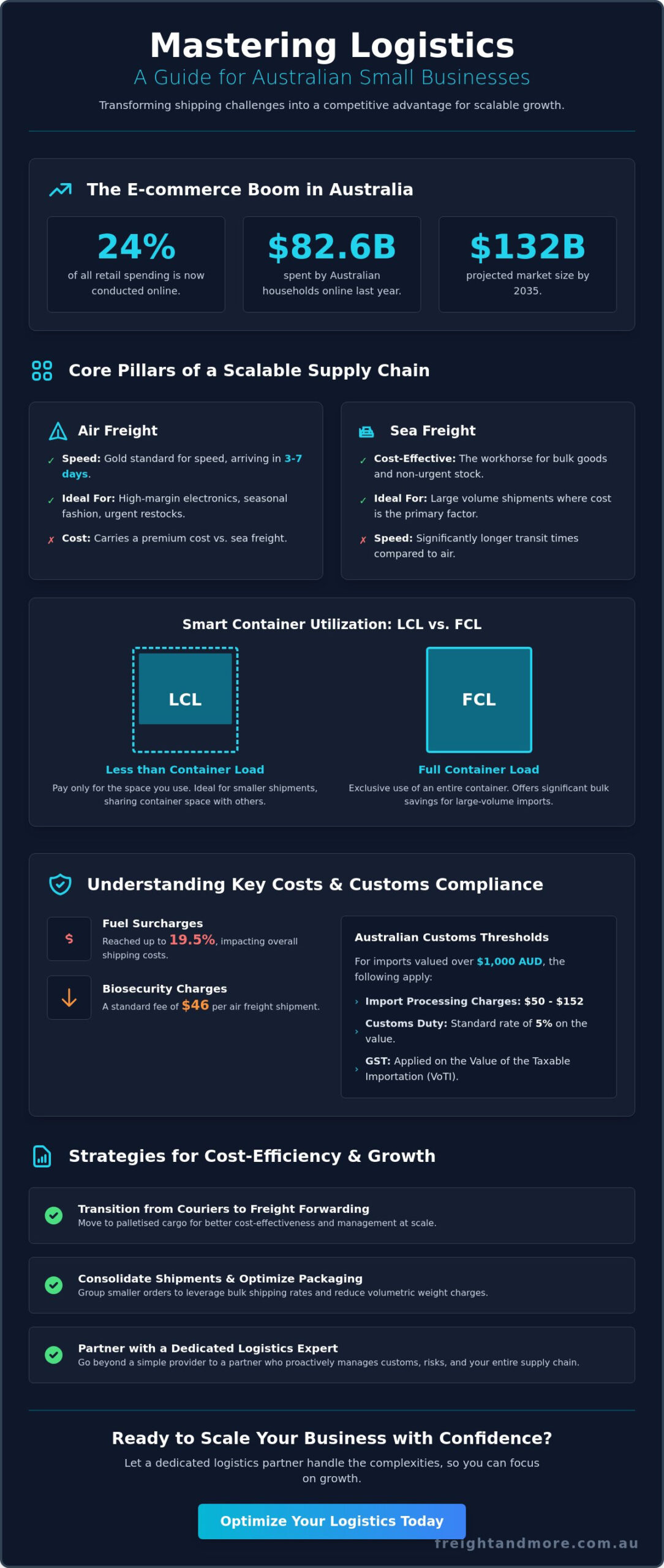
Did you know that 24% of all retail spending in Australia is now conducted online, with households spending a record $82.6 billion last year? Mastering logistics for small business australia is no longer just about moving boxes; it’s about securing your competitive edge in a market projected to reach $132 billion by 2035. You’ve likely felt the sting of rising fuel surcharges, which reached 19.5% this June, or found yourself staring at complex customs paperwork that feels like a foreign language. It’s frustrating when shipping costs eat your margins and supply chain visibility feels like a luxury you can’t afford.
We’re here to help you transform these challenges into a sophisticated growth lever. This guide empowers you to master every complexity of the Australian landscape, from customs compliance to international freight management. We’ll provide a clear framework for choosing between air and sea freight, explain the strategic benefits of LCL versus FCL shipping, and show you exactly how to avoid the customs delays that can derail your schedule. You’re about to gain the knowledge needed to reduce logistics overheads and scale your business with total confidence.
Key Takeaways
- Discover how to transition from basic courier services to a professional freight forwarding model that supports scalable, long-term growth.
- Learn how to strategically navigate international air and sea freight options, including how to leverage LCL and FCL shipping for significant bulk savings.
- Gain a clear understanding of Australian customs regulations, import duties, and GST to ensure your shipments clear the border without costly delays.
- Master the essential strategies of logistics for small business australia by consolidating shipments and optimizing packaging to reduce volumetric weight charges.
- Understand the critical difference between a simple service provider and a dedicated logistics partner who proactively manages your supply chain risks.
Understanding Logistics for Small Business in Australia
Effective logistics management involves much more than simply moving a box from point A to point B. It’s the strategic orchestration of your entire operation, ensuring that goods flow seamlessly from global suppliers to your Australian customers. By Understanding Supply Chain Management, you can begin to see logistics for small business australia as a holistic system rather than a series of isolated shipping tasks. In 2026, this distinction is vital. With fuel surcharges reaching 19.5% for domestic eParcel services this June, businesses can no longer afford a reactive approach. You need a resilient strategy that anticipates disruptions and manages costs proactively.
To better understand this concept, watch this helpful video:
The Australian market currently demands a shift from “lean” to “resilient” supply chains. This change is driven by evolving regulations, such as the mandatory climate disclosures for larger entities that now require smaller suppliers to track Scope 3 emissions. International freight also introduces complexities that domestic transport doesn’t face, including the calculation of GST on the Value of the Taxable Importation (VoTI) and the management of biosecurity charges, which currently sit at $46 per air freight shipment.
The Scope of Small Business Logistics
Modern logistics encompasses procurement, transport, warehouse management, and meticulous customs compliance. For the modern SME, logistics serves as a powerful competitive advantage that transforms simple product delivery into a seamless, trust-building customer experience. Achieving this requires end-to-end visibility. By 2026, an estimated 70% of providers use AI-driven solutions to forecast demand and optimize routes. This technology allows you to see exactly where your capital is tied up in inventory and where your shipments are at any given second.
Signs Your Business Has Outgrown Standard Couriers
If your daily operations involve managing dozens of individual parcel tracking numbers or dealing with frequent “lost in transit” claims, you’ve likely outgrown standard courier services. Moving to palletised cargo through professional freight forwarding is often more cost-effective once you reach consistent volumes. This transition requires specialized customs clearance expertise. When your imports exceed the $1,000 threshold, you face Import Processing Charges of $50 to $152, alongside standard 5% customs duties. Professional management ensures you don’t pay more than necessary while avoiding the delays that occur when paperwork is filed incorrectly.
The Core Pillars of a Scalable Australian Supply Chain
Building a resilient business requires a shift from reactive shipping to a structured, multi-modal strategy. A robust foundation for logistics for small business australia rests on three primary pillars: international freight selection, smart container utilization, and strategic local distribution. Small businesses that integrate these elements early are far better positioned to handle the 25.7% projected growth in the Australian e-commerce logistics market through 2035. This Modern Guide to Supply Chain Management highlights that a well-coordinated supply chain isn’t just a back-office function; it’s a vital driver of customer satisfaction and cash flow.
Air vs Sea Freight: Making the Right Call
Speed often dictates your choice between air and sea. International air freight remains the gold standard for high-margin electronics, seasonal fashion, or urgent restocking, typically arriving within 3 to 7 days. While faster, it carries a premium cost that must be balanced against your product margins. Conversely, sea freight is the workhorse of global trade. It offers substantial savings for bulky goods but requires longer lead times, often spanning 14 to 45 days depending on the trade lane. If you’re unsure which method suits your current inventory cycle, you can request a tailored assessment of your specific freight requirements.
LCL and FCL Explained for Small Importers
Efficiency in sea freight often comes down to container management. Less-than-Container Load (LCL) is the natural entry point for most SMEs. You only pay for the space your goods occupy within a shared container, allowing you to maintain stock levels without the capital outlay of a full shipment. As your volume grows, graduating to Full Container Load (FCL) becomes more economical. Generally, once your shipment exceeds 15 cubic meters, FCL provides better security and lower per-unit costs. For a deeper dive into these options, consult The Ultimate Guide to Sea Freight to see which strategy aligns with your 2026 growth targets.
Warehousing and Distribution Management
Local distribution is where many businesses lose their hard-earned margins. Utilizing a Third-Party Logistics (3PL) provider allows you to scale your footprint without the heavy overhead of a long-term commercial lease. In 2026, storage costs vary significantly across Australia. NSW currently averages $4.70 per pallet per week, while VIC offers a more competitive $3.75. By outsourcing warehouse management, you gain access to sophisticated pick-and-pack systems that improve inventory turnover. This setup ensures that once your goods clear customs, they move rapidly into the local transport network for final-mile delivery, meeting the high expectations of modern Australian consumers.
Navigating Customs and Compliance Without the Stress
Customs compliance is often the most daunting hurdle in logistics for small business australia, yet it remains the legal gatekeeper of your entire international supply chain. When your goods arrive at the Australian border, they’re subject to rigorous assessment by the Australian Border Force and the Department of Agriculture, Fisheries and Forestry. As of 2026, the Import Processing Charge (IPC) sits at $50 for goods valued between $1,000 and $10,000, rising to $152 for shipments exceeding that threshold. Additionally, a biosecurity charge of $46 applies to all air freight imports. Failing to account for these specific costs, or filing incorrect documentation, can lead to expensive storage fees and significant cash flow bottlenecks.
To ensure a smooth arrival, you must maintain meticulous records. Three essential documents form the backbone of every shipment: the Commercial Invoice, the Packing List, and the Bill of Lading. These papers don’t just describe what you’re moving; they provide the legal basis for calculating the 10% GST applied to the Value of the Taxable Importation (VoTI). This value includes the customs value of your goods plus duty, freight, and insurance costs. When these documents are prepared with precision, your goods move through the terminal without the friction that stalls so many growing enterprises.
The Hidden Costs of Non-Compliance
Incorrect tariff classification is a common trap that leads to overpayment of duties or, worse, heavy penalties for under-declaration. Customs Clearance is a vital legal safeguard for importers that ensures every item is correctly categorized under the Australian Customs Tariff Act, protecting your business from the risk of audits and seizures. By securing professional Customs Clearance Services, you ensure that your 5% standard customs duty is applied accurately, or that you’re utilizing legitimate exemptions that keep your landed costs as low as possible.
Working with a Professional Customs Broker
Attempting a DIY approach to customs is a high-risk strategy that often backfires for small businesses. Professional brokers act as your dedicated advocates, identifying duty-saving opportunities through various Free Trade Agreements (FTAs) that you might otherwise overlook. They handle the complex electronic lodgements required by the Integrated Cargo System, allowing you to focus on sales while they manage the regulatory heavy lifting. For a comprehensive look at how these experts manage the border for you, read our Guide to Import Customs Clearance Australia. This partnership transforms a stressful legal requirement into a streamlined, predictable part of your business operations.
Strategies to Optimise Your Shipping Costs and Efficiency
Optimising logistics for small business australia requires a sharp eye for hidden waste and a willingness to move beyond traditional shipping habits. In a market where fuel surcharges for domestic eParcel services reached 19.5% this June, every centimetre of packaging and every day of transit time counts toward your bottom line. Strategic optimization isn’t just about finding lower prices; it’s about building a leaner, more intelligent supply chain that protects your margins while ensuring your products arrive in pristine condition. You’ve worked hard to build your inventory, so protecting those business assets with marine transit insurance is a non-negotiable safeguard against the unpredictable nature of global transit.
One of the most effective ways to drive down costs is through shipment consolidation. By grouping smaller orders into a single, scheduled movement, you can leverage volume-based rates that are typically reserved for much larger enterprises. This approach reduces the frequency of fixed fees and allows you to manage your inventory levels with greater precision. When you combine consolidation with smarter packaging choices, the cumulative savings can be transformative for your annual logistics budget.
Leveraging Local and Interstate Transport
Your domestic distribution strategy should be as nuanced as your international one. While road transport provides unmatched door-to-door speed for regional deliveries, rail freight is often the more cost-effective choice for long-haul interstate transport between major Australian hubs. Local transport providers frequently offer more flexibility than global giants, as they’re better equipped to handle specific delivery requirements or urgent “last-mile” adjustments. Optimising the port-to-door process ensures that your goods don’t sit idle at the terminal, helping you avoid the mounting storage fees that occur when local transport isn’t perfectly synchronized with customs clearance.
Reducing Logistics Overheads in 2026
Lowering your overheads starts with a rigorous review of your packaging. Carriers charge based on volumetric weight, meaning you’re often paying to ship “dead air” if your boxes are oversized. Redesigning your packaging to fit your products more snugly can lead to immediate and significant savings across your entire supply chain. When negotiating with your freight forwarder, focus on long-term consistency rather than one-off price hunting. The “cheapest” quote is rarely the best value if it lacks the proactive communication and reliable tracking needed to prevent expensive supply chain disruptions. Consult with our logistics experts today to discover how we can help you refine your shipping strategy and secure better rates for your 2026 operations.
Partnering for Growth: Why a Dedicated Forwarder Matters
Scaling logistics for small business australia requires more than just a vendor; it demands a strategic ally who understands the unique pulse of your operation. While a standard service provider merely executes a transaction, a true logistics partner functions as a dedicated extension of your team. We don’t just move cargo. We identify potential risks, optimize trade lanes, and ensure your supply chain remains a resilient engine for growth. This proactive approach is what separates a business that merely survives from one that dominates its market in 2026.
At Freight and More Pty Ltd, we take immense pride in supporting the ambitions of Australian SMEs. We recognize that every business has a distinct footprint, which is why we reject the “one-size-fits-all” mentality of global courier giants. Whether your needs involve urgent international air freight for high-demand seasonal stock or a complex international sea freight strategy to manage bulky inventory, we provide the meticulous care and expert-led advice you need to thrive. Our commitment is to remove the obstacles that stand between you and your global customers, allowing you to focus on what you do best: building your brand.
The Freight and More Advantage
Our competitive edge lies in a sophisticated combination of a vast global network of agents and deep-seated local Australian expertise. This synergy allows us to offer a comprehensive “door-to-door” service model that eliminates the stress of managing multiple vendors. We handle the entire journey, from supplier pickup and international transit to Explore Our Full Range of Logistics Services, including local transport and specialized warehouse management. This integrated approach ensures total visibility and accountability at every stage of the journey, giving you the confidence that your goods are in expert hands.
Next Steps for Your Small Business
Moving from a fragmented shipping process to a streamlined supply chain is a bold step toward professional excellence. To prepare for your first consultation, gather your recent shipping data and identify the specific customs or transit delays that have impacted your cash flow. When you sit down with a forwarder, ask for a comprehensive quote that includes all potential charges, such as biosecurity fees and customs duties, to ensure you have a transparent view of your landed costs. This level of preparation allows us to tailor a solution that fits your specific margins and growth targets.
Secure Your Future Growth with a Resilient Supply Chain
Mastering logistics for small business australia represents the most significant shift you can make to move from a reactive operation to a scalable global brand. By transitioning to professional freight forwarding and implementing a structured approach to customs compliance, you eliminate the friction that stalls so many Australian enterprises. Efficiency isn’t just about the lowest price; it’s about building a supply chain that responds to market shifts with precision and reliability. You’ve now seen how strategic consolidation and multi-modal transport can protect your margins while ensuring your products arrive exactly when they’re needed.
With over 15 years of Australian logistics expertise, we’re ready to function as your dedicated partner and guide. Our national coverage, supported by a vast global agent network, ensures that we can manage your shipments with meticulous care from the factory floor to the customer’s door. We take pride in providing comprehensive door-to-door freight solutions that allow you to focus on your core business while we handle the regulatory and transport heavy lifting. You don’t have to navigate these complexities alone.
Take the first step toward total supply chain confidence today. Get a Tailored Logistics Quote for Your Small Business and let’s build a more efficient future together!
Frequently Asked Questions
What is the most cost-effective way for a small business to ship to Australia?
International sea freight, specifically Less-than-Container Load (LCL) shipping, is generally the most economical choice for non-urgent shipments. By sharing container space with other importers, you only pay for the volume your goods occupy, which significantly reduces your overheads compared to air freight. It’s a strategic way to manage logistics for small business australia while keeping your landed costs competitive in a crowded market.
Do I need a customs broker for small business imports?
While engaging a customs broker isn’t a legal requirement, it’s a vital safeguard to ensure your business remains compliant with the Australian Border Force and biosecurity regulations. The risk of incorrect tariff classification or failing to account for the $1,000 import threshold is high for inexperienced importers. A broker acts as your proactive advocate, identifying duty-saving opportunities under various free trade agreements that you might otherwise miss.
How much does international freight forwarding cost for SMEs?
Total costs depend on several variables, including the weight and volume of your cargo, the chosen transport mode, and current fuel surcharges, which recently reached 19.5% for some domestic services. You’ll also need to account for the 5% standard customs duty and 10% GST on the Value of the Taxable Importation. Focus on the total value provided by a partner who prevents expensive terminal storage fees and customs delays rather than just looking for the lowest quote.
What is the difference between LCL and FCL shipping?
LCL, or Less-than-Container Load, allows you to share container space with other businesses, making it the ideal entry point for smaller volumes. FCL, or Full Container Load, gives you exclusive use of a 20ft or 40ft container for your goods. Most SMEs start with LCL to maintain lean inventory levels, only graduating to FCL once their shipment volume consistently exceeds approximately 15 cubic meters.
Can a freight forwarder help with interstate transport within Australia?
Yes, a comprehensive logistics partner manages the entire journey from the international port to your local warehouse or final customer door. This includes coordinating road or rail transport for interstate movements between major hubs like Sydney, Melbourne, and Brisbane. This end-to-end management ensures your supply chain remains seamless and efficient once your goods arrive on Australian soil, providing the flexibility that global giants often lack.
How long does customs clearance typically take in Australia?
Most shipments clear customs within 24 to 48 hours, provided your documentation is accurate and lodged correctly. Delays often occur if the Department of Agriculture requires a biosecurity inspection, which carries a $46 charge for air freight imports as of 2026. Ensuring your paperwork is filed electronically before the vessel or aircraft arrives is the best way to prevent unnecessary wait times and mounting terminal storage fees.
Is marine transit insurance necessary for small business shipments?
Marine transit insurance is a critical safeguard that protects your financial investment against loss, theft, or damage during the international voyage. Standard carrier liability is often very limited and rarely covers the full commercial value of your goods. If a shipment is lost at sea or damaged during transit, having a dedicated policy ensures your small business doesn’t suffer a devastating capital loss that could derail your growth.
What documents are required for importing commercial goods into Australia?
You must provide a commercial invoice, a detailed packing list, and a bill of lading for every commercial import. These documents are used by the Australian Border Force to verify the value of your goods and calculate the correct import duties and GST. Accuracy is paramount; discrepancies between these papers can lead to customs holds and potentially heavy penalties, so meticulous record-keeping is essential for logistics for small business australia.
