Road vs Rail Freight Australia: A Strategic Logistics Comparison for 2026

Did you know that moving cargo via rail in 2026 costs less than half as much per tonne-kilometre as road transport, while slashing your carbon footprint by a staggering 16 times? As you weigh the critical factors of road vs rail freight australia, you’re likely feeling the squeeze of volatile fuel surcharges and the mounting pressure to meet rigorous corporate ESG targets. It’s a complex landscape where the right choice can mean the difference between a bloated budget and a streamlined, resilient operation. We understand that you need more than just transport; you need a partnership that delivers results. This guide provides a comprehensive framework to help you choose the ideal transport mode to optimise your Australian supply chain for cost, speed, and sustainability. We’ll examine the mid-2026 Heavy Vehicle National Law reforms, analyze the impact of the A$1.75 billion national freight rail investment, and show you how a strategic intermodal approach can finally bring total predictability to your logistics spend.
Key Takeaways
- Master the economics of scale by identifying which high-volume, long-haul shipments are best suited for rail to achieve significant cost savings and meet ambitious sustainability targets.
- Leverage the unmatched agility of road transport for time-sensitive deliveries, ensuring your supply chain maintains the speed and flexibility required for door-to-door success.
- Utilise our strategic decision matrix to navigate the road vs rail freight australia debate, allowing you to pinpoint the exact break-even point for your specific cargo corridors.
- Discover how a proactive, intermodal approach removes operational obstacles and combines the distinct strengths of both modes for a more resilient and predictable logistics network.
- Prepare your operations for the 2026 Heavy Vehicle National Law reforms and significant government infrastructure shifts to maintain total compliance and a competitive advantage.
The Evolving Landscape of Rail and Transport in Australia
Australia’s logistics network functions as the vital circulatory system of our national trade, pumping goods across vast distances to keep the economy thriving. For years, businesses viewed transport through a binary lens, yet the conversation surrounding road vs rail freight australia has fundamentally shifted. We are now entering an era where the most successful supply chains don’t choose one over the other; they embrace a unified, intermodal mindset that leverages the specific strengths of each mode. This proactive approach ensures that your cargo moves with the precision and reliability your clients expect.
This evolution is particularly visible within the complex web of Rail transport in Australia, where historical challenges with track gauges and network connectivity are being addressed through massive federal investment. With A$1.75 billion committed to rail productivity and resilience in the 2026 budget, the infrastructure is finally catching up to the demands of modern commerce. Understanding the physical intersection of these modes is critical for both safety and operational planning, as demonstrated in this industry report:
Logistics Trends Shaping 2026
The current year marks a definitive turning point for national freight. Real-time digital tracking has moved from a luxury to a baseline requirement, providing the transparency needed to manage domestic transport with absolute confidence. This data-driven approach allows us to mitigate the impact of rising fuel prices, which continue to pressure road freight margins. As road freight rates hover between 8.36 and 9.72 cents per net tonne kilometre, the growth of high-productivity freight networks is essential for maintaining your profitability across the continent. We focus on removing these obstacles through meticulous planning and the adoption of cutting-edge logistics technology.
Integrating Local Transport with Global Trade
Your international freight success depends entirely on how effectively you bridge the gap between port arrivals and national distribution centres. If your domestic timing is off, the entire chain falters. Efficiently connecting sea freight to land-based networks ensures that your customs clearance process remains seamless and cost-effective. We act as the dedicated partner in this journey, removing obstacles at the wharf and coordinating the precise hand-off between ship, train, and truck. Expert-led transport management isn’t just about the move; it’s about the meticulous attention to detail that keeps your global trade commitments on track and your supply chain predictable.
Rail Freight: Efficiency and Scale for Long-Haul Logistics
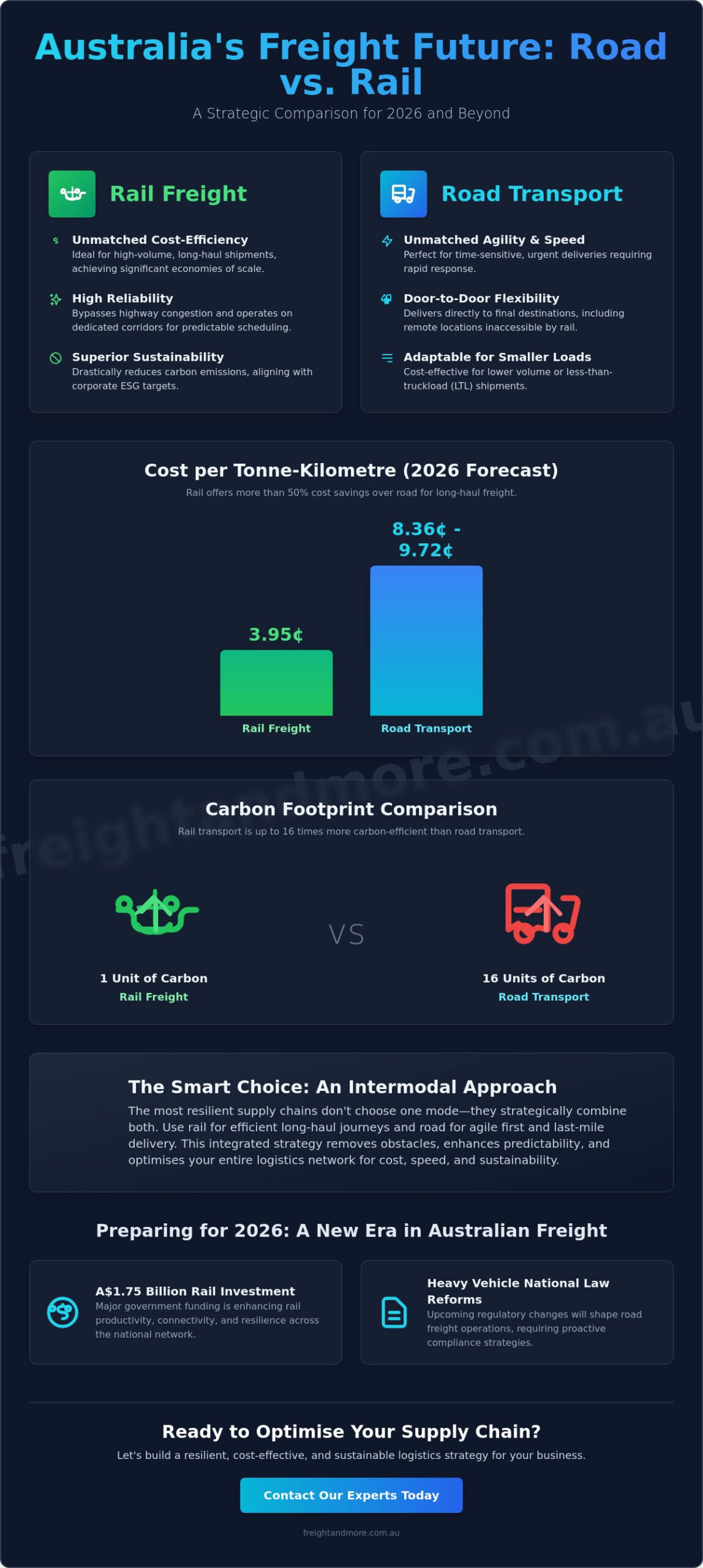
Efficiency at scale defines the Australian rail network. When your business moves high-volume, non-perishable commercial goods across the vast Australian continent, rail emerges as the undisputed gold standard for logistical efficiency. The economics are compelling; for 2026, rail freight rates are forecast at approximately 3.95 cents per net tonne kilometre, which is less than half the cost of road transport. This massive reduction in per-tonne costs on long-distance routes allows you to scale your operations without a linear increase in transport expenditure. By utilising dedicated rail corridors, your cargo bypasses the unpredictable congestion of major highways, providing a level of reliability that is essential for maintaining a steady supply chain. If you’re looking to optimise your budget while moving significant volume, discussing your long-haul requirements with our team is a proactive first step.
When to Prioritise Rail for Your Cargo
Deciding between road vs rail freight australia often comes down to distance and volume thresholds. Generally, once a route exceeds 1,000 kilometres, the cost advantages of rail become too significant to ignore. It’s the ideal choice for Full Container Load (FCL) movements where speed is less critical than cost-efficiency. While rail requires more strategic inventory planning to manage longer lead times, the predictability of the network helps you maintain stock levels without the volatility of road-based delays. We see savvy importers increasingly using rail for their base-load stock while keeping road options open for urgent replenishment.
The Sustainability Advantage in 2026
Meeting corporate ESG targets has transitioned from a boardroom discussion to a logistical necessity. Rail freight produces 16 times fewer carbon emissions per tonne-kilometre than road freight, making it the single most effective way to slash your supply chain’s environmental impact. This alignment with the National Freight and Supply Chain Strategy not only improves your brand’s green credentials but also prepares your business for future low-emission regulations. As the Australian network integrates more electric and hydrogen-powered locomotives, the sustainability gap will only continue to widen. This is a personality that is both globally minded and locally attentive, ensuring your cargo moves responsibly without sacrificing scale.
Road Transport: The Power of Flexibility and Speed
If rail is the heavy-lifting heart of the national network, road transport is the agile muscle that drives the final stage of every successful journey. The unmatched flexibility of door-to-door delivery eliminates the complexities of double-handling, ensuring your goods move from point A to point B with absolute minimal friction. When comparing road vs rail freight australia, the decision often hinges on the need for immediate responsiveness. For businesses managing time-sensitive or perishable shipments, road remains the essential choice. It provides the real-time adaptability required to pivot when port delays occur or when customer demands shift at a moment’s notice. If you require a partner who can navigate these shifts with a proactive, can-do attitude, we are ready to assist with meticulous care.
Speed and the ‘Last Mile’ Advantage
Direct routing is the primary reason road wins for urgent interstate transport requirements. Unlike rail, which relies on fixed hubs and scheduled departures, a truck can depart as soon as it’s loaded, taking the most efficient path to your destination. This agility is particularly vital for local transport and port-to-door delivery, where every hour counts toward your profitability. Additionally, road transport easily accommodates oversized or irregular cargo that cannot be moved via rail. With the 2026 Heavy Vehicle National Law reforms increasing maximum vehicle lengths to 20 metres, the capacity for road to handle diverse commercial loads has never been stronger. If you are an importer dealing with high-turnover consumer goods, we provide a tailored road solution that matches your rapid inventory cycles perfectly.
Urgent Freight Integration
Success in modern logistics requires perfect synchronisation between different modes of movement. We expertly coordinate road transport with international air freight schedules to ensure that once your high-priority cargo lands, it moves toward its destination without a second of wasted time. This integration is a necessity for cold chain operations and high-value logistics where temperature control and security are non-negotiable. Whether you are moving delicate medical supplies or high-end electronics, road transport provides the granular control needed to maintain product integrity. Road freight functions as the indispensable, rapid-response link that bridges the gap between global arrival and local delivery with unmatched precision.
Road vs Rail Freight: A Strategic Decision Matrix
Choosing between road vs rail freight australia requires a sophisticated understanding of how transit speed intersects with your bottom line. We approach this comparison not as a competition, but as a strategic puzzle where the right pieces create a high-performance supply chain. For major national long-haul corridors across the country, road transport typically offers a 24 to 36 hour transit time, whereas rail may take three to four days. However, the cost analysis tells a different story. With rail rates forecast at 3.95 cents per net tonne kilometre for 2026, compared to road’s 8.36 to 9.72 cents, the financial incentive for rail on long-haul routes is undeniable. We help you calculate the precise break-even point where the savings of rail outweigh the speed of road, ensuring your decision is backed by solid data.
Transit Time vs. Cost-Efficiency
The choice between Less than Container Load (LCL) and Full Container Load (FCL) often dictates your most economical mode. LCL shipments frequently favour road transport due to the necessity of frequent stops and consolidation at local depots. Conversely, FCL commercial shipments are the perfect candidates for rail’s massive scale. Balancing budget constraints with delivery deadlines is a delicate act that requires a proactive mindset. If your inventory planning allows for a slightly longer lead time, the reduced expenditure of rail can be reinvested into other areas of your business growth. If you’re unsure which path offers the best ROI for your current cargo, request a tailored logistics comparison from our experts.
Operational Risk and Security
Risk management is where a dedicated logistics partner truly proves their value. Road transport faces challenges from highway closures, seasonal weather impacts, and the evolving safety requirements of the mid-2026 Heavy Vehicle National Law reforms. These reforms introduce a two-tier accreditation system and stricter “Unfit to Drive” duties, which require meticulous compliance management to avoid delays. Rail, while generally more secure for heavy commercial cargo, is subject to fixed maintenance schedules and specific terminal access. Your choice of transport also influences your marine transit insurance considerations; rail often carries a lower risk profile for certain types of physical damage during transit. We ensure that your contingency planning is robust, providing digital monitoring across both modes so you never lose sight of your investment. Whether it’s a sudden road closure on a remote national route or a rail terminal delay, our “can-do” attitude ensures obstacles are removed before they impact your schedule.
Integrated Logistics: How Freight and More Pty Ltd Optimises the Journey
The debate of road vs rail freight australia often presents these modes as competitors, yet we see them as complementary forces within a single, high-performance strategy. We take pride in our proactive “can-do” approach, which transforms complex intermodal logistics into a seamless operational flow for your business. By moving beyond a binary choice, we help you harness the scale of rail for long-haul efficiency while maintaining the rapid-response capability of road for the final mile. Our role is to function as your dedicated guide, removing every obstacle from your path with the meticulous care and personal attention your cargo deserves. We leverage an extensive global network to coordinate local and interstate transport, ensuring that your goods move with the precision that only a seasoned industry veteran can provide.
Bespoke Transport Strategies for Your Business
Every commercial goal is unique, and your transport strategy should reflect that. We don’t believe in one-size-fits-all solutions. Instead, our expert-led team develops a tailored mix of road and rail that aligns with your specific budget, speed requirements, and sustainability targets. Navigating the shifting Australian regulatory environment, including the significant mid-2026 Heavy Vehicle National Law reforms, requires a partner who is both globally minded and locally attentive. We manage the intricate details of intermodal transfers, ensuring that the transition from a rail terminal to local transport is handled with absolute precision. This level of professional oversight reduces your freight expenditure while significantly improving supply chain predictability. It’s a supportive and energetic way to manage your cargo, giving you total peace of mind.
Ready to Streamline Your Supply Chain?
Reliability and transparency are the pillars of our service. We understand that in a fast-paced market, you need clear answers and dependable timelines to maintain your competitive edge. Obtaining a comprehensive freight quote is a straightforward process designed to give you total confidence in your logistics planning. Whether you are coordinating international sea freight arrivals or managing complex interstate distribution, our team is eager to assist. We remove the stress of coordination, allowing you to focus on growing your business while we handle the heavy lifting. Our commitment to excellence ensures that your needs are handled with meticulous care. Contact Freight and More Pty Ltd for your logistics consultation and experience a partnership built on excellence and trust!
Mastering Your 2026 Australian Freight Strategy
The choice in the road vs rail freight australia debate is no longer about picking a side; it’s about building a resilient, hybrid network that serves your specific commercial goals. By leveraging rail for your long-haul, high-volume shipments, you can slash carbon emissions and significantly reduce your per-tonne expenditure. Simultaneously, maintaining a flexible road transport component ensures you’re always ready to meet urgent customer demands and navigate the complexities of the 2026 Heavy Vehicle National Law reforms. We’ve been providing expert freight forwarding since 2009, and our team is ready to help you remove logistical obstacles with meticulous care. Whether you need comprehensive door-to-door national logistics or the support of our global network of agents, we offer the professional oversight your business deserves. It’s time to transform your supply chain into a predictable, high-performance asset. Request a professional freight quote for your road and rail transport needs today! We look forward to helping your business thrive across the continent!
Frequently Asked Questions
What is the main difference between rail and road transport for freight?
Rail is designed for high-volume, long-distance haulage on fixed corridors, while road transport offers unmatched door-to-door flexibility and speed. Rail excels at moving massive commercial loads with superior fuel efficiency over thousands of kilometres. Road transport provides the agility needed for the “last mile” and urgent deliveries directly to your warehouse or customer’s doorstep.
Is rail freight generally cheaper than road transport in Australia?
Yes, rail is significantly more cost-effective for long-haul routes, often costing less than half of road transport on a per-tonne basis. While road transport faces rising fuel surcharges and the complexities of heavy vehicle regulations, rail benefits from massive economies of scale. It’s the ideal choice for non-perishable commercial goods moving across the continent over distances exceeding 1,000 kilometres.
How does intermodal transport benefit my commercial supply chain?
Intermodal transport combines the distinct strengths of different modes to create a more resilient and cost-efficient logistics network. You gain the bulk savings of rail for the long-haul journey while retaining the precision of road for local delivery. This proactive approach reduces double-handling and helps you maintain total supply chain predictability even during periods of market volatility.
Which transport mode is better for reducing my company’s carbon footprint?
Rail is the clear winner for sustainability, producing 16 times fewer carbon emissions per tonne-kilometre than road transport. If your business is working to meet strict corporate ESG targets, shifting long-haul cargo to the national rail network is the most impactful step you can take. It’s a bold move toward a greener future that enhances your brand’s reputation for environmental responsibility.
Can rail freight handle less-than-container load (LCL) shipments?
While rail is typically optimised for Full Container Loads (FCL), LCL shipments can be moved via rail through consolidation at major intermodal hubs. However, road transport is often more efficient for LCL due to the frequent handling and direct routing required. We help you evaluate your specific volume to determine if the rail savings outweigh the potential speed trade-offs for your smaller consignments.
What are the typical transit times for interstate rail vs road freight?
Road transport usually offers faster transit times, such as 24 to 36 hours for major East Coast corridors, compared to three to four days for rail. When navigating the road vs rail freight australia decision, you must weigh this speed against your overall budget. Rail provides a steady, predictable pulse for non-urgent stock replenishment while road handles the rapid-response requirements of your supply chain.
How do I choose the right transport mode for my international imports?
Your choice depends on the urgency of your cargo, your total volume, and your final delivery destination across Australia. High-value or perishable items often require the speed of road transport once they clear customs at the port. For large-scale industrial imports or base-load consumer goods, rail offers a superior ROI that helps keep your landed costs competitive in the local market.
What role does a freight forwarder play in coordinating road and rail?
A freight forwarder acts as your dedicated partner and logistics architect, managing the complex hand-offs between different transport modes. We remove operational obstacles by coordinating port arrivals, customs clearance, and intermodal transfers with meticulous care. Our proactive oversight ensures your cargo moves through the road vs rail freight australia network with total transparency and professional reliability.
