Import Duties and Taxes Australia: A Complete Guide

What if the customs fees currently eating into your profit margins aren’t actually fixed costs, but manageable variables that could be optimized with the right strategy? You’ve likely felt the sting of unpredictable customs delays or the frustration of seeing unexpected government processing fees appear on your invoice. It’s a common struggle for many commercial importers who find themselves lost in the confusion over HS code classifications and shifting regulations. This Import duties and taxes Australia guide provides the clarity you need to move forward with total confidence.
We’ll help you master the complexities of Australian import costs and compliance through a definitive, expert led strategic roadmap. You’ll gain a clear financial understanding of the 10% GST on taxable importations, the updated 2026 Import Processing Charges, and the latest Biosecurity Cost Recovery Charges. By the end of this article, you’ll have the tools to ensure ABF compliance and significantly reduce your total shipping overheads. Let’s transform your logistics chain into a streamlined, cost effective operation that supports your business growth.
Key Takeaways
- You’ll master the calculation of total landed costs by identifying precise HS codes and establishing the correct Customs Value in Australian Dollars.
- Explore how to leverage strategic Free Trade Agreements and Tariff Concessions to legally minimize or even eliminate your duty liabilities.
- Follow this definitive Import duties and taxes Australia guide to gain total confidence in meeting ABF compliance standards and avoiding expensive border delays.
- Learn why meticulous documentation, including accurate commercial invoices and detailed packing lists, is non-negotiable for successful commercial importing.
- Discover how integrating professional customs brokerage into your freight strategy removes obstacles and streamlines your entire international supply chain.
Understanding the Australian Import Duty Landscape in 2026
Import duty isn’t just a random fee; it’s a strategic tariff applied to goods entering the country to protect our local industries from unfair competition while generating essential revenue for the government. The Australian Border Force (ABF) acts as the primary gatekeeper, ensuring that every shipment is correctly assessed and that all revenue is collected with meticulous precision. This system is a core component of the broader framework of Taxation in Australia, which includes various levies designed to support national infrastructure and economic stability. If you’re a business owner, you’ll need to look far beyond the sticker price of your goods to understand the true cost of your inventory.
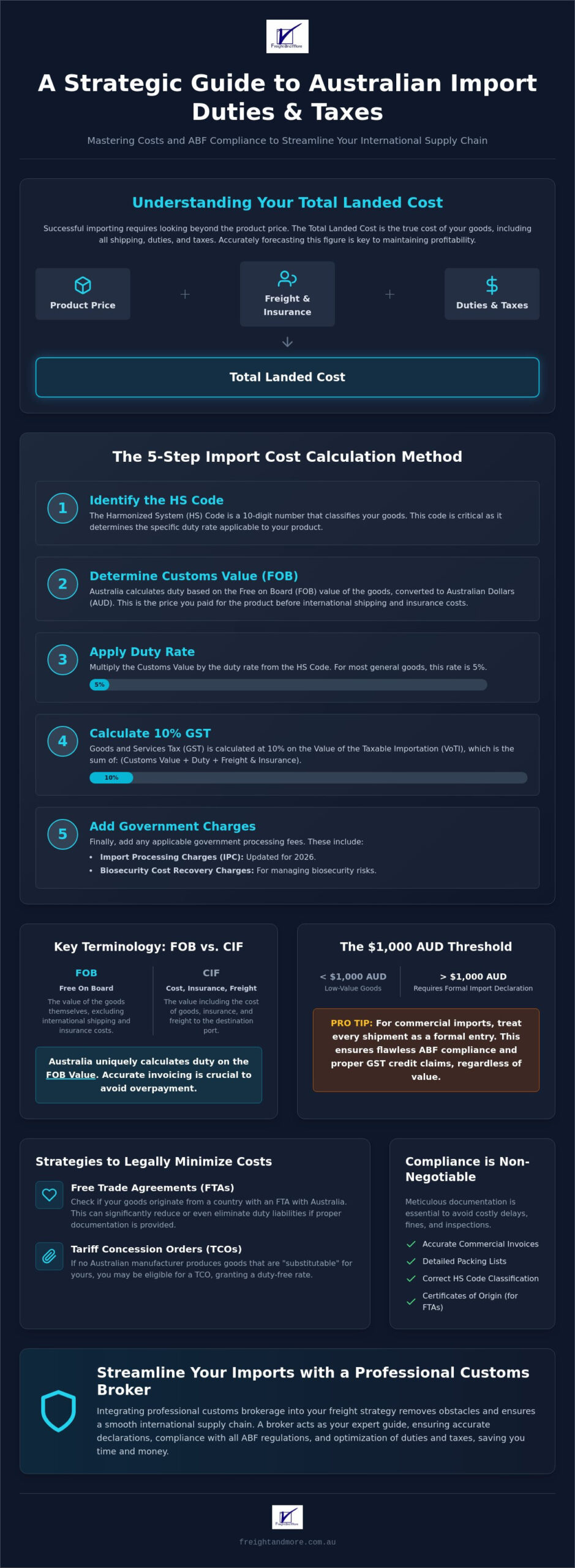
Success in international trade requires a shift in mindset from simple purchasing to calculating your “Total Landed Cost.” This figure represents the comprehensive sum of the product price, freight charges, insurance, duties, and taxes. Using this Import duties and taxes Australia guide, you’ll learn how to forecast these expenses accurately, turning what many see as a hurdle into a predictable part of your business’s financial planning. Our team at Freight and More takes pride in helping you decode these numbers, ensuring your supply chain remains both profitable and compliant.
To better understand the broader tax environment that influences these costs, watch this helpful video:
The $1,000 Threshold: Low-Value vs. Commercial Shipments
While a $1,000 AUD threshold exists for low-value goods, businesses should approach this limit with professional caution. Any shipment valued above this amount requires a formal Import Declaration, but we often recommend that commercial importers treat every consignment as a formal entry regardless of the invoice total. This proactive approach ensures you’re capturing all necessary data for GST credits and maintaining a flawless compliance record with the ABF. Trying to under-value goods to bypass this threshold is a dangerous game that leads to heavy penalties, cargo seizures, and long-term audits that can cripple your business operations. We focus on removing these obstacles by ensuring your documentation is handled with the highest level of care from day one.
Key Terminology for Importers: FOB vs. CIF
Understanding how the government calculates value is the first step toward financial precision. You’ll frequently encounter the terms Free on Board (FOB) and Cost, Insurance, and Freight (CIF) during your negotiations. Australia is unique because it calculates duty based on the FOB value, which is essentially the price paid for the goods before they’re loaded onto the ship or plane. This “Customs Value” serves as the foundation for your entire tax liability and must be reported with total accuracy. If you’re unsure how to separate these costs on your invoice, our customs clearance specialists can help you break down the numbers to avoid overpaying. Mastering these details is a vital part of using this Import duties and taxes Australia guide to protect your bottom line.
Calculating Your Import Costs: Duty, GST, and Government Charges
Precision in calculation is the hallmark of a successful importer. To transform your logistics from a source of stress into a predictable business expense, you must follow a methodical sequence of steps. This Import duties and taxes Australia guide simplifies the process into five manageable stages. First, you must identify the correct Harmonized System (HS) Code for your specific commodity, as this ten digit number dictates your duty rate. Next, determine your Customs Value in Australian Dollars; this is typically the FOB price you paid for the goods. Once you have this base, apply the relevant duty rate, which is 5% for most general goods. The fourth step involves calculating the 10% GST on the “Value of the Taxable Importation,” which includes the Customs Value, the duty payable, and the costs of international transport and insurance. Finally, factor in fixed government fees to reach your total landed cost.
Accuracy at every stage prevents costly surprises at the border. The Australian Border Force guide to import costs provides the legislative basis for these assessments, but applying them to your specific cargo requires meticulous attention to detail. If you’re unsure about how these variables impact your bottom line, reach out to our team for a tailored logistics assessment.
Decoding the Standard 5% Duty Rate and Exceptions
While a 5% duty rate applies to many categories like textiles, machinery, and general consumer goods, the landscape is filled with nuances. Some items, such as certain medical supplies or high tech electronics, may qualify for a 0% duty rate under specific concessionary codes. Conversely, “sin tax” items like alcohol and tobacco, or luxury motor vehicles, attract significantly higher rates or additional taxes. We take pride in helping you navigate these classifications to ensure you never pay a cent more than legally required.
Import Processing Charges (IPC) for Air and Sea Freight
Government fees vary significantly based on your shipment value and the transport mode. For consignments valued between $1,000 and $10,000, the electronic Import Processing Charge is currently AUD 50.00; however, this jumps to AUD 152.00 for shipments exceeding $10,000. You must also account for the Biosecurity Cost Recovery Charge, which as of July 2026 is AUD 48.00 for air freight and AUD 71.00 for sea freight. These fixed costs are non negotiable, but planning for them early ensures your margins remain protected. For the most up to date breakdown of these government levies, consult our customs clearance services team.
Leveraging Free Trade Agreements (FTAs) and Tariff Concessions
Many importers view customs duties as a fixed, unavoidable cost of doing business. However, this Import duties and taxes Australia guide reveals how strategic planning can legally reduce your duty liability to zero. Australia’s extensive network of Free Trade Agreements (FTAs) provides a powerful competitive advantage for businesses that know how to use them. By sourcing from partner nations, you can often eliminate the standard 5% duty entirely, though it’s vital to remember that GST on imported goods still applies in most cases.
The most significant hurdle for many is the “Rules of Origin” requirement. It’s not enough for your cargo to simply ship from a specific country; the goods must be substantially transformed or manufactured there to qualify. We take a proactive approach in helping you verify these details with your suppliers, ensuring your documentation stands up to ABF scrutiny. This meticulous care prevents the shock of back-dated duty invoices that can occur if an FTA claim is later found to be invalid. We’re here to act as your dedicated partner in navigating these complex legal frameworks.
Maximising Benefits from Major Trade Partners
Australia’s 2026 trade partnerships are more diverse than ever, offering significant duty relief through several key agreements:
- ChAFTA: The bilateral agreement with China that remains a cornerstone for Australian consumer goods.
- AUKFTA: The comprehensive deal with the United Kingdom that has streamlined trade for European-origin goods.
- CPTPP & RCEP: Massive multi-lateral agreements covering much of the Asia-Pacific region.
To unlock these savings, you’ll need a valid Certificate of Origin or a specific declaration from the producer. These benefits aren’t automatic. You must claim them at the time of entry, which is where our expert customs brokerage team adds immense value by ensuring every possible concession is utilized for your benefit.
The Tariff Concession System (TCOs) Explained
If an FTA doesn’t apply to your shipment, you might still find relief through a Tariff Concession Order (TCO). This system is designed for goods that have no local Australian equivalent, effectively removing the protective duty when there’s no local industry to protect. You can search the existing TCO database for concessions that match your specific HS code. If you’re importing unique items and no concession exists, we can guide you through the process of applying for a new TCO. This strategy is especially effective for clients using our Sea Freight Services for heavy machinery or specialized industrial components. We’re dedicated to removing these financial obstacles so your business can thrive on a global scale.
Avoiding Costly Delays: Documentation and Compliance Requirements
Paperwork is the lifeblood of your shipment; it’s also where most commercial importers encounter their biggest obstacles. Even with a perfect understanding of this Import duties and taxes Australia guide, a single typo on a commercial invoice can trigger an Australian Border Force (ABF) audit that keeps your cargo sitting on the wharf for weeks. Your Commercial Invoice is the foundation of your entry. It must list the correct currency, a detailed description of every item, and the precise terms of sale. Vague descriptions like “machine parts” or “samples” are immediate red flags that invite unwanted scrutiny. We take meticulous care in reviewing these documents before they reach the border, ensuring your business stays on the right side of compliance.
Your Packing List should be equally precise, detailing the weight, dimensions, and piece counts of every pallet or carton. This document allows customs officers to verify that the physical cargo matches the digital declaration. Alongside these, the Bill of Lading or Air Waybill serves as your contract of carriage and legal title to the goods. For those importing via ocean, a Packing Declaration is non negotiable. It confirms whether your timber packaging has been treated to meet strict biosecurity standards. If you’re feeling overwhelmed by these requirements, you can request a professional documentation audit to ensure your next shipment is bulletproof.
HS Codes and Classification Accuracy
Australia utilizes a complex 10 digit Customs Tariff nomenclature to classify every possible type of imported good. “Close enough” isn’t an option here. Mis-describing your goods to save a few dollars on duty is a high risk strategy that leads to heavy fines, cargo seizures, and a permanently increased audit profile for your business. We pride ourselves on our licensed expertise, helping you identify the specific code that ensures you pay the lowest legal rate while remaining fully compliant. Precision in classification is the only way to turn your logistics into a predictable competitive advantage.
Biosecurity and Quarantine: The Hidden Cost of Non-Compliance
The Department of Agriculture, Fisheries and Forestry (DAFF) manages Australia’s biosecurity with extreme rigour. They’re looking for common risks like untreated timber packaging, soil, or organic matter that could threaten our local ecosystem. Non compliance here is expensive. Beyond the potential for fumigation costs, you must account for the Biosecurity Cost Recovery Charge. As of July 2026, this charge is AUD 48.00 for air freight and AUD 71.00 for sea freight. To see how these requirements fit into the broader logistics picture, explore our companion resource on Customs Clearance Australia: The 2026 Business Guide to Seamless Importing. We’re here to help you navigate these departmental layers with total confidence.
Streamlining Your Imports with Professional Customs Brokerage
You’ve now explored the essential layers of this Import duties and taxes Australia guide, but the true test lies in the meticulous execution of your next shipment. While understanding the theory of HS codes and GST is vital, the practical application within the Australian Border Force’s systems requires a licensed expert who functions as your dedicated partner. A seasoned broker acts as a proactive financial advocate, identifying opportunities for Duty Drawbacks where you can reclaim paid duties on goods that are subsequently re-exported. This level of detail transforms customs clearance from a mere administrative hurdle into a strategic advantage for your bottom line.
We close the loop on your logistics by integrating every stage of the journey, from the initial port clearance to the final local transport and delivery to your warehouse. By following this Import duties and taxes Australia guide and partnering with a licensed broker, you ensure your business remains agile and compliant in a fluctuating global market. We take pride in removing the obstacles that slow you down, allowing you to focus on scaling your operations while we handle the complexities of the border.
Why DIY Customs Clearance is a Significant Business Risk
The Integrated Cargo System (ICS) is a sophisticated but unforgiving platform that doesn’t cater well to non professionals. One minor data entry error can trigger a chain reaction of storage and demurrage fees that quickly eclipse any perceived savings from a DIY approach. These costs accumulate daily, often reaching thousands of dollars before a mistake is even identified. It’s a simple reality that a broker’s fee is often entirely offset by the duty savings and concessions they find on your behalf.
The Freight and More Advantage: Beyond Just Paperwork
We manage the entire journey from the overseas factory floor to your Australian doorstep with a level of personalized service that global logistics giants simply cannot match. Whether you require International Air Freight for urgent inventory or a complex sea freight solution, our team provides the bespoke advice you need to succeed. We’re bold overachievers who go beyond industry norms to ensure your cargo moves seamlessly through every checkpoint. Don’t leave your compliance to chance. Request a comprehensive import quote today and experience the difference of a partner who is as motivated by your success as you are!
Take Control of Your International Supply Chain
Mastering the intricacies of cross-border trade is no longer a source of uncertainty, but a strategic opportunity for your business to excel. This Import duties and taxes Australia guide has provided you with a clear roadmap to navigate 2026 regulations, from precise HS code classification to the legal optimization of duties through Free Trade Agreements. You now understand that while government fees and GST are inevitable, unpredictable delays and compliance risks are entirely avoidable with meticulous preparation and expert guidance.
We’re ready to help you turn these complex variables into a streamlined, predictable success story for your enterprise. As licensed Australian Customs Brokers with national coverage and deep expertise in commercial air and sea freight, we take pride in handling your cargo with the personal attention it deserves. Let’s remove the obstacles standing between your overseas suppliers and your Australian customers.
Partner with the experts at Freight and More for seamless customs clearance and gain the total confidence that comes with professional logistics management. Your global growth starts with a single, well-executed shipment, and we’re excited to guide you every step of the way!
Frequently Asked Questions
How is import duty calculated in Australia for 2026?
Import duty is calculated as a percentage of the Customs Value of your goods, which is typically the Free on Board (FOB) price in Australian Dollars. Most general commodities attract a standard 5% duty rate. This Import duties and taxes Australia guide highlights that while duty is based on the product price alone, other taxes like GST will factor in your international freight and insurance costs as well.
Do I have to pay GST on imported goods if I am a registered business?
Yes, you are required to pay the 10% GST on taxable importations at the point of entry regardless of your business registration status. The tax is calculated on the “Value of the Taxable Importation,” which includes the customs value, the duty, and all transport and insurance costs. Most businesses can then claim this amount back as an input tax credit on their next Business Activity Statement.
What is an HS Code and why does it matter for my import taxes?
An HS Code is a ten digit classification number that tells the Australian Border Force exactly what your product is and what materials it contains. It is the single most important factor in determining your duty rate and biosecurity requirements. Using an incorrect code can lead to expensive overpayments or severe penalties for mis-description, so precision is absolutely non negotiable for commercial importers.
Can I claim a duty exemption under a Free Trade Agreement?
You can legally reduce your duty to zero if your goods meet the specific “Rules of Origin” criteria of an active Free Trade Agreement. This requires you to possess a valid Certificate of Origin or a formal declaration from the manufacturer proving the goods were produced in the partner country. These concessions aren’t automatic. You must proactively claim them during your formal import declaration process.
What are the current Import Processing Charges for sea freight?
For sea freight shipments valued over $10,000, the electronic Import Processing Charge is currently AUD 152.00. If your consignment is valued between $1,000 and $10,000, the charge is AUD 50.00. Additionally, you must factor in the Biosecurity Cost Recovery Charge of AUD 71.00 for sea entries to ensure your total landed cost calculations are accurate for the 2026 financial year.
How long does the customs clearance process typically take in Australia?
Electronic customs clearance is often completed within 24 to 48 hours if your documentation is perfect and no biosecurity concerns are identified. Delays usually occur when the Department of Agriculture, Fisheries and Forestry flags a shipment for a physical inspection or if paperwork is missing. We focus on meticulous document review to ensure your cargo moves through the port as fast as possible.
What happens if I classify my goods under the wrong tariff code?
Using the wrong tariff code can result in heavy fines, the seizure of your goods, and a permanent increase in your business’s audit profile with the ABF. Even if the error was accidental, you may be forced to pay back-dated duties and interest on previous shipments. We take pride in removing this risk by providing expert classification advice that keeps your business fully compliant.
Do I need a customs broker for every shipment?
While you can technically lodge your own declarations, using a licensed broker is essential for managing the high risks and complexities of commercial importing. A professional broker understands the nuances of the Integrated Cargo System and can identify duty savings that non professionals often overlook. The peace of mind and financial protection a broker provides typically far outweighs the cost of their service fee.
