Customs Clearance Australia: The 2026 Business Guide to Seamless Importing

Your supply chain is far more than a series of logistical steps; it’s a high-stakes legal commitment to the Australian Border Force that either secures your profit or invites unnecessary risk. If you’ve ever felt overwhelmed by the intricacies of the Integrated Cargo System or been blindsided by unexpected import processing charges, you’re certainly not alone. Managing customs clearance australia requires meticulous attention to detail, especially with the 2026 expansion of customs controls and the heightened biosecurity enforcement now in place. We understand that your priority is getting goods into the hands of your customers without the headache of border holds or hidden fees!
This guide is designed to help you master the current regulatory environment so you can achieve 100% compliance and enjoy fast, predictable releases. You’ll discover how the latest updates, such as the TC 26/21 tariff exemptions and the 2026 Firearms and Customs Laws Act, impact your specific business model. We’ll show you exactly how professional brokerage protects your supply chain from paperwork errors and costly delays. Let’s dive into the strategies that ensure your cargo moves through the border with absolute precision and energetic speed!
Key Takeaways
- Identify the critical AUD 1,000 threshold that triggers formal import declarations and learn why specific items like alcohol and tobacco are always subject to taxes.
- Discover how expert customs clearance australia services mitigate the significant legal risks of self-assessment, ensuring your business remains fully compliant with the Australian Border Force.
- Review our definitive documentation checklist to ensure your commercial invoices and packing lists meet every regulatory standard for immediate cargo release.
- Explore the strategic advantages of integrating your brokerage into a complete logistics chain, allowing for a seamless transition from international freight to local delivery!
- Gain total clarity on how the 2026 regulatory updates impact your landing costs, helping you protect your profit margins from unexpected border fees.
Understanding Customs Clearance Australia: Your Gateway to Global Trade
Customs clearance is the mandatory legal process for every item crossing the border into our country. It’s the mechanism that ensures your goods are authorized for entry and comply with all local laws. The Australian Border Force (ABF) manages this gateway, balancing the need for efficient trade with the critical duty of community protection and revenue collection. For any business, customs clearance australia isn’t just an administrative task; it’s a strategic pillar of your logistics that determines how quickly you can get your products to market.
Commercial importers must treat customs as a top priority. When your goods arrive, you’ll need to decide between clearing them for "Home Consumption" or moving them into "Licensed Warehouses." Home consumption means you pay all duties and taxes immediately so the goods can enter the local economy. Conversely, licensed warehouses allow you to store cargo and defer those payments until the goods are actually needed. The urgency of your clearance often depends on your transport mode. Air freight demands rapid-fire processing to avoid terminal storage fees, while sea freight requires early lodgement to navigate the complexities of container de-hiring and wharf access. If you’re looking for expert guidance, our team specializes in managing these customs clearance requirements with precision.
To gain more insight into the professional landscape of this industry, watch this helpful video:
The Role of the Integrated Cargo System (ICS)
The ICS is the national electronic backbone for all cargo reporting in Australia. It’s a sophisticated system, but for businesses without dedicated software, it’s notoriously complex to navigate. Professional forwarders utilize Electronic Data Interchange (EDI) to communicate directly with the ICS. This digital handshake speeds up processing times significantly, reducing the manual errors that often plague self-lodged declarations. Without this specialized connectivity, your business risks being left behind in a sea of digital paperwork.
Why National Compliance Matters in 2026
We’ve seen a significant shift in how trade regulations are enforced. In 2026, the ABF has increased its focus on precision, especially with the introduction of the Combatting Antisemitism, Hate and Extremism (Firearms and Customs Laws) Act 2026. This means your documentation must be beyond reproach to avoid being flagged. Incorrect tariff classification isn’t just a minor error; it can lead to heavy financial penalties and "red line" inspections. These inspections mean your cargo is physically held for examination, which can derail your entire schedule. Maintaining 100% compliance is the only way to ensure your goods move seamlessly from the port to your warehouse.
Navigating the AUD 1,000 Threshold and Import Declarations
The AUD 1,000 threshold is the most significant dividing line in Australian importing. If your goods’ customs value is at or below this mark, you’ll likely use a Self-Assessed Clearance (SAC) declaration. It’s a streamlined process, but don’t let the simplicity fool you. You still need to comply with biosecurity and prohibited goods regulations. However, there’s a major exception to this rule. Alcohol and tobacco products are always subject to duties and taxes, regardless of their value. Even a single bottle of premium whiskey requires a formal entry. For everything else under the threshold, GST is typically collected by the overseas seller at the point of sale under the Low Value Imported Goods (LVIG) regime.
When your commercial shipment exceeds AUD 1,000, the complexity of customs clearance australia increases significantly. This is where the N10 Import Declaration becomes mandatory. It’s a formal legal document that requires precise data entry into the Integrated Cargo System. As of late 2025, the Australian Border Force applies specific Import Processing Charges (IPC) for these declarations. You’ll pay AUD 50 for goods valued between AUD 1,000 and AUD 10,000, while shipments valued at AUD 10,000 and above incur a charge of AUD 152. These costs are fixed, so accurate valuation is the only way to ensure your landing costs remain predictable.
The N10 Declaration: For High-Value Commercial Cargo
The N10 declaration is the standard for high-value cargo. You’ll need to provide an accurate tariff classification, the correct customs value, and the country of origin. Getting the valuation right is vital. If you overvalue your goods, you’ll end up overpaying GST and duties. If you undervalue them, you risk heavy fines from the ABF. For a deeper look at the specific paperwork needed, consult the official Import Requirements and Documentation guide. It’s a helpful resource for understanding the nuances of commercial invoices and bills of lading.
The N20 Warehouse Declaration
Sometimes, you aren’t ready to pay all those taxes the moment the ship docks. This is where the N20 Warehouse Declaration shines. Instead of clearing goods for home consumption, you move them into a licensed facility. You defer the duty and GST until the items are actually cleared for sale. It’s a brilliant cash-flow strategy for businesses dealing with large inventories. If you’re looking to optimize your storage and defer costs, our warehouse management solutions provide the flexibility you need. If you’re unsure which declaration suits your next shipment, feel free to reach out for expert customs advice.
Licensed Customs Broker vs. Self-Assessment: Evaluating the Risks
Many new importers view self-lodgement as a simple way to trim overheads. However, this is often a false economy that leads to significant financial strain. When you handle your own customs clearance australia, you assume full legal liability for every single data point entered into the Integrated Cargo System. If the Australian Border Force (ABF) discovers an error, saying "I didn’t know" isn’t a valid legal defense. You’re the one on the hook for the penalties. Australia operates on a strict self-assessment basis, meaning the responsibility for accuracy sits squarely on your shoulders, regardless of your experience level.
A licensed broker provides "Trade and Tariff Consultancy" that goes far beyond simple data entry. We proactively search for Tariff Concession Orders (TCOs) that might apply to your specific goods. For example, on June 10, 2026, the Australian government introduced new import tariff exemptions (TC 26/21) that reduced the tariff from 5% to 0% for specific items. A professional broker ensures you don’t miss these opportunities to legally reduce your tax liability. We’re dedicated to protecting your profit margins while ensuring you remain a "low risk" importer in the eyes of the authorities.
The Hidden Costs of DIY Customs Entry
The most painful costs aren’t the ones you see on a quote. They’re the storage and demurrage fees that pile up when your cargo is stuck at the wharf because of a paperwork error. Misclassification is a common trap for the inexperienced. Tariff classification is the 10-digit code determining your duty rate. Get it wrong, and you’re inviting an ABF audit. These audits can result in significant fines and ongoing "red line" scrutiny for all your future shipments. It’s a high price to pay for a perceived saving on brokerage fees.
Strategic Benefits of Professional Brokerage
Professional brokers act as a sophisticated buffer between your business and the ABF. We provide a layer of security by vetting your documents against current Australian import requirements before they ever reach a customs officer. This proactive approach allows us to pre-clear your cargo while it’s still in transit across the ocean or air. By the time the vessel docks, your goods are often already released and ready for transport. This speed is essential for maintaining a healthy supply chain and understanding import costs in Australia. We’re here to solve problems before they even start, giving you total peace of mind!
For businesses looking for a partner to help navigate these complexities, you can discover more about Freight Forwarding and Customs Brokerage to see how expert logistics management can simplify your Australian operations.
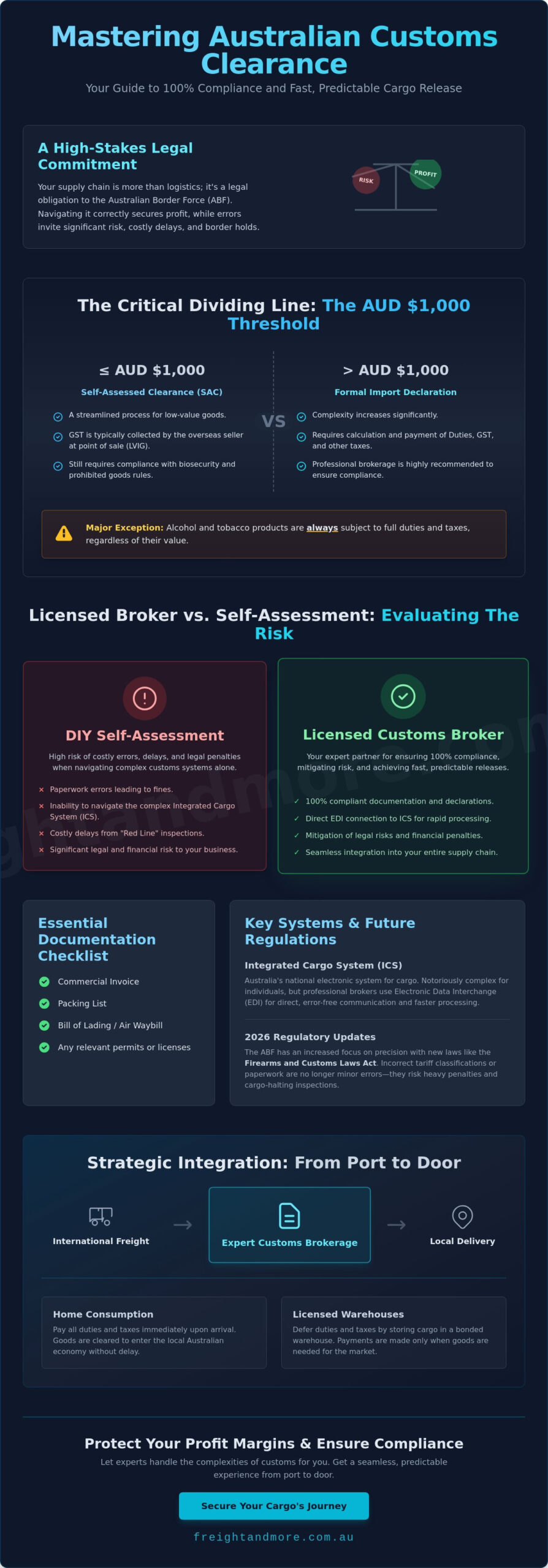
Essential Documentation Checklist for Seamless Compliance
The success of your import operation hinges on a single, undeniable factor: the precision of your paperwork. While we’ve discussed the legal frameworks and thresholds, the actual execution of customs clearance australia happens through the data found in your shipping documents. These files aren’t just records; they’re the evidence the Australian Border Force and the Department of Agriculture, Fisheries and Forestry (DAFF) use to assess your cargo. Missing a single detail can turn a routine arrival into a costly delay. We’ve compiled the definitive list of requirements to keep your goods moving at peak velocity!
Your Commercial Invoice is the most critical document in the set. It must clearly state the Incoterms 2020, the currency of the transaction, and a detailed description of the goods. Avoid vague terms like "parts" or "samples." Instead, use specific language that matches your tariff classification. The Packing List serves as the roadmap for biosecurity inspections. It must detail exactly what is in each carton, pallet, or container. If you fail to declare biosecurity risk items accurately, you face on-the-spot fines starting at AUD 313 and reaching up to AUD 6,260 for serious breaches. Precision isn’t just about speed; it’s about protecting your bottom line from avoidable penalties.
The transport document you provide depends on your chosen freight mode. For sea freight, you’ll require a Bill of Lading, while air freight requires an Air Waybill. These documents act as a contract of carriage and a title to the goods. They must be perfectly aligned with your invoice and packing list. Any discrepancy between the weight or piece count on these documents will trigger an immediate red flag in the Integrated Cargo System, likely resulting in a cargo hold that could last days.
The Importance of Incoterms 2020 in Customs
Incoterms like FOB (Free on Board) or CIF (Cost, Insurance, and Freight) do more than define who pays the shipping bill. They dictate exactly where the risk transfers and who is responsible for the customs costs and duties. Using the wrong term leads to disputes with suppliers and significant clearance delays. For a deeper dive into how these terms impact your 2026 operations, review our essential business checklist to ensure your contracts are airtight.
Certificates of Origin and Free Trade Agreements (FTAs)
Australia has an extensive network of FTAs that can reduce your import duties from the standard 5% to 0%. However, you can’t just claim these benefits; you must prove them. A valid Certificate of Origin is mandatory to access these lower rates. Be warned: the formatting requirements for these certificates are exceptionally strict. A missing signature or an incorrect date can invalidate the entire claim, forcing you to pay the full duty rate. We’re here to help you audit your documents before they reach the border! If you want to ensure your next shipment is 100% compliant, contact our expert brokerage team today for a professional document review.
Strategic Customs Brokerage with Freight and More
At Freight and More Pty Ltd, we don’t view customs as a final hurdle but as a seamless part of your global logistics strategy. By integrating customs clearance australia directly into our international freight operations, we eliminate the friction that often occurs when using multiple service providers. This holistic approach ensures that your data flows from the point of origin to the Australian Border Force without any loss of clarity. We function as your dedicated partner, managing every detail with meticulous care so you can focus on growing your business!
Our door-to-door delivery model combines expert brokerage with local transport to provide a truly comprehensive solution. We take a proactive stance by identifying potential bottlenecks before your cargo even leaves the supplier’s warehouse. This includes a thorough review of your documentation to ensure it meets the 2026 standards we’ve discussed earlier. If you want to stay ahead of the curve, check out our guide on avoiding customs delays in Australia. Leveraging our global network of agents allows us to maintain origin-to-destination compliance, giving you total visibility over your supply chain.
Integrated Air and Sea Freight Solutions
Whether you’re moving time-sensitive electronics via air or bulk industrial equipment through our sea freight services, our brokerage team works in tandem with our freight specialists. This synergy means you have a single point of contact who understands your specific business needs. We provide national coverage across all Australian states, ensuring that whether your cargo arrives in Melbourne, Sydney, or Perth, the level of service remains consistently excellent. It’s about providing scale without losing the personal touch. We’re committed to making your logistics feel effortless!
Start Your Compliant Import Journey Today
For many new importers, establishing a professional online presence is just as vital as securing a reliable supply chain; you can explore Starter Website Package to build a high-quality digital foundation for your Australian small business.
Entering the world of international trade can feel daunting for first-time commercial importers, but it doesn’t have to be. We offer welcoming, professional support tailored to your unique requirements. From the moment you reach out for an initial quote to the final delivery at your warehouse door, we’re here to guide you. Our team is ready to solve your most complex logistics puzzles with a can-do attitude. Visit our enquiries page today to receive a tailored strategy for your next shipment. Don’t leave your compliance to chance. Partner with Freight and More Pty Ltd for expert customs clearance and experience the difference that professional reliability makes.
Secure Your Supply Chain Success in 2026!
Navigating the Australian border doesn’t have to be a source of stress or financial uncertainty for your business. We’ve explored the critical AUD 1,000 threshold and why precision in tariff classification is absolutely non-negotiable for your commercial success. You now understand that meticulous documentation is the primary tool for avoiding those heavy biosecurity fines and "red line" inspections that stall your business momentum. Mastering customs clearance australia requires a sophisticated blend of current regulatory knowledge and proactive logistics management to keep your goods moving at peak velocity.
Since 2009, our team has provided premium licensed customs brokerage services that integrate perfectly with our international air, sea, and local transport solutions. Our deep expertise in navigating the complexities of ABF and DAFF regulations ensures your cargo remains compliant while your landing costs stay predictable and transparent. We pride ourselves on being the dedicated partner you need to remove every obstacle from your supply chain! Let’s turn your importing challenges into a streamlined competitive advantage. We’re eager to help you achieve a fast, flawless release for your next shipment!
Frequently Asked Questions
How much does customs clearance cost in Australia?
Government fees are fixed based on the value of your shipment and the required declaration type. As of 2026, the Australian Border Force applies an Import Processing Charge of AUD 50 for goods valued between AUD 1,000 and AUD 10,000, while consignments valued at AUD 10,000 or more incur a charge of AUD 152. Professional brokerage fees are separate and vary depending on the complexity of your cargo and the number of tariff lines required to be lodged.
How long does it take for cargo to clear customs in Australia?
Clearance timelines depend heavily on your transport mode and the nature of your goods. Express air freight can often clear within a few hours, while sea freight typically takes between 3 and 7 business days. If your shipment requires a biosecurity inspection by the Department of Agriculture, Fisheries and Forestry, you should allow for an additional 5 to 10 business days for the physical examination and final release from customs control.
What is the AUD 1,000 rule for Australian imports?
The AUD 1,000 rule establishes the threshold for formal import declarations. Goods valued above this amount require an N10 Import Declaration and are subject to duties, taxes, and processing charges. For items valued at AUD 1,000 or less, GST is usually collected by the overseas seller at the point of sale. Remember that alcohol and tobacco are excluded from this rule and always require a formal entry regardless of their value.
Can I clear my own commercial goods through customs?
You can legally lodge your own declarations, but it carries significant risk for your business. Australia operates on a self-assessment basis, meaning you’re legally responsible for the accuracy of every data point provided to the authorities. Incorrect classifications or valuation errors can lead to heavy fines and cargo holds. Most commercial importers choose a licensed professional to manage customs clearance australia to ensure total compliance and speed.
What happens if my goods are held by Australian Border Force?
If the Australian Border Force holds your goods, they’ve likely flagged your shipment for a document check or a physical inspection. You’ll receive a notification requesting further information, such as proof of payment, permits, or technical specifications. Delays at the border can lead to expensive wharf storage fees, so it’s vital to respond with accurate documentation immediately to resolve the hold and secure a fast release of your cargo.
What is a Tariff Concession Order (TCO) and can it save me money?
A Tariff Concession Order is a legal instrument that reduces the customs duty rate from 5% to 0% for specific goods. These are granted when there are no known Australian manufacturers of identical or similar items. Identifying an applicable TCO is a primary way brokers save you money on your landing costs. We stay updated on the latest orders, such as the TC 26/21 exemptions introduced in June 2026, to protect your profit margins.
Do I need to pay GST on imported commercial goods?
Yes, a 10% Goods and Services Tax applies to most commercial imports entering Australia. This tax is calculated on the "taxable import" value, which includes the customs value of the goods plus international shipping, insurance, and any applicable customs duty. While most businesses can claim this GST back as an input tax credit on their Business Activity Statement, the payment is generally required at the time the goods clear customs.
What is the difference between a freight forwarder and a customs broker?
A freight forwarder manages the physical movement of your cargo across borders, while a customs broker focuses on the legal compliance and entry of those goods. While forwarders handle the logistics of air and sea transport, brokers are licensed experts who interact with the Integrated Cargo System to lodge declarations. Choosing a partner that offers both ensures your customs clearance australia is perfectly synchronized with your delivery schedule for a seamless door-to-door experience!
