FCL Shipping Australia: The Complete 2026 Guide to Full Container Logistics

If you’re still relying on shared containers to move your goods, you’re likely paying an invisible “complexity tax” that’s eating your margins and stalling your growth. You’ve probably felt the frustration of unpredictable port delays or been hit by unexpected inward wharfage fees that weren’t in the initial quote. It’s exhausting to manage the risk of cargo damage while trying to keep up with Australia’s rigorous biosecurity regulations and the latest 2026 IMO safety mandates. We understand that you want reliability and precision above all else!
Selecting the right hardware is the first step toward a flawless supply chain. In 2026, the 40ft High Cube (HC) has cemented its position as the global gold standard for exporters, offering an extra 30cm of vertical clearance that can drastically improve your shipping margins. However, choosing the biggest box isn’t always the smartest move for fcl shipping australia. You need to balance volume against weight and local road regulations to ensure your goods move smoothly from the wharf to your warehouse. For businesses looking to invest in their own fleet, Les Déplaceurs offers a reliable selection of 20 and 40-foot maritime containers for sale and rent.
This guide will show you how to master fcl shipping australia to achieve total control over your cargo security while significantly lowering your per-unit costs. You’ll learn exactly how to bypass the delays of consolidation, saving between 5 to 14 days in transit time compared to LCL. We’ll break down the current 2026 customs environment, including the new UAE tariff corridor and upcoming dairy import permit changes, so you can scale your supply chain with professional confidence. Let’s transform your logistics from a source of stress into a streamlined engine for your business success.
Key Takeaways
- Discover how dedicated containers provide an elite layer of security and speed by bypassing the common delays found in shared shipping environments.
- Get up to speed on 2026 container dimensions so you can maximize your cargo capacity and avoid the expense of over-ordering or under-utilizing space.
- Apply the 15 CBM rule to calculate your exact ROI and confirm when fcl shipping australia is the most cost-effective choice for your bottom line.
- Simplify the journey through Australian ports by understanding the critical role of DAFF and how to prepare for biosecurity inspections before your goods arrive.
- Build a more resilient supply chain by connecting international sea freight directly with local transport solutions for a truly streamlined logistics experience.
Understanding FCL Shipping: Why Full Container Loads Drive Australian Trade
In a country where 98% of international trade by volume arrives by sea, mastering the logistics of your imports isn’t just a back-office task; it’s a critical competitive advantage. When we talk about fcl shipping australia, we’re describing a method where your business has exclusive use of an entire shipping container. Unlike shared loads, your cargo is the sole occupant of the space. This exclusivity transforms a simple metal box into a dedicated, mobile warehouse that protects your inventory from the point of origin all the way to your Australian facility.
As we move through 2026, the Australian market has seen a stabilization of freight rates, making the shift from pallet-based shipping to full containers more accessible for growing enterprises. Choosing FCL means you aren’t just buying space; you’re buying speed and security. Because the container is sealed at the factory and remains unopened until it reaches its final destination, the risk of “touches” by third-party handlers is virtually eliminated. For businesses dealing with high-value electronics, sensitive medical supplies, or premium retail stock, this reduction in handling is the best insurance policy you can have.
FCL vs. LCL: The Fundamental Difference
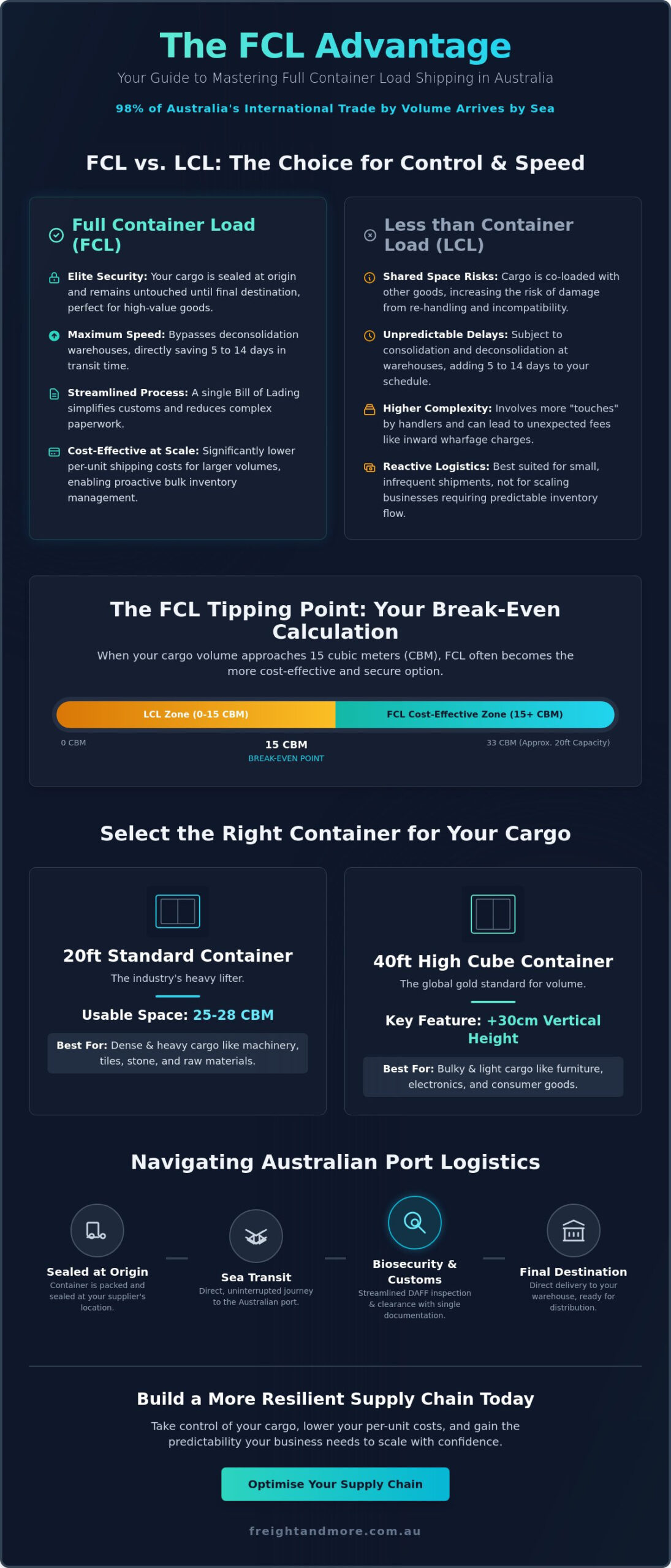
The choice between Full Container Load (FCL) and Less than Container Load (LCL) often comes down to peace of mind. With FCL, your goods are packed and sealed at the origin, which is vital for maintaining the integrity of your supply chain. You don’t have to worry about your cargo being squeezed next to incompatible goods or damaged during the frequent re-handling that occurs in consolidated shipments. This “sealed at origin” status also simplifies your documentation. Instead of managing a complex trail of paperwork for multiple small consignments, you deal with a single Bill of Lading and a streamlined customs process. This efficiency is supported by standardized container dimensions that ensure your cargo fits perfectly into global transport networks without surprises.
The Strategic Advantage for Australian Businesses
Scalability is the heartbeat of a successful Australian business. Transitioning to FCL allows you to move away from reactive, pallet-by-pallet ordering and toward proactive bulk inventory management. This shift doesn’t just lower your per-unit shipping costs; it provides much-needed predictability. You won’t be at the mercy of deconsolidation warehouses, which can often add 5 to 14 days to your total transit time. By controlling the entire container, you can align your arrivals precisely with Australian wharf schedules. This reliability ensures your brand’s reputation remains spotless, as your customers can always count on your stock arriving in pristine condition and on time. It’s about taking the guesswork out of your logistics so you can focus on growth.
Selecting the Right Container: Dimensions, Capacity, and 2026 Standards
Selecting the right hardware is the first step toward a flawless supply chain. In 2026, the 40ft High Cube (HC) has cemented its position as the global gold standard for exporters, offering an extra 30cm of vertical clearance that can drastically improve your shipping margins. However, choosing the biggest box isn’t always the smartest move for fcl shipping australia. You need to balance volume against weight and local road regulations to ensure your goods move smoothly from the wharf to your warehouse.
Precision is key when calculating your load. While a standard 20ft container has a theoretical volume of approximately 33 cubic meters, its actual usable space is typically closer to 25 to 28 cubic meters. You must account for the “air gap” between cartons and the physical footprint of pallets. Over-ordering stock based on theoretical limits leads to costly floor-loading or, even worse, the need for a second container you didn’t budget for. Always plan for the reality of the pack, not just the math on the spec sheet.
20ft vs. 40ft: Which TEU Fits Your Cargo?
20ft units are the heavy lifters of the industry. They’re perfect for dense, heavy materials like tiles, machinery, or stone where you’ll hit weight limits long before you run out of room. Conversely, if you’re moving bulky consumer goods or furniture, the 40ft High Cube is your best friend. It typically accommodates 20 to 22 Australian standard pallets (1165mm x 1165mm), whereas a 20ft unit generally fits 10 to 11. If you’re unsure which configuration maximizes your ROI, our team can help you optimize your container selection based on your specific cargo profile.
Specialised Equipment for Unique Freight Needs
Temperature-sensitive freight, such as premium Australian wine or fresh produce, requires Reefer containers to maintain climate integrity. For oversized industrial gear that won’t fit through standard doors, Open Top or Flat Rack containers provide the necessary flexibility. Regardless of the equipment type, your supplier must use export-grade units that meet strict biosecurity standards. Understanding the Australian Border Force import process is vital here, as your container choice directly impacts your customs declarations and the likelihood of mandatory inspections.
Weight limitations are just as important as volume. You must stay compliant with the National Heavy Vehicle Regulator (NHVR) standards once your container hits Australian roads. A container might be rated for a 28-tonne payload, but local bridge and road limits often require a much lighter load for standard transport. We always recommend verifying your weight distribution early to avoid expensive “heavy haulage” permits or being forced to transload cargo at the terminal.
FCL vs LCL: Calculating the Break-Even Point and ROI for Your Cargo
Deciding between a full container and a shared load isn’t just about the volume of your goods; it’s a strategic financial calculation that impacts your entire bottom line. Many importers fall into the trap of thinking they need a massive shipment to justify fcl shipping australia, but the mathematical tipping point is often lower than you’d expect. In the 2026 market, the 15 CBM rule remains the definitive benchmark. Once your cargo exceeds 14 to 16 cubic meters, the flat-rate ocean freight of a 20ft container almost always becomes more cost-effective than the cumulative per-CBM charges of an LCL shipment. We’re here to help you find that sweet spot where your margins start to soar!
The real ROI of FCL isn’t found only in the freight rate; it’s found in the time you save. Because your container doesn’t need to wait for deconsolidation at a third-party warehouse, you typically gain 5 to 14 days in transit time. For a retail business, getting stock on shelves two weeks earlier can be the difference between hitting a seasonal peak and missing it entirely. Speed is cash flow. By choosing FCL, you reduce your inventory carrying costs and keep your capital moving through your business rather than sitting on a wharf.
The True Cost of Shipping to Australia
LCL freight often looks “cheap” at the point of origin, but those low rates frequently mask expensive Australian port handling charges. When your goods arrive as part of a consolidated load, you’re hit with de-consolidation fees that simply don’t apply to FCL. With a full container, your destination costs are more predictable. You’ll manage standard terminal handling charges, the A$50.70 Import Processing Charge for sea cargo, and specific port fees like the Port of Melbourne inward wharfage of A$144.38 per TEU. FCL simplifies your landed cost per unit into a single, manageable figure that protects your profit margins from unexpected spikes.
2026 Market Trends: Fuel, Capacity, and Rates
The 2026 shipping landscape is defined by new environmental regulations and shifting global alliances. Stricter IMO mandates regarding firefighting foams and container loss reporting have introduced new surcharges, but FCL remains the most stable way to navigate these changes. While LCL space can be volatile, proactive rate locking with a dedicated freight forwarder allows you to secure competitive long-term pricing. We take pride in helping you navigate these capacity shifts, ensuring your supply chain remains resilient even when global lanes face seasonal fluctuations. It’s about being proactive, not reactive, to ensure your business stays ahead of the curve.
Navigating Australian Customs and Port Logistics for FCL Shipments
Once your vessel berths at a major Australian hub, the race against the “free time” clock begins. Managing the final leg of fcl shipping australia requires a proactive strategy to ensure your container moves swiftly from the terminal to your facility. Most shipping lines provide a standard window of seven to ten days for you to collect, unpack, and return the empty container. If you miss this window, you’ll face detention charges that can quickly spiral into hundreds of dollars per day. We take pride in staying ahead of these deadlines, coordinating your documentation well before the ship hits the horizon.
Compliance is your best defense against unexpected costs. Your customs broker must ensure every detail of your declaration is 100% accurate to avoid the Australian Border Force (ABF) placing a hold on your cargo. This is where precision pays off. By managing the interface between sea freight and local transport, we ensure your goods aren’t just cleared, but are actually moving while your competitors are still stuck in a paperwork queue. It’s about being prepared for every contingency so you never have to worry about the wharf.
Biosecurity and Tailgate Inspections
The Department of Agriculture, Fisheries and Forestry (DAFF) plays a critical role in protecting Australia’s ecosystem, and full containers are frequently flagged for “tailgate inspections.” These checks involve an officer opening the container doors at a licensed facility to look for soil, pests, or prohibited organic matter. To minimize the risk of a hold, ensure your supplier uses ISPM 15 compliant timber for all pallets and dunnage. A proactive customs broker will identify high-risk commodities early, preparing the necessary biosecurity permits to speed up the release of your FCL cargo without a hitch.
Port-to-Door Transport Options
The final mile is often the most misunderstood part of the journey. For many Australian sites, a sideloader is the most efficient choice because it allows the driver to drop the container directly onto the ground for easy unpacking. However, if your premises have limited space or specific entry requirements, you might need a tilt tray or a standard skeletal trailer. You must verify that your site can safely handle the weight and length of a 40ft unit before the truck arrives. If you need help coordinating the perfect delivery method, contact us for expert local transport advice today!
Optimising Your Supply Chain with Freight and More’s FCL Solutions
At Freight and More Pty Ltd, we believe that logistics should be a catalyst for your growth, not a hurdle to overcome. Our approach to fcl shipping australia is built on a foundation of professional confidence and a proactive, “can-do” attitude that ensures your cargo is always in expert hands. We don’t just move boxes; we manage a sophisticated end-to-end journey that connects international sea freight with reliable local transport. By functioning as your dedicated partner, we remove the friction from complex customs regulations and biosecurity requirements, allowing you to focus on scaling your business with total peace of mind.
Reliability in 2026 requires more than just a booking system; it demands a global reach. Our extensive network of international agents allows us to secure container space and competitive equipment even during the most volatile peak seasons. If global shipping alliances shift or capacity tightens, our team is already working behind the scenes to protect your supply chain. We take immense pride in our meticulous attention to detail, ensuring that every container is tracked, every document is verified, and every milestone is communicated with transparency. You’ll never have to wonder where your investment is or when it will arrive.
Bespoke Logistics for Ambitious Businesses
Every industry has its own rhythm, and we tailor our FCL solutions to match yours. Whether you are importing heavy industrial machinery or fast-moving retail goods, we design a logistics plan that prioritizes your specific ROI goals. We are committed to total transparency, which means you’ll never encounter hidden fees or unexpected “surprises” on your final invoice. Many of our clients find that a hybrid approach works best for their needs. If you are also evaluating your urgent cargo requirements, we can show you how to integrate our sea freight services with a leading air freight forwarding company model to create a resilient, multi-modal supply chain.
Start Your FCL Journey Today
There has never been a better time to audit your shipping volumes and identify opportunities for FCL optimization. If your business is moving more than 15 CBM per shipment, making the switch to full containers could significantly lower your per-unit costs and improve your delivery speed. The “Freight and More Pty Ltd” difference lies in our welcoming enthusiasm and our seasoned expertise. We are ready to solve your most complex logistics problems with precision and care. Contact our expert team for a tailored FCL shipping quote today!
Take Command of Your Australian Supply Chain
Master the complexities of your logistics by shifting from reactive shipping to a proactive FCL strategy. You’ve seen how exclusive container use eliminates the “shared load tax” and slashes transit times by up to 14 days. Whether you’re leveraging the 40ft High Cube for volume or 20ft units for heavy machinery, the right choice ensures your goods arrive in pristine condition every time. Mastering fcl shipping australia is your clear path to total control over your inventory and landed costs.
Since 2009, we’ve helped ambitious businesses navigate the intricate web of Australian Customs and biosecurity with meticulous precision. Our established global agent network and national port-to-door transport infrastructure mean you’re never navigating the wharf alone. It’s time to stop worrying about hidden port charges and start scaling with confidence! Request a Comprehensive FCL Shipping Quote from Our Proactive Logistics Team today. We’re eager to solve your logistics challenges and help your business thrive!
Frequently Asked Questions
What is the difference between FCL and LCL shipping?
FCL gives you exclusive use of the container, ensuring your cargo isn’t mixed with other shipments. This exclusivity is the primary reason why fcl shipping australia is more secure, as the container remains sealed from the factory to your door. It’s the best way to avoid the risks associated with shared cargo, such as odors, leaks, or physical damage from adjacent goods.
How much weight can I pack into a 20ft FCL container for Australia?
A standard 20ft container can physically hold up to 28 tonnes of payload, but you must respect local road weight limits. In Australia, the National Heavy Vehicle Regulator (NHVR) sets strict guidelines to ensure road safety and bridge integrity. Loading to the maximum capacity often requires specialized heavy-haulage transport, which can increase your local delivery costs significantly if not planned correctly.
What is the typical transit time for FCL shipping to Australia?
Transit times depend on the origin port, but most shipments from Southeast Asia to Australia take between 12 and 25 days on the water. Because FCL shipments don’t require time for consolidation or deconsolidation, they are typically delivered much faster than shared loads. We monitor every vessel’s progress proactively to ensure your warehouse team is ready for the arrival at the terminal.
How do I avoid demurrage and detention charges on my container?
Avoiding these charges requires precise coordination between your customs clearance and local transport. Demurrage is charged by the terminal for staying too long on the wharf, while detention is a fee from the shipping line for not returning the empty container. We manage these timelines carefully to ensure your container is collected and returned well within the standard free-time window offered by the carrier.
Does my business need a customs broker for FCL imports?
For commercial fcl shipping australia, a customs broker is essential for navigating the complexities of the Australian Border Force. Any shipment valued over A$1,000 requires a formal import declaration and the payment of relevant duties and GST. Our expert brokerage team ensures your goods are correctly classified under the Harmonized System to avoid penalties and ensure a smooth, compliant release.
Can I track my FCL container in real-time?
You can track your cargo using the container number or the Bill of Lading through the shipping line’s digital portal. This allows you to see exactly where your goods are in the world and when the vessel is expected to berth at the port. We provide our clients with regular, energetic updates to ensure you have total visibility over your supply chain at every stage.
What happens if my FCL container is selected for a DAFF inspection?
If DAFF selects your container for inspection, it will be directed to a licensed biosecurity facility for a tailgate check. This process is designed to protect Australia’s agricultural interests from pests or soil contamination. We handle the logistics of moving the container to the inspection site and ensure all biosecurity directions are followed to get your cargo released as quickly as possible.
Is marine insurance necessary for FCL shipments?
Marine insurance is highly recommended because carrier liability is strictly limited under international conventions. In the rare event of a vessel accident, heavy weather damage, or general average, the compensation from the shipping line may not cover your total loss. Protecting your investment with a comprehensive policy ensures your business remains resilient and your financial interests are fully protected regardless of what happens at sea.
