How to Calculate Sea Freight Costs in Australia

A standard ocean freight quote is often just the tip of the iceberg, leaving many Australian importers blindsided by a wave of unexpected arrival fees. You’ve likely felt that sinking feeling when a shipment reaches the port, only to be met with hidden charges, complex LCL pricing structures, or confusion over exactly how much GST and duty you owe. It’s an exhausting cycle that makes budgeting for your logistics feel like guesswork. We’re here to change that.
By providing a clear, expert-led framework on how to calculate sea freight costs Australia wide, we’ll help you move your goods with total financial clarity, allowing you to focus on business growth while we handle the intricate details of your supply chain. Mastering these complexities means you’ll avoid costly port storage delays and gain the confidence to choose the most efficient shipping method for your specific needs. We’ll break down the 2026 import landscape, including the A$68 sea freight biosecurity charge and the impact of recently abolished nuisance tariffs, ensuring your next shipment arrives without any expensive surprises. Let’s get your logistics budget back on track with a predictable, professional approach to ocean freight.
Key Takeaways
- Distinguish between FCL and LCL shipping structures to ensure you are selecting the most cost-effective container option for your specific cargo volume.
- Identify the shifting variables of 2026 ocean logistics, including fuel fluctuations and the Bunker Adjustment Factor, to maintain a predictable shipping budget.
- Eliminate the stress of “hidden” arrival fees by understanding the specific port handling and biosecurity charges unique to the Australian border.
- Master the comprehensive landed cost formula to learn exactly how to calculate sea freight costs Australia wide, ensuring your final bill matches your initial quote.
- Leverage the expertise of a professional freight forwarder to navigate complex customs clearance and optimize your local transport for a seamless delivery.
Understanding Sea Freight Basics for Australian Importers
Australia’s unique position as an island nation makes sea freight the undisputed champion for moving bulk goods across the globe. It remains the most cost-effective method for large-scale imports, serving as the essential backbone of our international trade in 2026. If you’re looking to understand how to calaculate sea freight costs Australia wide, you must start by looking beyond the simple ocean journey. We focus on helping you achieve a predictable budget by mastering the “Total Landed Cost” framework.
To better understand this concept, watch this helpful video:
A common mistake for many entrepreneurs is focusing solely on the port-to-port Freight rate. While this is a primary component, a truly accurate calculation includes every expense from the factory floor to your Australian warehouse door. When you learn how to calaculate sea freight costs Australia importers often realize that the base ocean price is just one piece of the puzzle. This comprehensive approach ensures you aren’t surprised by local handling fees or unexpected biosecurity charges upon arrival at our ports.
FCL vs LCL: Which is Most Cost-Effective for Your Cargo?
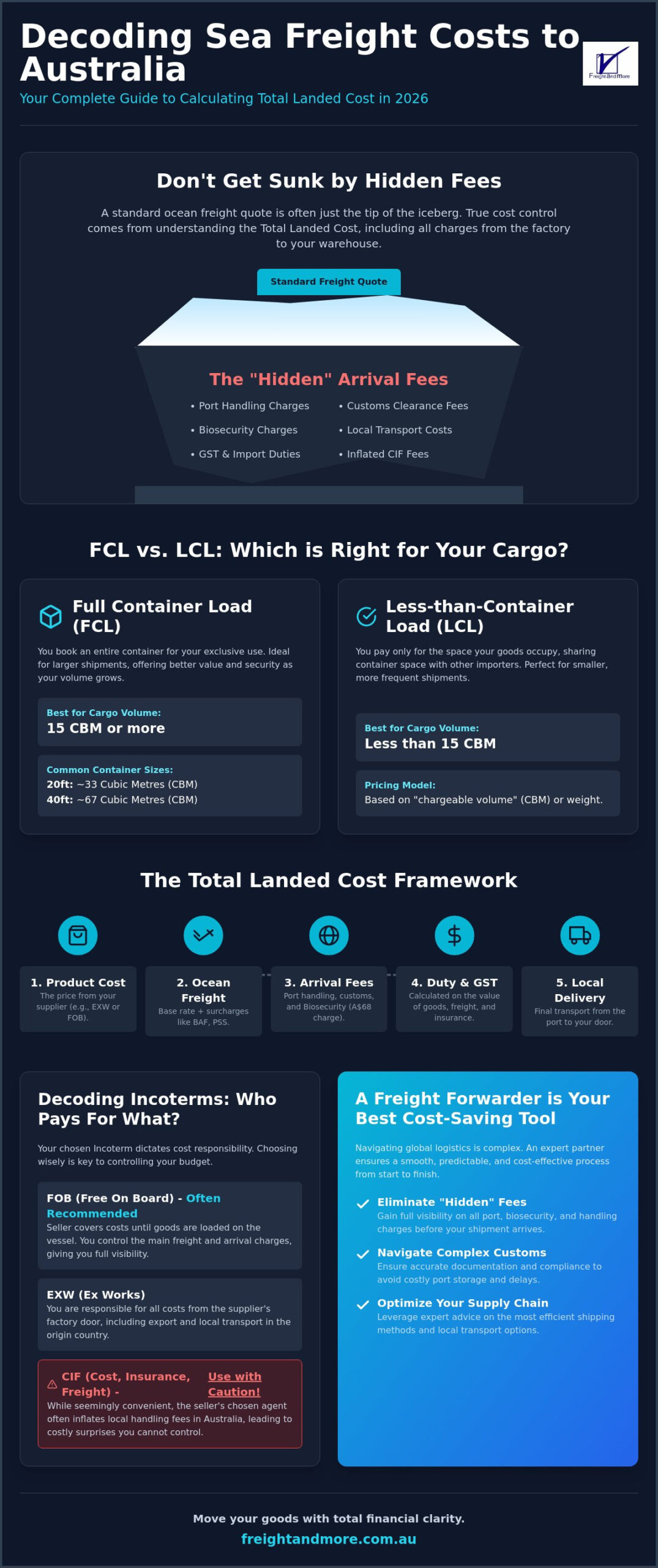
Choosing between Full Container Load (FCL) and Less-than-Container Load (LCL) is your first major decision. For FCL, you’ll typically use standard 20ft or 40ft containers. A 20ft container holds roughly 33 cubic metres (CBM), while a 40ft container offers about 67 CBM. If you have enough cargo to fill at least 15 to 20 CBM, upgrading to FCL often saves you money. This is because LCL shipments are priced based on “chargeable volume,” where you pay for the space you occupy. While LCL is great for smaller batches, the flat-rate nature of FCL handling often makes it the superior choice as your volume grows.
For those coordinating small-scale relocations or niche shipments from Europe, Fool Movers provides an efficient way to manage volumes up to 12 m³ before they are consolidated for their sea freight journey to Australia.
The Impact of Incoterms on Your Freight Calculation
Your chosen Incoterms dictate who is responsible for specific costs during the international sea freight journey. If you buy under Ex Works (EXW) terms, you’re responsible for everything from the supplier’s door. Free On Board (FOB) is often preferred, as the seller covers costs until the goods are loaded onto the vessel. Be cautious with Cost, Insurance, and Freight (CIF) agreements. While they seem convenient, they often lead to much higher “hidden” costs at Australian ports. This happens because the seller chooses the agent, often resulting in inflated local handling fees that you cannot control. We recommend taking charge of your logistics early to maintain full visibility over your spending.
Key Factors Influencing Ocean Freight Rates in 2026
Understanding the base rate is your first step, but it’s rarely the final figure on your invoice. If you want to know how to calaculate sea freight costs Australia importers face today, you have to look at the layering of surcharges that shipping lines apply. These aren’t just administrative extras; they’re dynamic reflections of global trade conditions that can fluctuate weekly. By staying informed about recent trends in the value of imports of freight services, you can anticipate these shifts before they impact your bottom line. We take pride in helping you see through the fog of these complex pricing structures with professional precision.
Base Freight and Common Surcharges
Ocean freight rates are typically quoted per container for FCL or per weight/measurement (w/m) for LCL shipments. Learning how to calaculate sea freight costs Australia wide requires an eye for detail, as mandatory surcharges often catch businesses off guard during the initial planning phase. You’ll need to account for several key variables:
- Peak Season Surcharge (PSS): This is applied during high-demand months when vessel space is at a premium and global trade volume spikes.
- Currency Adjustment Factor (CAF): This manages exchange rate volatility, particularly between the US dollar and the Australian dollar.
- Bunker Adjustment Factor (BAF): This is a floating charge designed to cover the shifting costs of vessel fuel.
In 2026, major shipping lines have introduced Emergency Bunker Surcharges that can add 10% to 25% or more to your base cost. This makes it vital to have a partner who monitors these updates daily. We don’t want you to be surprised by a bill that doesn’t match your expectations.
Route Complexity and Seasonal Demand
The path your cargo takes significantly influences the price. Direct routes to major Australian hubs like Melbourne, Sydney, or Brisbane are priced differently than transshipment routes that involve moving cargo between vessels at intermediate ports. Australia also faces a unique “empty container” challenge. Because we often import more volume than we export, shipping lines must factor in the cost of repositioning empty containers back to high-demand regions. Current 2026 data shows that Shanghai–Sydney spot rates have averaged about US$2,766 per 40-foot container, but these figures can climb rapidly when blank sailings reduce available space. Market volatility remains high, with rates from main Asian trade lanes climbing 15% to 25% month-on-month in mid-2026. Staying proactive is the best way to manage these variables. If you’re feeling overwhelmed by these moving parts, you can always discuss your specific route requirements with our team to get a clear, all-inclusive picture.
Navigating Australian Local Charges and Border Fees
The most frequent question we hear from importers is why the final invoice often looks different from the initial ocean quote. This discrepancy usually stems from the specialized local charges applied once a vessel enters Australian waters. Mastering how to calaculate sea freight costs Australia requires a deep dive into the local charges that occur after your cargo clears the horizon. We take pride in being the proactive partner that removes this “hidden cost” anxiety by providing total transparency from the start. Working with the Australian Border Force and other agencies involves a specific set of fees that are essential for legal compliance and smooth delivery.
Port Service Charges and Terminal Handling (THC)
Terminal Handling Charges (THC) are mandatory fees paid to the port authorities for the movement of containers within the terminal. These costs vary by port and carrier; for instance, Ports Victoria (Melbourne) has set inward wharfage fees at A$144.38 per TEU as of early 2026. You must also account for infrastructure levies and container maintenance fees, which carriers like CMA CGM have revised to include charges like A$22 for a 20ft container. Don’t let your cargo sit idle. Demurrage fees apply if you fail to pick up your container from the wharf within the “free time” period, while detention fees are charged if the empty container isn’t returned to the depot promptly. We help you manage these timelines meticulously to avoid these avoidable expenses.
Customs Duties, GST, and Compliance Levies
Calculating your tax obligation is a critical step in your logistics budget. The Goods and Services Tax (GST) is 10% of the Value of the Taxable Importation (VOTI). To find this, you sum the customs value of the goods, any applicable duty, the international freight cost, and the insurance premium. While many “nuisance tariffs” were abolished in July 2026, many goods still attract a 0% to 5% duty rate. You’ll also face an Import Processing Charge (IPC) for goods valued over A$1,000, which is A$50.00 for shipments up to A$10,000 and A$152.00 for those exceeding that value. Additionally, the Department of Agriculture, Fisheries and Forestry (DAFF) applies a biosecurity cost recovery charge of A$68.00 per sea freight declaration. Securing professional customs clearance Australia wide is the most effective way to ensure these calculations are accurate and that you are utilizing all available Free Trade Agreements. Learn more about our sea freight services and how we simplify these compliance hurdles for your business.
How to Calculate Your Total Landed Cost: A Step-by-Step Framework
Mastering the math is essential for any successful import strategy. While a basic ocean quote provides a starting point, it’s the final leg of the journey where many budgets unravel due to overlooked local transport nuances. Learning how to calaculate sea freight costs Australia wide requires moving beyond the port-to-port mindset. You need a “Total Landed Cost” approach. This formula is simple but vital: Price of Goods + Shipping + Insurance + Customs + Local Delivery. Without each piece, your budget is just a guess.
To secure a precise international sea freight quote, your data must be flawless. Generic estimates often fail because they don’t account for the specific Australian delivery postcode. Distance from the terminal, site access restrictions, and even the time of day can influence your final bill. Before you request a quote, ensure you have these documents ready:
- Commercial Invoice: Detailing the value and type of goods for duty and GST calculation.
- Packing List: Providing exact weights, dimensions, and packaging types (e.g., pallets vs. crates).
- Certificate of Origin: Necessary if you’re claiming benefits under a Free Trade Agreement.
Step 1: Measuring Cargo and Determining Chargeable Weight
Sea freight uses a specific 1:1000 ratio to determine cost. This means 1 cubic metre (CBM) is considered equivalent to 1,000kg. For an LCL shipment of three standard pallets, each measuring 1.2m x 1.0m x 1.2m, your total volume is 4.32 CBM. If those pallets weigh a total of 500kg, you’ll be charged based on the 4.32 CBM volume because it’s the larger value. Chargeable Weight is defined as the greater value between the gross weight and the volumetric weight of your cargo.
Step 2: Factoring in Door-to-Door Logistics
Once your container arrives, “Wharf Cartage” fees apply to move it from the terminal to a bonded depot or your warehouse. For FCL shipments, you’ll choose between a “Standard Trailer” or a “Sideloader.” A sideloader has a built-in crane to drop the container on the ground, which is often necessary if you don’t have a loading dock. For LCL cargo, you must factor in the cost of “De-stuffing,” which is the process of unpacking your goods from a shared container at a warehouse before local delivery. If you have your packing list ready, request a tailored landed cost quote today to see these calculations in action for your specific route.
Why a Professional Freight Forwarder is Your Best Cost-Saving Tool
While digital calculators offer a convenient starting point, they often fail to capture the real-time volatility of the Australian shipping landscape. Learning how to calaculate sea freight costs Australia requires more than just a basic formula; it demands a partner who understands the rhythm of our ports and the nuances of international trade. We don’t just book space on a vessel. Our team works to optimize the entire freight forwarding process, identifying the most efficient routes that balance transit time with cost to ensure your cargo doesn’t sit idle in expensive transshipment hubs. We take pride in being the proactive guide that moves you from “estimated” figures to a precise, professional budget.
One often overlooked aspect of a secure logistics budget is marine transit insurance. While it represents a small upfront cost, it’s a vital tool for protecting your investment against the unpredictable nature of ocean travel. If your cargo is damaged during a storm or lost due to a rare maritime incident, the financial impact can be devastating without proper coverage. We help you integrate this protection into your total cost structure, providing peace of mind that your business remains resilient regardless of what happens at sea.
Beyond the Calculator: The Value of Expert Oversight
Professional forwarders provide a level of oversight that automated tools simply cannot match. We negotiate competitive rates through volume consolidation, allowing even smaller LCL shipments to benefit from the pricing power of a global network. When unexpected events occur, such as port strikes or severe weather delays, we’re already working on contingency plans to reroute your cargo and minimize demurrage fees. Local Australian expertise is particularly vital when dealing with our strict biosecurity laws. We ensure your documentation is flawless before the vessel arrives, preventing the costly DAFF inspection delays that often plague inexperienced importers.
Requesting a Comprehensive Quote from Freight and More
To provide you with a “no-surprises” quote, we look at the complete picture of your supply chain. When you reach out, having your commercial invoice and packing list ready allows us to apply the exact 2026 tariff codes and biosecurity charges relevant to your goods. With offices in major Australian hubs and a robust global agent network, we offer a seamless door-to-door capability that covers everything from the factory floor to local road or rail transport. If you’re ready to stop guessing and start shipping with confidence, request a tailored sea freight quote today and let us simplify how to calaculate sea freight costs Australia for your business.
Take Control of Your International Shipping Budget Today
You now possess the framework to move beyond basic port-to-port estimates and embrace a comprehensive “Total Landed Cost” strategy. By accounting for the intricate layers of Australian port fees, biosecurity charges, and the specific nuances of LCL versus FCL logistics, you can finally eliminate the anxiety of hidden arrival costs. Understanding how to calaculate sea freight costs Australia wide is the essential first step toward building a more predictable and profitable supply chain for your business.
We are here to help you turn this knowledge into a competitive advantage. As a 100% Australian owned and operated company, we provide national coverage with a global reach, ensuring your cargo is managed with meticulous care at every stage. We are specialists in seamless customs clearance, and we take pride in removing the obstacles that stand between you and a successful delivery. Get a transparent, expert-led sea freight quote from Freight and More today to experience a higher standard of reliability. We look forward to becoming your dedicated partner in ocean logistics!
Frequently Asked Questions
How much does sea freight cost per kilogram to Australia?
Sea freight is typically calculated based on volume rather than a simple per-kilogram rate. For LCL shipments, carriers use a 1:1000 ratio where one cubic metre is considered equivalent to 1,000kg. If you’re trying to learn how to calaculate sea freight costs Australia wide, you’ll find that you’re charged on whichever value is greater. This ensures shipping lines maximize vessel space efficiently while providing a fair price for heavier cargo.
What are the most common hidden costs in Australian sea freight?
Common hidden costs often include Terminal Handling Charges (THC), wharfage fees, and infrastructure levies that aren’t always included in the base ocean rate. You might also encounter biosecurity charges from DAFF or detention fees if your container isn’t returned within the agreed free time period. We proactively include these variables in our quotes so you don’t face a surprise bill upon your shipment’s arrival.
How is GST calculated on imported goods in Australia?
GST is a 10% tax applied to the Value of the Taxable Importation (VOTI). This isn’t just the price of your goods; it’s the sum of the customs value, any applicable duty, international freight costs, and insurance premiums. It’s vital to include every component of the VOTI to ensure your tax calculation is compliant with Australian Border Force regulations and to avoid any underpayment penalties.
Is it cheaper to ship FCL or LCL for my business?
FCL is generally more cost-effective once your cargo volume exceeds approximately 15 to 20 cubic metres. While LCL allows you to pay only for the space you use, the handling fees at the port are often higher per unit because the container must be unpacked at a shared depot. We’ll help you analyze your shipment size to determine the most economical choice for your specific cargo needs.
What is the difference between port-to-port and door-to-door rates?
Port-to-port rates only cover the journey from the origin terminal to the destination wharf in Australia. In contrast, door-to-door rates provide a comprehensive solution that includes customs clearance, local cartage, and final delivery to your warehouse. Choosing a door-to-door service is the most reliable way to maintain a predictable logistics budget without the stress of managing multiple sub-contractors yourself.
How long does sea freight take to arrive at Australian ports?
Transit times depend heavily on your origin port and current global schedule reliability. Direct shipments from major Asian hubs typically take between 15 and 25 days, while cargo from Europe or North America can take 40 to 50 days. As of mid-2026, global schedule reliability remains around 39%, so it’s wise to factor in a buffer for potential transshipment delays during peak seasons.
Do I need a customs broker to calculate my shipping costs?
While you can estimate base rates yourself, a professional customs broker is essential for calculating the true landed cost. They identify the correct HS codes to ensure you don’t overpay on duty or face expensive penalties for misclassification. Our expertise in how to calaculate sea freight costs Australia ensures your compliance is handled with meticulous care from the moment your goods leave the factory floor.
What happens if my cargo is flagged for a DAFF inspection?
If your cargo is flagged, it must be moved to a DAFF-approved bonded facility for a physical inspection. You’ll be responsible for the cost recovery charges, which include a standard A$68.00 sea freight declaration fee plus any additional hourly inspection rates. These inspections can cause significant delays, so having clean documentation and a proactive partner is vital to avoiding extra port storage costs.
