The Comprehensive Guide to the Freight Forwarding Process in 2026

Did you know that AI-powered document processing can now slash manual data entry time by up to 90%, yet many businesses still feel completely buried under a mountain of international paperwork? It’s understandable if the fear of hidden customs fees or the complexity of the June 2026 fuel surcharge increases keeps you on edge. You’ve likely experienced the frustration of a shipment stalling due to a single missing document or unexpected port congestion, and you deserve a partner who turns that chaos into a streamlined strategy. Mastering the freight forwarding process doesn’t have to be an uphill battle when you have a clear, expert-led roadmap at your fingertips.
We’re here to provide exactly that, offering you the absolute confidence needed to manage your global logistics with precision and ease. In this comprehensive guide, we’ll break down the six essential stages of the shipping journey, from export haulage to final delivery. You’ll gain a deep understanding of legal compliance requirements, learn how to choose between air and sea freight for maximum efficiency, and discover how to protect your bottom line against shifting regulatory costs. Let’s dive into the details and secure your supply chain for the year ahead!
Key Takeaways
- Master every intricate step of the freight forwarding process to replace logistical uncertainty with a streamlined, professional roadmap for your global trade.
- Learn how to navigate Australian Border Force (ABF) requirements with absolute confidence, ensuring your documentation remains compliant and your cargo moves without delay.
- Conduct a strategic comparison between air and sea freight operations to determine exactly when the speed of air justifies the investment for your specific cargo.
- Discover how proactive, expert-led communication can effectively shield your business from the anxiety of port congestion and unexpected regulatory shifts.
- Gain the industry-literate insights needed to partner with a logistics architect who treats your supply chain with the meticulous care and personal attention it deserves.
Demystifying the Freight Forwarding Process in 2026
Think of a modern freight forwarder as a logistics architect rather than just a transporter of goods. While a carrier physically moves your cargo from point A to point B, a comprehensive forwarder designs the entire blueprint for your supply chain. This distinction is vital because the freight forwarding process in 2026 has become increasingly volatile. With FedEx consolidating international fuel surcharges and vessel fuel surcharges hitting $1,246 as of June 2026, you need more than a middleman; you need a strategic partner who anticipates these shifts before they impact your bottom line.
Choosing a managed process is the only way to stay ahead of 2026 global trade complexities. A customs broker might handle your paperwork, and a carrier provides the vessel, but a full-service forwarder integrates our services to manage every variable. For Australian importers, this means navigating the Merchandise Processing Fee (MPF) which, for fiscal year 2026, carries a minimum of $33.58 for formal entries. Exporters face a different set of hurdles, requiring precise origin handling and coordination with international agents to ensure cargo meets strict destination requirements without incurring storage penalties.
To better understand this concept, watch this helpful video:
The Strategic Planning Phase: Before the Cargo Moves
Success begins long before your goods reach the wharf or runway. We start by assessing your cargo volume, weight, and dimensions to provide an accurate quote that accounts for current 2026 carrier adjustments. It’s about finding the “sweet spot” where your budget meets your deadline. We also provide critical consulting on Incoterms 2020. Since there’s no “Incoterms 2026” update, it’s essential that your contracts correctly reference the 2020 standards to define exactly where your liability starts and ends. This proactive planning removes the guesswork and protects you from unexpected costs.
The Value of a Global Network of Agents
A forwarder is only as strong as their connections. Having a dedicated network of local agents at the origin means we have “boots on the ground” to spot potential delays before they escalate. These international partnerships are the key to securing carrier capacity when space is tight or port congestion peaks. Our team manages the seamless communication required across different time zones and languages, ensuring your shipment doesn’t stall because of a simple misunderstanding. It’s this blend of global reach and local attention that makes the freight forwarding process feel personal and dependable, no matter where your business grows.
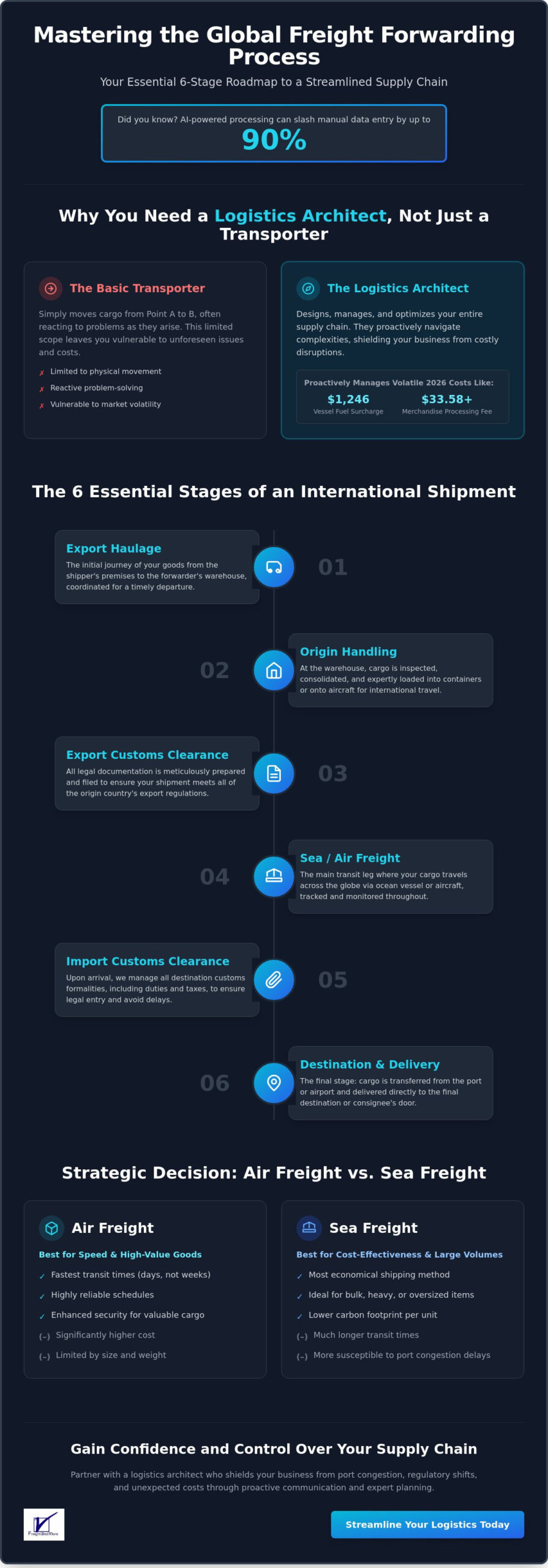
The 6 Essential Stages of an International Shipment
The physical journey of your cargo is a synchronized dance of logistics and law. Every successful freight forwarding process follows a structured path to ensure your goods don’t just move, but arrive safely and legally. It’s a high-stakes sequence where timing is everything, and missing a single beat can lead to significant delays or unexpected costs.
- Step 1: Export Haulage – This is the initial transfer where your goods move from the shipper’s premises to the forwarder’s warehouse. It requires reliable coordination to ensure the cargo is ready for its international voyage.
- Step 2: Origin Handling – Once at the warehouse, the cargo undergoes inspection and consolidation. This stage includes the physical loading of the goods into containers or onto aircraft at the port of departure.
- Step 3: Export Customs Clearance – Before leaving the country, your shipment must meet all legal requirements. Expert Customs Brokers and Freight Forwarders handle the complex declarations and permits required by origin authorities.
- Step 4: Main Carriage – This is the primary leg of the journey. Whether you’ve chosen the speed of air or the scale of sea freight, your cargo is now in international transit across borders.
- Step 5: Import Customs Clearance – As your goods arrive, they face the critical gateway of the destination country. In 2026, this involves managing specific fees like the Harbor Maintenance Fee (HMF) for sea freight, which is currently 0.125% of the cargo’s value.
Destination Handling and Last-Mile Delivery
After the main carriage concludes, destination handling begins at the terminal or warehouse. This involves unloading the cargo and processing it through the final security and administrative checks. The reliability of local transport is absolutely paramount here; it’s the difference between meeting a retail deadline and facing a costly stockout. We meticulously coordinate the last-mile delivery to your warehouse or storefront, ensuring a smooth handoff that completes the freight forwarding process. If you’re looking for a partner to manage these complex final steps with precision, feel free to reach out for a tailored logistics plan.
Consolidation vs. Direct Shipping
Strategic shipping requires choosing the right container model for your specific volume. LCL (Less-than-Container Load) consolidation is an excellent choice for smaller shipments, as it allows your goods to share container space and costs with other cargo. Conversely, FCL (Full Container Load) provides a dedicated container, offering higher security and faster transit times because there’s no need for mid-journey deconsolidation. Freight consolidation effectively reduces shipping overhead for Australian businesses in 2026 by distributing the weight of increased fuel surcharges across multiple cargo owners.
Navigating Customs Clearance and Regulatory Compliance
The regulatory landscape of 2026 requires a meticulous eye for detail and a proactive mindset. A licensed customs broker acts as your dedicated legal representative, ensuring your goods meet every stringent requirement before they even touch the dock. This expertise is a cornerstone of the freight forwarding process, especially when dealing with the Australian Border Force (ABF). For commercial imports, the ABF mandates strict reporting timelines and accurate valuation. If your shipment is valued over $2,500, you’ll need to account for specific processing fees that can fluctuate based on the fiscal year’s latest adjustments.
Australia’s unique environment makes biosecurity a top priority for every importer. The Department of Agriculture, Fisheries and Forestry (DAFF) monitors every arrival for potential risks, from timber packaging to organic materials. Professional customs clearance services are essential here. We identify which goods require specific treatments or inspections, preventing your cargo from being held in expensive quarantine. It’s about proactive management. We solve problems before they become penalties, ensuring your supply chain remains resilient and compliant.
Essential Documentation for Seamless Transit
Accuracy is your best defense against delays. The Bill of Lading serves as the ultimate legal contract and title to your goods; without it, the journey simply stops. We also ensure your commercial invoices and packing lists are perfectly aligned for duty assessment. If you’re importing from a country with a Free Trade Agreement, a valid Certificate of Origin is vital. It can often reduce your duty rate to zero, significantly boosting your profit margins and giving you a competitive edge in the Australian market.
Managing Duties, Taxes, and GST
Calculating costs shouldn’t be a guessing game. Customs duty is determined by the specific HS Code classification of your product. While many consumer goods fall between 2.5% and 6%, some specific categories can reach as high as 37.5%. We facilitate secure payments to the authorities on your behalf, providing total transparency throughout the freight forwarding process. This approach eliminates “hidden” costs. You get a clear view of your brokerage and handling fees from the start. Additionally, reviewing Freight Forwarding Service Fees for North American logistics can help you maintain a transparent and predictable supply chain cost structure. We handle the complexity so you can focus on growing your business with absolute confidence.
Strategic Decisions: Air Freight vs. Sea Freight Operations
Choosing between the sky and the ocean is often the most consequential moment in your freight forwarding process. It’s a balance of urgency, budget, and the physical nature of your cargo. While air freight forwarding offers unparalleled speed for time-sensitive launches, economical sea routes remain the backbone of large-scale global trade. You must weigh the higher premium of flight against the potential for lost sales if your inventory doesn’t arrive on time. We’ll help you run a cost-benefit analysis that considers every variable, from the June 2026 fuel surcharge adjustments to your specific delivery window.
Safety and sustainability are also shifting the scales in 2026. High-value commercial goods or fragile electronics often benefit from the smoother handling and reduced transit touchpoints of air travel. However, for businesses focused on environmental, social, and governance (ESG) goals, sea freight generally offers a lower carbon footprint. Many forwarders now offer “green routing” options to help you meet these targets while managing your bottom line. It’s about making a choice that aligns with your brand’s values and your customer’s expectations without sacrificing reliability.
The Mechanics of Sea Freight Services
Mastering global shipping lanes requires a deep understanding of major port procedures and carrier schedules. For bulk commodities or heavy machinery, the strategic advantage of sea freight services is undeniable. It allows for massive volume at a fraction of the cost of other modes. You should, however, maintain realistic transit time expectations. Maritime delays and port congestion can still occur, so we always recommend a proactive buffer in your planning. Our team monitors these global lanes constantly to keep you informed and your cargo moving through the freight forwarding process.
Optimising Air Cargo for Business Speed
When every day counts, air freight consolidation provides a cost-effective way to access the speed of flight without paying for an entire pallet you don’t need. Your cargo will undergo rigorous international security screening, ensuring it meets all safety standards before departure. Air freight protects cash flow by reducing inventory lead times, allowing you to turn over capital much faster than traditional sea routes. If you need a precision-timed delivery to stay ahead of the competition, contact us today for a custom air or sea freight quote.
Partnering for Success: How Freight and More Streamlines Your Logistics
Choosing a partner to manage your global trade is a decision that impacts every facet of your business. As an Australian-owned forwarder with an expansive global reach, we provide a unique blend of local expertise and international scale. This ensures that your freight forwarding process isn’t just a series of transactions, but a meticulously managed strategy tailored to your specific commercial goals. We understand the nuances of the Australian market, from local transport logistics to the latest ABF regulatory shifts, allowing us to anticipate challenges before they disrupt your schedule.
Proactive communication is the foundation of our service. You’ll never be left wondering where your cargo is or why a delay has occurred. Instead, we provide regular, transparent updates that remove the stress typically associated with international shipping. By moving toward a fully integrated, end-to-end supply chain model, we eliminate the friction between different providers. This holistic approach ensures your goods move seamlessly from the factory floor to the final destination with the care and attention your business deserves.
Seamless Door-to-Door Solutions
There is a distinct peace of mind that comes with door-to-door international shipping. By maintaining single-point accountability across all six stages of the journey, we significantly reduce the risk of administrative errors or handling mishaps. Busy business owners often prefer this managed, “hands-off” approach because it allows them to focus on growth while we handle the heavy lifting. Whether it’s coordinating warehouse management or final local delivery, our team ensures every link in the chain is secure and efficient.
Get Started with a Professional Logistics Consultation
Ready to optimize your shipping strategy? Preparing for your first enquiry is simple. To receive an accurate quote, have your cargo dimensions, weight, and volume ready, along with the specific origin and destination addresses. Knowing your required delivery dates and any special handling needs for fragile or high-value goods will help us design the perfect solution for you. Take the next step toward a more reliable supply chain and contact Freight and More for a personalized quote. We are eager to show you how our expertise can transform your freight forwarding process into a competitive advantage.
Secure Your Supply Chain for 2026 and Beyond!
Mastering the freight forwarding process is the key to unlocking seamless global growth for your business. By understanding the six essential stages of international shipping and making strategic decisions between air and sea freight, you’ve already taken the first step toward total logistical confidence. Navigating the complexities of Australian Border Force requirements and biosecurity protocols doesn’t have to be a source of anxiety when you’ve got an expert guide by your side. We take pride in handling every detail with meticulous care; ensuring your cargo arrives exactly when and where it’s needed!
As an Australian owned and operated partner since 2009, we’ve built a reputation for excellence through our expert in-house customs brokerage and an extensive global network of reliable shipping agents. If you’re ready to remove the obstacles from your supply chain and enjoy a truly managed, proactive service, we’re here to assist. Request a Comprehensive Freight Quote from Freight and More today to experience the difference that personal attention makes. Let’s build a more resilient and successful future for your business together!
Frequently Asked Questions
What exactly does a freight forwarder do?
A freight forwarder acts as a strategic logistics architect who coordinates the entire journey of your goods across international borders. They don’t typically own the ships or planes; instead, they leverage a global network of carriers and agents to secure space and manage documentation. From negotiating rates to overseeing warehouse management and local transport, they ensure every stage of the journey is executed with precision and care.
Is freight forwarding the same as shipping?
No, shipping refers specifically to the physical transportation of cargo via sea, air, or land. Freight forwarding is a much broader management service that encompasses the entire freight forwarding process, including strategic planning, customs brokerage, and last-mile delivery. While a shipping line moves the container, a forwarder manages the complex legal and logistical requirements that ensure your container actually reaches its final destination without penalty.
How much does the freight forwarding process cost in Australia?
Total costs depend on several factors, including your cargo’s weight, dimensions, chosen transport mode, and current fuel surcharges. In 2026, you’ll need to account for mandatory government fees like the Merchandise Processing Fee (MPF) for formal entries. Because every shipment is unique, we recommend requesting a tailored quote to ensure you receive an accurate assessment of the handling and brokerage fees specific to your commercial needs.
Can a freight forwarder handle customs clearance?
Yes, a comprehensive forwarder can manage the entire customs clearance procedure on your behalf. Utilizing an expert in-house customs broker is often the most efficient way to navigate Australian Border Force (ABF) and biosecurity (DAFF) requirements. This integration prevents communication gaps between different service providers, ensuring your documentation is filed correctly and your duties are calculated accurately to avoid costly storage fees at the wharf.
What happens if my shipment is delayed during the process?
If a delay occurs due to port congestion or weather, your forwarder should proactively notify you and implement contingency plans. This might involve rerouting cargo through different terminals or coordinating with local transport partners to expedite the final delivery phase. While some delays are outside of human control, having a dedicated partner ensures you have a professional team working to minimize the impact on your supply chain.
Do I need marine transit insurance for my freight?
We highly recommend securing marine transit insurance for every international shipment you undertake. Carrier liability is often strictly limited by international conventions, which may not cover the full value of your commercial goods in the event of damage or loss. Taking out a policy provides essential financial protection and peace of mind, ensuring your investment is shielded from the unpredictable risks of global transit and maritime accidents.
How long does the international freight process typically take?
Transit times vary significantly depending on whether you choose air or sea freight for your cargo. Air freight typically takes between 3 to 10 days, including time for origin handling and customs clearance at the destination. Sea freight is more economical but slower, often requiring 20 to 45 days depending on the specific shipping lanes and port efficiency. We’ll help you plan your inventory lead times based on these realistic windows.
What documents do I need to provide to my freight forwarder?
You’ll need to provide several critical documents to ensure a smooth freight forwarding process, starting with a detailed Commercial Invoice and a Comprehensive Packing List. A Bill of Lading or Air Waybill is also required to serve as the contract of carriage. If you’re claiming benefits under a Free Trade Agreement, you must provide a valid Certificate of Origin to satisfy Australian Border Force requirements and secure duty concessions.
