LCL vs FCL Shipping: Choosing the Best Freight Method

The cheapest shipping quote on your desk might actually be the most expensive mistake for your bottom line. While it’s tempting to focus solely on the initial freight rate, savvy importers know that the real value lies in balancing speed, security, and total landed cost. If you’ve ever felt the sting of unpredictable Australian port charges or the stress of cargo damage in a shared container, you aren’t alone. It’s a common challenge for businesses trying to scale while keeping overheads under control, especially with global trade lanes facing fresh complexities.
Understanding the critical difference between LCL and FCL shipping is the first step toward reclaiming control over your supply chain. We’re here to help you master these logistics nuances so you can achieve faster delivery to your Australian warehouses and significantly reduce the risk of transit damage. This guide explores the 15 cubic meter breakeven point, the impact of 2026 IMO safety regulations on container reporting, and the strategic trade-offs that determine whether you should book a dedicated container or share the space. You’ll discover how to navigate the two to five day transit delay typical of LCL and how to secure your cargo against the latest maritime risks.
Key Takeaways
- Understand the fundamental difference between LCL and FCL shipping to decide if sharing container space or securing a private unit is the right move for your cargo.
- Discover how the “13 CBM rule” acts as a financial tipping point, helping you transition from volume-based pricing to more predictable full-container costs.
- Learn to navigate the operational hurdles of Container Freight Stations and avoid the common paperwork errors that can delay shared shipments by up to 10 days.
- Gain expert insights into managing total landed costs, ensuring your sea freight strategy accounts for Australian port fees and customs compliance from the start.
- Evaluate the security benefits of exclusive container use to minimize handling and safeguard your high-value goods during their journey to Australian shores.
Understanding the Basics: What Are LCL and FCL Shipping?
Sea freight is the lifeblood of our nation’s trade. Even in 2026, with global container trade projected to grow by 2.5% to 3.5%, our island geography makes maritime logistics the most viable path for bulk goods. To manage these massive volumes, the industry relies on the TEU, or Twenty-foot Equivalent Unit. This standard measure allows us to coordinate complex movements across a vast global network. Understanding the fundamental difference between LCL and FCL shipping is essential for any business looking to optimize its international reach. It isn’t just about volume; it’s about how you manage your supply chain’s heartbeat. LCL serves as a cost-sharing model specifically designed for smaller cargo volumes that don’t require the exclusive use of a whole container.
To better understand this concept, watch this helpful video:
Defining Less-than-Container Load (LCL)
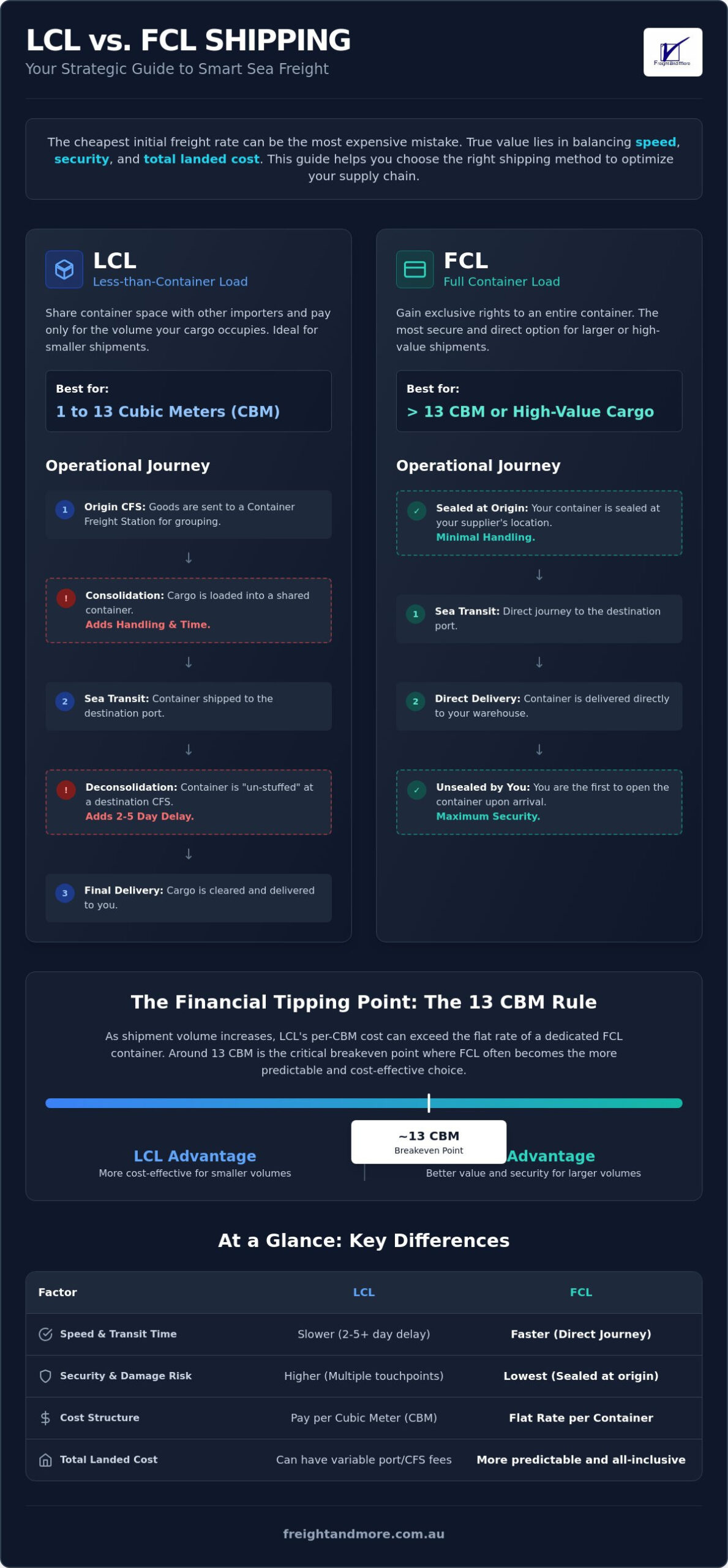
If you aren’t moving enough stock to fill a standard unit, Less-than-container load (LCL) is your most efficient solution. Through a process called consolidation, we group your cargo with shipments from other businesses into a single container. This allows you to pay only for the space you occupy, which is typically measured in cubic meters (CBM). It’s the ideal choice for shipments ranging from 1 to 13 CBM. By leveraging our international sea freight network, you gain access to global markets without the high overhead of a full container. We handle the logistics of merging these smaller shipments at a warehouse before they ever reach the port.
Defining Full Container Load (FCL)
When your operations scale or your cargo requires maximum protection, Full Container Load (FCL) becomes the logical step. FCL grants you exclusive rights to the entire container space, whether you fill it to the brim or leave it half empty. You can choose between standard 20ft, 40ft, or 40ft High Cube options based on your specific inventory needs. The primary advantage here is security. Since the container is sealed at the origin and remains closed until it reaches your warehouse, the risk of transit damage or tampering is significantly reduced. This direct journey often bypasses the extra handling required for shared shipments. With new 2026 safety regulations like mandatory electronic inclinometers on large vessels, your FCL cargo is tracked and protected with higher precision than ever before.
The Operational Journey: How LCL and FCL Shipments Move
Moving goods from a global factory to an Australian warehouse is a complex relay race where every handover matters. It isn’t a simple point-to-point journey. The fundamental difference between LCL and FCL shipping is found in the number of touchpoints your cargo encounters before it reaches its final destination. For smart businesses optimizing their shipping strategies, these operational steps are the primary factor in determining both the speed and the reliability of their supply chain. Understanding how these methods diverge on the ground helps you set realistic expectations for your inventory arrival.
The LCL Consolidation and Deconsolidation Process
LCL is a collaborative process that requires precision at every turn. First, your goods are collected and transported to an origin Container Freight Station (CFS). This facility is the heart of LCL logistics; it’s where we group your cargo with other compatible shipments bound for the same Australian port. Once the container arrives on our shores, it must be moved to a destination CFS for “un-stuffing.” This deconsolidation process typically adds 2 to 5 days to the total transit time compared to a full container. It’s a vital phase where each shipment is separated, checked, and prepared for individual customs clearance. While this adds extra steps, it remains a highly cost-effective way to move smaller volumes without paying for empty air.
The FCL Direct Loading Advantage
FCL offers a streamlined, “hook-and-go” experience that prioritizes speed and cargo integrity. The container is delivered directly to your supplier’s premises where they load your goods exclusively. A high-security seal is applied immediately, and that seal remains untouched throughout the entire ocean voyage. When the ship docks in Australia, the container is lifted off and is often ready for immediate transport to your door. There’s no waiting for other importers’ paperwork to be finalized or for deconsolidation queues at the CFS. This directness translates to faster delivery to your warehouse and significantly lower risk of transit damage because your goods aren’t handled multiple times during the journey.
At Freight and More, we pride ourselves on managing every link in this international chain. We don’t just book a slot on a ship. We coordinate with our global agent network to ensure your stock moves through every CFS and port gate without unnecessary pauses. Our team stays proactive, handling the complexities of Australian customs compliance so you don’t have to. Whether your cargo needs the careful grouping of an LCL service or the rapid transit of an FCL unit, we oversee the process with meticulous attention to detail. If you’re ready to streamline your next shipment and reduce your transit stress, start a conversation with our logistics experts today.
Comparing the Costs: Freight Rates vs. Total Landed Cost
Fixed vs. Variable Costs in Sea Freight
FCL operates on a flat-rate model, giving you a predictable price for the entire container regardless of how much stock you actually pack inside. This is particularly beneficial for high-volume importers who can maximize every inch of space to drive down the cost-per-unit. Conversely, LCL uses volume-based pricing, where you pay per cubic meter (CBM). It’s a flexible way to manage cash flow for smaller batches. However, there’s a clear tipping point. Industry data suggests that once your shipment reaches approximately 14 to 15 CBM, FCL often becomes the more economical choice. Even if you don’t fill the container, the flat rate can result in a lower total expenditure than the cumulative CBM charges of a shared container. Our sea freight services are designed to help you identify these thresholds so you never overpay for your logistics.
Hidden Fees: Deconsolidation and Port Charges
Australian ports have specific fee structures that can surprise the unprepared, especially during peak seasons when rates can climb by 40% to 80%. When your goods arrive in a shared container, they must go through a deconsolidation process at a local warehouse. This adds Terminal Handling Charges (THC) and specific LCL service fees that aren’t present in FCL shipments. LCL has higher handling fees per unit than FCL. These costs can eat into your profit margins if you haven’t accounted for the extra labor involved in sorting and “un-stuffing” the container. Integrating customs clearance Australia into your cost calculations is also vital, as the complexity of the paperwork and the number of individual line items can vary between the two methods. We provide the transparency you need to navigate these port-side expenses with total confidence and precision.
Speed, Security, and Risk: Which Option Protects Your Supply Chain?
Choosing the right freight method is about more than just moving boxes. It’s a vital decision about the resilience of your entire supply chain. A significant difference between LCL and FCL shipping is the level of control you maintain over the environment and the timeline of your goods. While global schedule reliability reached 64.7% recently, external factors like port congestion and customs inspections can still disrupt your flow. Protecting your cargo requires a proactive strategy that anticipates these risks before they impact your Australian warehouse arrival dates.
Transit Times and Potential for Delays
Speed is often the deciding factor for commercial shipments. FCL is almost always the faster choice because it bypasses the time-intensive consolidation and deconsolidation stages. On average, LCL shipments take 2 to 5 days longer than FCL due to the extra handling at Container Freight Stations. This gap can widen to 10 days during peak seasons or when ports face heavy backlogs. If your goods are time-sensitive or tied to a strict promotional launch, the direct nature of a full container provides the predictability you need. FCL allows your stock to move as a single unit, avoiding the queues that shared shipments must navigate at both ends of the journey.
The risk of “contagion” is a unique challenge for shared containers. If just one shipper in your shared container has incorrect customs paperwork or restricted items, the entire unit can be flagged for a mandatory inspection. This means your perfectly documented goods are held up by someone else’s mistake. In an FCL scenario, you’re only responsible for your own compliance, which significantly reduces the chance of unexpected delays at the Australian border. We mitigate these risks by meticulously vetting every piece of documentation, ensuring your cargo moves as smoothly as possible through the regulatory landscape. This level of professional oversight is essential in every market; for example, tranzitexpress.com provides expert freight brokerage to help businesses navigate these complexities in the US.
Cargo Handling and Damage Prevention
Every time a pallet is moved, the risk of transit damage increases. LCL involves multiple touchpoints: loading at the factory, consolidation at the origin warehouse, and “un-stuffing” at the destination. This increased handling makes your cargo more vulnerable to shifting loads or accidental impact. FCL offers a superior security profile because the container is sealed at the supplier’s door and remains closed until it reaches you. This “shipper-sealed” status is the gold standard for high-value or fragile items. Regardless of the method you choose, securing comprehensive marine transit insurance is a non-negotiable step to protect your financial interests against the unpredictability of the open sea.
At Freight and More, we function as your dedicated partner and guide through these complex logistics hurdles. We don’t just move freight; we manage risk with a detail-oriented approach that prioritizes the safety of your inventory. Our global network and local expertise allow us to foresee obstacles and provide bespoke advice tailored to your specific cargo needs. If you want to eliminate the guesswork and secure your supply chain with a team of seasoned veterans, request a tailored shipping consultation and let us handle the heavy lifting for you.
Strategic Decision Matrix: Choosing the Right Option for Your Business
If your business is navigating the shift toward leaner inventory models in 2026, your choice of sea freight is more than a simple logistics decision. It’s a powerful financial lever. Mastering the strategic difference between LCL and FCL shipping allows you to pivot quickly as market demands fluctuate, ensuring you never carry more stock than necessary while keeping your landed costs low. The decision often rests on a delicate balance of volume, urgency, and the specific needs of your Australian supply chain. We’re dedicated to helping you find that “sweet spot” where efficiency meets economy.
A reliable rule of thumb for many of our clients is the 13 CBM threshold. While the technical breakeven point often sits around 14 to 15 cubic meters, we frequently find that at 13 CBM, the added security and speed of a 20ft container outweigh the marginal cost savings of a shared shipment. Our enquiries team is always ready to run these numbers for you, providing a clear comparison that accounts for current port fees and transit trends. We take pride in removing the guesswork, allowing you to make data-driven choices that protect your bottom line.
When LCL is the Smarter Financial Move
LCL provides the flexibility that modern startups and growing enterprises crave. It’s the perfect solution for sample orders or testing new product lines without committing to a massive inventory investment. By adopting a “Just-in-Time” shipping model, you can ship smaller amounts more frequently. This approach significantly reduces your Australian warehousing overheads because you aren’t paying to store months of surplus stock. It’s an excellent way to manage cash flow, keeping your capital free for marketing and operational growth rather than tied up in a single, giant shipment. If you’re looking for high-frequency, low-volume reliability, LCL is your strongest ally.
Why FCL is the Gold Standard for Scaled Operations
For established businesses with high-volume requirements, FCL remains the undisputed champion of efficiency. You achieve the lowest possible cost-per-unit by utilizing the full volume of a 20ft or 40ft container, which is essential for maintaining competitive margins. Beyond the price, you gain total control over how your commercial goods are loaded and secured. This exclusivity minimizes the risk of damage from external cargo and ensures your stock arrives exactly as it left the factory. To see how these principles are applied by specialists in other major trade hubs, you can explore Container Haulage with Jagelo Haulage for reliable UK-based solutions.
FCL also offers a significant advantage during customs clearance. Because your container holds only your goods, the process is typically faster and less prone to the collective delays that can affect shared units. This leads to more predictable delivery windows and faster transport to your final destination. We’re here to function as your partner and guide, providing the expert oversight you need to ship with total confidence and precision. Whether you’re scaling up or staying lean, we have the network and the expertise to make your sea freight seamless.
Empower Your Global Supply Chain
Navigating the complexities of international trade requires more than just a booking; it demands a strategic alignment of your cargo needs with the most efficient freight method available. Mastering the difference between LCL and FCL shipping allows you to pivot between the flexibility of shared containers and the high-volume security of exclusive units with total confidence. By focusing on total landed costs and transit reliability, you can ensure your goods arrive at their Australian destination safely and on schedule.
Freight and More brings over 15 years of international logistics excellence to your business, functioning as a proactive partner that simplifies every step of the journey. We integrate expert Australian customs brokerage with seamless door-to-door national delivery to remove the obstacles from your supply chain. Our team is eager to help you optimize your shipping overheads and protect your cargo integrity through meticulous oversight and bespoke advice. Request a Tailored Sea Freight Quote from Freight and More today to secure a logistics strategy that scales with your ambition. We’re ready to help you succeed!
Frequently Asked Questions
What is the main difference between LCL and FCL shipping?
The primary difference between LCL and FCL shipping is whether you share container space with other importers or have exclusive use of the entire unit. In an LCL setup, your cargo is grouped with other shipments at a warehouse before loading. FCL means the container is dedicated solely to your goods from the moment it’s sealed at the factory. This choice impacts your total costs, security levels, and the speed of your supply chain.
Is LCL or FCL cheaper for a 10 CBM shipment to Australia?
LCL is generally the more economical choice for a 10 CBM shipment because you only pay for the volume you occupy. FCL typically becomes more cost-effective once you reach the 14 to 15 CBM mark. However, you must consider Australian port charges and deconsolidation fees, which are often higher per unit for LCL. We always recommend calculating the total landed cost to ensure your small-batch strategy remains profitable in the long run.
How much longer does LCL take compared to FCL?
LCL shipments typically take 2 to 5 days longer than FCL due to the mandatory consolidation and deconsolidation processes at both ends of the voyage. Your goods must wait for the container to be stuffed with other shipments at the origin and un-stuffed at a local Australian warehouse upon arrival. If your cargo is time-critical, FCL offers a more direct approach that bypasses these extra handling steps and gets your stock to the warehouse faster.
Can I ship fragile goods via LCL or is FCL mandatory?
You can ship fragile goods via LCL, but FCL is the preferred option to minimize the risk of transit damage. LCL involves multiple touchpoints and manual handling as pallets are moved in and out of shared containers. With FCL, your goods are loaded once, sealed, and remain untouched until they reach your door. If you choose LCL for delicate items, ensure your packaging is exceptionally robust to withstand the extra movement during the consolidation phase.
What happens if another shipper’s goods in my LCL container are flagged by customs?
If another shipper’s goods in your shared LCL container are flagged by Australian Border Force, the entire container is often held for inspection. This means your perfectly documented cargo could face delays through no fault of your own. This risk is a unique drawback when considering the difference between LCL and FCL shipping. In an FCL scenario, you’re only responsible for your own compliance, giving you greater control over your delivery timeline.
At what volume does FCL become more cost-effective than LCL?
FCL usually becomes more cost-effective than LCL when your shipment volume reaches approximately 14 to 15 cubic meters (CBM). Even if you don’t fill a 20ft container to its capacity, the flat-rate freight price often results in a lower cost-per-unit than individual CBM charges. This tipping point varies based on current shipping rates and port fees, so it’s vital to have our team run a comparative analysis for your specific route.
Do I need different insurance for LCL vs FCL shipments?
You don’t need different types of insurance, but your marine transit insurance should be tailored to the specific risks of your chosen method. LCL shipments face higher risks from physical handling and un-stuffing accidents, while FCL risks are more focused on maritime perils or container loss. Regardless of the method, we strongly advise securing comprehensive coverage to protect your financial investment against the unpredictability of international sea freight and potential port delays.
Can Freight and More handle the local delivery for both LCL and FCL?
Yes, Freight and More provides integrated local transport for both LCL and FCL shipments across Australia. Once your goods clear customs, we coordinate the final leg of the journey to ensure a seamless door-to-door experience. Whether we’re delivering a full container via sideloader or a few pallets from a deconsolidation warehouse, our team manages the logistics to ensure your stock reaches its destination with the same care and precision as its ocean voyage.
