The Comprehensive Guide to Interstate Road Transport in Australia for 2026

By August 1, 2026, the landscape of interstate road transport australia will undergo its most significant regulatory transformation in years, turning standard compliance into a high-stakes strategic advantage. You’ve likely felt the pressure of unpredictable transit times across our vast continent or wrestled with the nuances of LTL versus FCL costs while trying to maintain a lean supply chain. It’s a complex environment where even a minor oversight in Chain of Responsibility can disrupt your entire operation, leading to delays and unexpected costs. We understand that moving commercial cargo isn’t just about the distance traveled; it’s about the precision of every leg from the port to the final warehouse.
This guide empowers you to master these complexities by providing expert insights into the new Heavy Vehicle National Law reforms and the updated General Mass Limits effective this August. You’ll gain total confidence in selecting the right vehicle configurations and service levels to ensure your domestic freight integrates seamlessly with international arrivals. We’ll dive into the shift toward mandatory Safety Management Systems, the impact of the reinstated Road User Charge, and how to optimize your logistics model for a new era of Australian transport.
Key Takeaways
- Prepare for the August 2026 regulatory shifts by understanding how risk-based safety management systems and increased vehicle mass limits will redefine operational efficiency.
- Master the selection between LTL and FCL models to optimize your budget and transit times across the vast network of interstate road transport australia.
- Navigate the complexities of the Chain of Responsibility with clarity, ensuring your business remains fully compliant with the latest National Heavy Vehicle Regulator standards.
- Gain a strategic advantage by comparing road, rail, and air freight to determine which mode offers the best door-to-door flexibility for your specific commercial cargo.
- Learn how to integrate your domestic legs with international freight arrivals to create a truly seamless and proactive end-to-end supply chain solution.
The Landscape of Interstate Road Transport in Australia
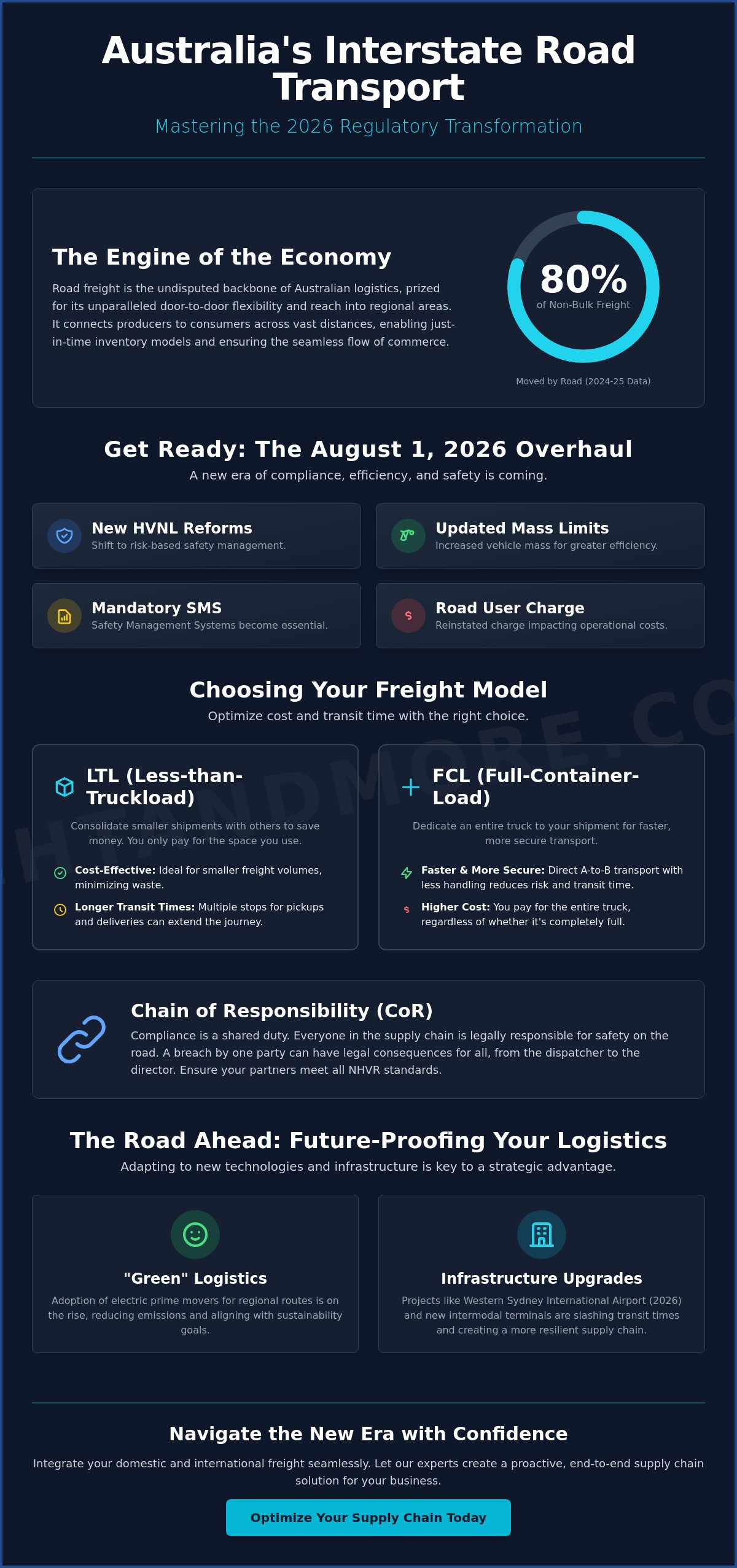
Interstate road transport australia involves the movement of commercial goods across state and territory borders, utilizing a complex network of heavy vehicles to bridge the gap between production and consumption. In a country as geographically expansive as ours, this sector functions as the literal lifeblood of the economy. By 2026, road freight continues to dominate the logistics sector, accounting for nearly 80% of non-bulk freight moved across the nation according to 2024-25 industry data. This reliance stems from the unique capability of trucks to provide door-to-door service, reaching regional pockets where other modes of transport simply cannot compete.
Understanding the historical and regulatory foundation of Road transport in Australia is essential for any business looking to optimize its supply chain. The national highway network serves as the primary artery for commerce, connecting major capital cities like Melbourne, Sydney, and Brisbane through high-volume corridors. These routes allow for a level of flexibility that rail and sea freight often lack, providing the agility needed to respond to sudden market shifts or urgent delivery requirements.
To better understand the scale and daily operations of these vital corridors, watch this helpful video:
The Strategic Role of Road Freight in 2026
Modern Australian retailers and manufacturers rely heavily on road transport to support just-in-time inventory models, which minimize storage costs and maximize cash flow. As we move through 2026, we’re seeing a significant shift toward “green” logistics, with more operators adopting electric prime movers for regional corridors to combat emissions. This evolution isn’t just about sustainability; it’s about efficiency. The adoption of more sophisticated heavy vehicle configurations allows for larger payloads, reducing the total number of trips required to move the same volume of goods. For businesses operating in regional Australia, road freight remains the only viable option for maintaining consistent connectivity to metropolitan hubs and international exit points.
Infrastructure and Connectivity Across State Borders
The efficiency of interstate movement is currently being enhanced by major infrastructure projects designed to slash transit times and improve vehicle safety. The opening of the Western Sydney International Airport in 2026 is a prime example, acting as a massive catalyst for road freight demand in the surrounding regions. Additionally, the development of sophisticated intermodal terminals is bridging the gap between sea ports and road networks, allowing for a more fluid transition of goods from international arrivals to domestic delivery. If your cargo requires customs clearance before hitting the road, these integrated hubs ensure that the transition from wharf to warehouse is handled with meticulous care and minimal delay. These upgrades to our freight corridors don’t just move trucks faster; they create a more resilient and predictable supply chain for every Australian business.
Understanding Freight Models: LTL, FCL, and Vehicle Configurations
Selecting the right freight model is the foundation of a successful logistics strategy. It isn’t just about moving goods from point A to point B; it’s about aligning your volume, budget, and timeline with the most efficient mode of interstate road transport australia. Whether you’re shipping a single pallet of electronics or a fleet’s worth of industrial machinery, the choice between Less-than-Truckload (LTL) and Full-Container-Load (FCL) will dictate your operational rhythm. Each model offers distinct advantages in handling, cost, and speed that savvy businesses must leverage to stay competitive.
As highlighted in the National Freight and Supply Chain Strategy, the push for greater efficiency across our networks means that choosing the correct vehicle configuration is more important than ever. Beyond the major metropolitan hubs, on-forwarding services become essential. These services act as the final link, ensuring that cargo arriving at a central terminal in a state capital reaches its ultimate remote destination with the same level of care and precision as the primary interstate leg.
LTL vs. FCL: A Decision Framework for Businesses
LTL is often the go-to solution for businesses with smaller, palletised consignments that don’t require an entire trailer. By sharing space with other shippers, you benefit from reduced rates, though transit times may be slightly longer due to consolidation stops. FCL, or dedicated transport, is the preferred choice for large volumes, high-value shipments, or fragile goods that require minimal handling. The tipping point usually occurs when your cargo occupies more than 60% of a trailer’s capacity; at this stage, the cost of a dedicated vehicle often becomes more economical than individual pallet rates. Security is another major factor. If your cargo is sensitive, FCL offers the peace of mind that comes with a sealed, direct journey.
Heavy Vehicle Equipment and Trailer Types
The Australian landscape demands diverse equipment to handle varying climates and cargo types. We utilize several specialized trailer configurations to ensure your goods arrive in pristine condition:
- Tautliners: These are the versatile workhorses of the industry. Featuring heavy-duty side curtains, they provide easy access for loading while offering robust weather protection for general palletised goods.
- Flat-tops and Drop-decks: If you’re moving oversized industrial equipment or mining machinery, these open trailers are indispensable. They allow for crane loading and can accommodate heights and widths that enclosed trailers cannot.
- Pantechs and Refrigerated Vans: For high-security commercial goods or temperature-sensitive items like pharmaceuticals and perishables, these rigid-wall trailers are the gold standard. They offer maximum protection against theft and external environmental factors.
Matching your specific cargo to these configurations ensures maximum security and compliance with national safety standards. If you’re unsure which trailer type best suits your next shipment, our team is ready to provide bespoke advice tailored to your needs.
Road Freight vs. Rail and Air: A Strategic Comparison
Choosing the most effective mode for moving goods across our continent is a balancing act of priority, budget, and precision. While rail and air each hold a specific place in the logistics ecosystem, interstate road transport australia remains the “Goldilocks” solution for the vast majority of commercial cargo. It offers a level of responsiveness that fixed-schedule alternatives simply can’t match. You aren’t beholden to a train’s departure time or an airline’s weight restrictions; instead, you gain a solution that moves according to your business’s specific pulse.
All operators in this space must adhere strictly to the Heavy Vehicle National Law (HVNL), which ensures a standardized level of safety and compliance across state lines. This regulatory framework provides a reliable foundation for road transport, making it a predictable and secure choice for high-value commercial shipments. While rail is often touted for bulk commodities over massive distances, road transport provides the agility needed for door-to-door delivery without the need for complex intermodal transfers at every step.
Transit Time and Reliability Benchmarks
Road transport consistently outperforms rail when it comes to total transit time because it avoids the “last-mile” delays inherent in hub-based systems. When you ship via rail or air, your cargo often spends significant time sitting in terminals waiting for consolidation or local pick-up. A truck, however, can travel directly from your warehouse to the receiver’s dock. While extreme weather can impact all modes, road networks offer more rerouting options than a fixed rail line. You’ll find that for most interstate routes, such as the Melbourne-to-Sydney corridor, road transport provides the most reliable delivery window for time-sensitive commercial goods.
Cost-Efficiency and Scalability
From a cost perspective, road transport offers a scalable model that adapts to your fluctuating business volumes. Rail freight might offer a lower price-per-tonne for massive bulk shipments, but it lacks the flexibility to handle smaller, varied consignments economically. Air freight remains the premium choice for low-volume, time-critical items, yet its cost is often prohibitive for standard commercial cargo. In 2026, environmental considerations are also taking center stage. With heavy vehicles contributing 23% of total transport emissions, the industry’s shift toward electric prime movers and more efficient vehicle configurations is making road freight a more sustainable, high-performance choice for the modern supply chain.
Navigating Compliance and Safety in Australian Logistics
Compliance in interstate road transport australia is entering a new era of transparency and shared accountability. As of August 1, 2026, the Heavy Vehicle National Law (HVNL) reforms move toward a risk-based approach, requiring all accredited operators to have a documented and auditable Safety Management System (SMS). This shift ensures that safety isn’t just a checklist but a core part of every logistics decision. The National Heavy Vehicle Regulator (NHVR) oversees these standards, providing a unified framework that keeps our roads safe and your cargo secure. Reliable interstate road transport australia depends on every player in the supply chain doing their part to minimize risk.
The Chain of Responsibility (CoR) Explained
The Chain of Responsibility is a legal framework ensuring all parties share responsibility for heavy vehicle safety. This means that if you are the consignor or the receiver, you are just as legally liable for breaches as the driver or the carrier. If your business influences how goods are packed, loaded, or scheduled, you are a party in the chain. We help you mitigate these risks by acting as a proactive partner, ensuring every leg of the journey adheres to the highest safety standards. By choosing a partner with a robust SMS, you protect your business from the severe penalties associated with CoR failures.
Cargo Preparation and Loading Standards
Proper cargo preparation is the first line of defense against transit damage and regulatory fines. Best practices involve using high-quality pallets and industrial-grade wrapping to prevent shifting during long-haul travel; sourcing reliable load restraint gear from experts like Cargo Care NZ can further ensure your freight remains secure. You must also strictly adhere to Mass, Dimension, and Loading (MDL) requirements. From August 1, 2026, General Mass Limits have increased to align with Concessional Mass Limits, providing a maximum mass increase for many combinations exceeding 55 tonnes. However, accurate documentation and weight declarations remain non-negotiable. Fatigue management is equally critical, with electronic work diaries now serving as the standard for monitoring driver hours and ensuring everyone on the road is rested and alert.
Safety and compliance are the pillars of a resilient and professional supply chain. If you want to ensure your operations meet the 2026 standards, contact our team for a comprehensive compliance review.
Optimising Your Supply Chain with End-to-End Transport Solutions
Success in modern commerce depends on more than just moving boxes; it requires a strategic bridge between international borders and domestic doorsteps. Interstate road transport australia serves as the final, critical link that completes the international freight forwarding cycle. When your cargo arrives at a major port, the speed and efficiency of the following road leg determine whether your supply chain remains lean or becomes a bottleneck. Integrating your sea freight services directly with a robust road network ensures that port-to-door logistics feel like a single, fluid motion rather than a series of disconnected hurdles.
Leveraging 3PL warehouse management acts as a vital buffer for these interstate movements. By strategically positioning stock in centralized hubs, you can manage fluctuating demand across state lines without the stress of immediate cross-docking. This approach allows you to consolidate shipments, reduce the frequency of urgent LTL runs, and maintain a consistent flow of goods to your regional customers. It’s about building resilience into your network so that a delay at sea doesn’t necessarily mean an empty shelf in a different state.
From Port to Door: The Final Leg
Streamlining the transition from an international arrival to an interstate departure is where most logistics strategies either succeed or fail. Delays often occur during the handover between different providers, which is why using a single partner for customs clearance and domestic delivery is a significant advantage. Local expertise in customs brokerage prevents the administrative friction that often stalls domestic transport. For a deeper look at how to coordinate these complex movements, refer to our Complete Guide to Door-to-Door Shipping in Australia for 2026. Having a team that understands both the wharf requirements and the highway regulations ensures your cargo never sits idle.
The Value of a Comprehensive Logistics Partner
Freight and More Pty Ltd specializes in managing the intricate details of interstate and local transport, providing a seamless experience for businesses of all sizes. We combine a sophisticated global agent network with deep Australian domestic expertise to offer a level of service that smaller local carriers can’t match. This global-local synergy means we can troubleshoot international issues before they impact your domestic schedule. We don’t believe in one-size-fits-all solutions; instead, we tailor our road transport configurations to your specific industry requirements. Whether you’re moving high-value electronics or heavy industrial machinery, our proactive approach ensures your needs are handled with meticulous care and personal attention every step of the way.
Mastering Your Australian Logistics Strategy for 2026 and Beyond
The 2026 regulatory landscape demands a more proactive and risk-based approach to your supply chain than ever before. You now have the tools to navigate the Heavy Vehicle National Law reforms with confidence, ensuring your commercial cargo moves with maximum efficiency and total compliance. By strategically choosing between LTL and FCL models and integrating your interstate legs with professional customs clearance, you transform your logistics from a cost center into a competitive advantage.
Since 2009, Freight and More Pty Ltd has functioned as a dedicated partner for businesses across the country, offering deep industry expertise and a global network of agents. We manage the entire lifecycle of your shipment, providing comprehensive end-to-end logistics that bridge the gap from international ports to local doorsteps. Our national coverage ensures that your goods are handled with meticulous care, regardless of the distance or complexity involved.
Request a tailored quote for your interstate transport needs today and let us help you streamline your interstate road transport australia with precision and scale. We’re ready to solve your logistics challenges and help you reach your next business milestone!
Frequently Asked Questions
How long does interstate road transport typically take in Australia?
Transit times for interstate road transport australia vary significantly based on the specific route and service level you select. A standard journey between Melbourne and Sydney typically takes 12 to 24 hours, while crossing to Perth from the East Coast generally requires 4 to 7 days. These timelines are influenced by mandatory fatigue management breaks and current road conditions on major national freight corridors.
What is the difference between LTL and FCL in road freight?
LTL stands for Less-than-Truckload, where you share trailer space and costs with other shippers, making it ideal for smaller palletised consignments. FCL, or Full-Container-Load, provides a dedicated vehicle for your cargo alone. You’ll want to choose FCL if you have enough volume to fill a trailer or if your high-value goods require the highest level of security and minimal handling.
What is the Chain of Responsibility (CoR) and how does it affect my business?
The Chain of Responsibility is a legal framework ensuring that anyone with control over a transport task shares responsibility for heavy vehicle safety. It means your business is legally liable for breaches like overloading or driver fatigue, even if you aren’t behind the wheel. We help you manage this risk by ensuring all loading and scheduling practices meet the 2026 National Heavy Vehicle Regulator standards.
Is road transport safer than rail for fragile commercial goods?
Road transport often provides a more stable environment for fragile commercial goods because it involves significantly less vibration and shunting than rail freight. Specialized equipment like air-ride suspension and Pantech trailers offers superior shock absorption during the journey. By choosing a dedicated road service, you minimize the number of times your goods are handled, which reduces the primary cause of transit damage.
Can interstate road transport be integrated with international air or sea freight?
Yes, interstate legs are frequently the final component of a seamless international supply chain. We specialize in coordinating the transition from international air or sea arrivals directly into our domestic road network. By integrating interstate road transport australia with our customs clearance services, we eliminate the administrative friction and delays often found when switching between different logistics providers at the port.
What documents are required for shipping commercial goods interstate?
You’ll need a comprehensive set of documents to ensure a smooth journey, starting with a detailed consignment note and a commercial invoice. A precise packing list is also essential for weight verification and safety audits during transit. If you’re moving hazardous materials, specific dangerous goods declarations are mandatory to comply with Australian safety regulations and ensure the protection of both the driver and the public.
How are interstate road transport costs calculated for businesses?
Costs are primarily determined by the “chargeable weight” of your cargo, which considers both the actual physical weight and the cubic space it occupies. The distance between pickup and delivery points, the type of specialized equipment required, and current fuel surcharges also play a major role. We provide transparent breakdowns so you understand exactly how your budget is allocated across the different stages of the transport process.
What vehicle types are best for oversized industrial equipment?
Flat-tops and drop-decks are the most effective vehicle types for moving oversized industrial or mining equipment across state borders. These open trailers allow for easy crane loading from the top or sides and can accommodate heights that would be impossible in a standard enclosed van. For exceptionally heavy loads, we utilize multi-axle configurations that comply with the updated 2026 General Mass Limits for heavy vehicles.
