Cost-Effective Freight Forwarding in Australia: The 2026 Strategic Checklist

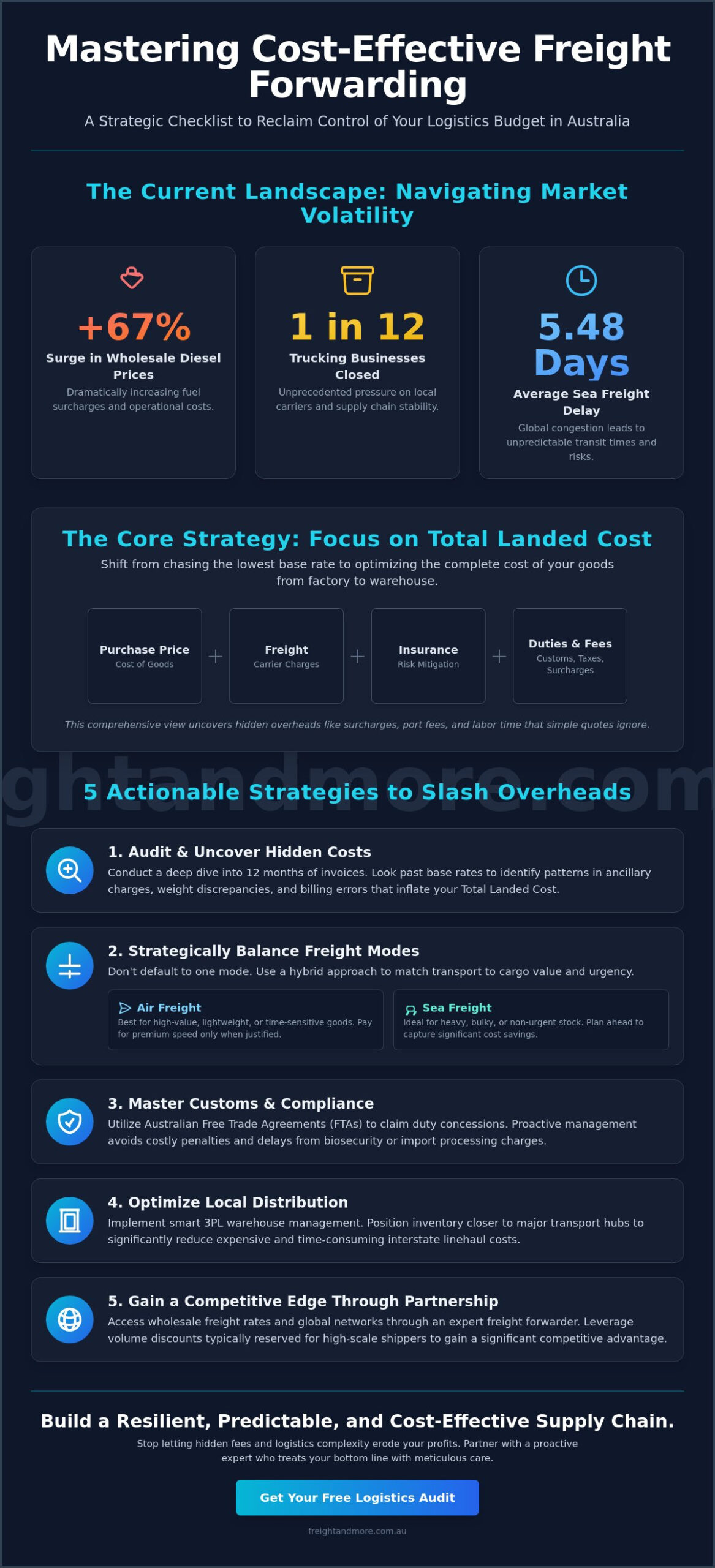
With wholesale diesel prices in Australia surging by more than 67% since March 2026, it’s a sobering reality that one in every twelve trucking businesses across the country closed down in the last year. You’ve likely felt this volatility firsthand through rising fuel surcharges and unexpected port congestion fees that eat into your margins before your goods even reach the warehouse. It’s frustrating to watch your overheads climb while you’re stuck navigating the complexity of multiple carriers and the constant threat of customs delays. We understand that in this high-stakes environment, you need more than just a service provider; you need a proactive partner who treats your bottom line with the same meticulous care as you do.
The good news is that achieving cost-effective freight forwarding australia wide is entirely possible when you shift your focus from chasing the lowest base rate to optimising your entire landed cost. This comprehensive 2026 strategic checklist is designed to help you master these complexities and reclaim control over your logistics budget. We’ll show you how to navigate the latest biosecurity charges and Import Processing Charges while leveraging Free Trade Agreements to your advantage. By the end of this guide, you’ll have a clear, actionable roadmap to slash overheads, streamline your customs clearance, and build a resilient supply chain that delivers predictable results every time.
Key Takeaways
- Identify the true Total Landed Cost of your goods by auditing previous invoices to uncover hidden overheads that exist far beyond simple base rates.
- Strategically balance air and sea freight modes to ensure you’re only paying for premium speed when your cargo value density truly justifies the investment.
- Implement cost-effective freight forwarding australia strategies by utilising Australian Free Trade Agreements to claim duty concessions and avoid unnecessary compliance penalties.
- Streamline your local distribution through smart 3PL warehouse management, positioning your inventory closer to major hubs to reduce expensive interstate transport costs.
- Gain a competitive edge by accessing wholesale freight rates and global networks that provide the volume discounts typically reserved for high-scale shippers.
Auditing Your Current Logistics Landscape for 2026
Every successful strategy begins with a clear view of where you stand. To achieve truly cost-effective freight forwarding australia wide, you must start by conducting a comprehensive audit of every freight invoice issued over the last twelve months. This isn’t just a basic review of numbers; it’s a deep dive into the patterns of your supply chain. You need to look past the attractive base rates and see the reality of your logistics spend. If you are still unsure of the foundational roles involved, understanding What is a Freight Forwarder? can clarify how these entities consolidate your cargo and negotiate on your behalf to protect your margins.
To help you visualise how professional management transforms your shipping strategy, watch this helpful video:
Calculating the True Cost of Your Shipping Operations
Many businesses mistakenly equate their shipping budget with the quotes they receive from carriers. However, your true financial commitment includes the labour time your team spends on packing, manifest creation, and constant tracking updates. We encourage you to look at the Total Landed Cost as your primary metric for success. Total landed cost is the sum of purchase price, freight, insurance, and duties. Including marine transit insurance is a non-negotiable step in this calculation. It protects your capital against the 5.48-day average delay seen in global sea freight, ensuring your risk-adjusted costs remain stable even when the unexpected happens.
Identifying Hidden Surcharges and Billing Errors
Billing errors are more common than most importers realise. During your audit, review carrier invoices specifically for weight discrepancies or incorrect zone classifications that might have quietly inflated your costs. You must also track the frequency of ancillary charges. With wholesale diesel prices in Australia seeing a massive 67% increase since March 2026, fuel surcharges are no longer just a minor line item. If your current providers aren’t transparent about terminal handling charges or if they’re failing to meet promised transit times, you’re experiencing waste that directly impacts your profitability. We’re here to help you strip away these inefficiencies and build a leaner, more predictable operation.
Optimising Freight Modes: Air, Sea, and Consolidation Strategies
Choosing the right transport mode is a balancing act that directly dictates your profit margins. To secure cost-effective freight forwarding australia wide, you must categorise your inventory by both urgency and value density. High-value, lightweight electronics might justify the expense of air transit, while heavy industrial components or seasonal retail stock are better suited for the ocean. We’ve seen businesses transform their results by simply moving non-urgent shipments from air to sea, capturing significant savings without disrupting their supply chain. It’s about being proactive rather than reactive with your scheduling. By planning ahead, you can leverage consolidation services that turn expensive, fragmented shipments into streamlined, efficient movements. This level of strategic oversight is exactly what the Australasian Supply Chain & Logistics Association advocates for to build resilient Australian businesses.
A hybrid approach often provides the best of both worlds. You might ship the bulk of your inventory via sea freight to keep costs low while using a small air freight allocation for urgent stock replenishment. This ensures you never miss a sale due to stockouts but keeps your average shipping cost per unit manageable. It’s a sophisticated way to manage cash flow while maintaining a high level of service for your customers. We take pride in helping you find that perfect equilibrium through meticulous data analysis and a "can-do" attitude toward complex logistics challenges.
LCL vs. FCL: Choosing the Right Sea Freight Option
If your shipment volume occupies more than 15 cubic metres, moving to a Full Container Load (FCL) often becomes more economical than Less than Container Load (LCL). While LCL allows you to pay only for the space you use, FCL offers superior security and eliminates many handling fees. Our sea freight services help you navigate these choices by consolidating smaller shipments into efficient, cost-protected movements.
Strategic Air Freight Management
International air freight is a powerful tool that requires surgical precision to remain affordable. Reserve this mode for high-margin goods or time-critical components. To keep these expenses down, you must optimise your packaging to reduce volumetric weight charges. For a deeper look at how to vet your providers for these high-speed requirements, see The Definitive Guide to Choosing an Air Freight Forwarding Company in 2026. If you’re ready to refine your mode selection, feel free to discuss your specific volume requirements with our expert team.
Reducing Costs Through Professional Customs and Compliance Management
Compliance isn’t merely a box-ticking exercise; it’s a high-impact financial strategy. To maintain truly cost-effective freight forwarding australia wide, you must treat customs documentation with the same precision as your financial ledgers. Even a minor error in tariff classification can result in you paying a 5% duty that wasn’t legally required, or worse, trigger heavy penalties from the Australian Border Force. We take a proactive approach by leveraging Australia’s extensive network of Free Trade Agreements (FTAs) to claim every available duty concession for our clients. By ensuring your documentation is flawlessly prepared before your cargo arrives, you avoid the administrative friction that leads to costly inspections and terminal storage fees.
The Financial Impact of Customs Brokerage
Professional customs clearance acts as your primary defence against unnecessary taxation and administrative waste. Expert brokers identify specific tax-saving opportunities, such as Tariff Concession Orders (TCOs), that generalists often overlook. Professional brokerage prevents five-figure demurrage penalties by ensuring your paperwork is lodged and processed well before the vessel berths. This foresight is essential when navigating current regulations, where the Import Processing Charge (IPC) stands at A$50 for goods valued under A$10,000 and A$152 for shipments above that threshold. For a comprehensive look at navigating these requirements, our Ultimate Guide to Freight Forwarding Services in Australia offers deep insights into maintaining a compliant supply chain.
Avoiding Demurrage and Detention Fees
Demurrage and detention fees are the silent killers of many logistics budgets. These daily charges accumulate rapidly when you fail to collect a container from the wharf or return the empty equipment to the depot within the "free time" window. To keep your operations lean, you must set up proactive alerts for container arrivals and coordinate seamlessly with your local transport providers. Data from the Australian freight and logistics industry facts shows the sheer scale of cargo moving through our ports, making terminal congestion a constant threat to your timeline. We recommend auditing your supply chain to identify recurring bottlenecks, such as slow document turnover or warehouse congestion, and addressing them before they manifest as storage charges. A "can-do" attitude combined with meticulous scheduling ensures your goods keep moving and your costs stay down.
Streamlining Warehousing and Local Distribution Efficiency
Efficient local distribution is the final, critical link in maintaining cost-effective freight forwarding australia wide. Once your goods clear customs, the clock starts ticking on storage costs and transport levies. You can significantly reduce these overheads by positioning your inventory strategically within the country. For instance, while warehousing in some key regions averages A$4.70 per pallet per week, optimising your distribution network by utilising facilities in other strategically advantageous areas can lower that cost to A$3.75. Small adjustments like these, combined with a proactive approach to supply chain design, ensure your capital isn’t tied up in expensive floor space. Freight and More Pty Ltd helps you look at the big picture to find these pockets of efficiency that others often miss.
The 3PL Advantage for Australian Importers
Leasing your own facility often introduces heavy fixed costs that don’t scale with your business. By utilising professional warehouse management, you convert those fixed overheads into variable costs that only apply when you have stock on hand. This is particularly vital for growth. Our Logistics for Small Business in Australia guide highlights how scaling requires agility. Implementing robust inventory systems prevents the "overstock trap" where high receiving fees, ranging from A$14 to A$50 per pallet, and pick-and-pack charges erode your profit. Cross-docking is another powerful tool; by moving goods directly from the port to the end customer, you bypass storage fees entirely.
Optimising Local and Interstate Transport
Moving heavy containers across the vast Australian landscape requires a calculated choice between road and rail freight. Road offers speed, but rail often provides a more predictable budget for non-urgent interstate movements. To slash your transport spend, you must consolidate multiple local orders into single interstate movements to minimise the impact of per-stop charges. If you’re operating out of major hubs, refining your handling best practices across your network is crucial. Reducing pick-and-pack errors through better layout design also saves you from the hidden cost of return logistics. If you want to see how much you could save by refining your local distribution, contact our logistics specialists for a tailored assessment.
Partnering with a Freight Forwarder to Secure Volume Discounts
The final piece of the logistics puzzle isn’t found in a spreadsheet or a warehouse; it’s found in the strength of your partnerships. Securing truly cost-effective freight forwarding australia wide depends on your ability to leverage the massive buying power of an established partner who moves significant volume across global lanes. While individual shippers often face rigid retail rates and limited negotiation room, a professional forwarder aggregates the requirements of hundreds of clients to unlock wholesale pricing. This collective volume gives us the leverage to secure space on vessels and aircraft even during peak seasons, ensuring your goods aren’t left on the wharf while your competitors’ shipments are moving. We take immense pride in being that dedicated partner, standing by your side to navigate every hurdle with professional confidence.
Accessing Global Network Rates
Our global network of agents acts as your eyes and ears on the ground in every major port, from Shanghai to Los Angeles. This extensive reach allows us to negotiate better local handling costs and terminal fees that are typically opaque to individual businesses. By leveraging the expertise of Freight and More Pty Ltd, you gain access to a team that navigates global shipping volatility with ease. We provide comprehensive door-to-door services that eliminate the need for you to manage fragmented providers. This streamlined approach not only reduces your administrative labour costs but also minimizes the risk of expensive hand-off errors between multiple carriers. Your cargo stays under one watchful eye, ensuring meticulous care from origin to destination.
Proactive Supply Chain Management
Beyond just moving boxes, your forwarder should function as a strategic consultant who identifies long-term structural savings within your business. We don’t just react to the market; we anticipate it. With global sea freight schedule reliability recently recorded at 62.2%, having a partner who can proactively reroute cargo or suggest alternative hubs is essential for maintaining your margins. We recommend scheduling regular reviews of your shipping lanes to ensure you’re always using the most efficient route and transport mode for your specific cargo. This proactive oversight helps you avoid the "emergency" shipping costs that often occur when supply chains are poorly managed. If you’re ready to see how our volume discounts and expert guidance can transform your bottom line, visit our Enquiry Page for a tailored cost-reduction analysis. We’re eager to solve your most complex problems and help you build a supply chain that is both resilient and highly profitable.
Securing Your Supply Chain Advantage for 2026
Mastering the intricacies of Australian logistics requires a fundamental shift from passive shipping to proactive supply chain management. By auditing your total landed costs and strategically balancing air and sea freight, you protect your margins against the volatile price shifts we’ve seen in the domestic market. Flawless customs compliance remains your strongest defence against the hidden drain of terminal fees and administrative penalties. Implementing these disciplined strategies is the essential foundation for achieving cost-effective freight forwarding australia wide.
We’re here to help you navigate these complexities with total confidence. As an Australian owned and operated partner since 2009, with established offices in Melbourne, Sydney, and Brisbane, Freight and More Pty Ltd brings nearly two decades of local expertise to your doorstep. Our team provides the expert Customs Brokerage and Clearance services you need to turn logistical challenges into competitive advantages. Don’t let rising fuel surcharges or port congestion dictate your success. Take control of your distribution budget and experience the difference that meticulous care and global connectivity can make for your brand. Request a Comprehensive Freight Audit and Quote from Freight and More Pty Ltd today. We’re ready to help your business thrive in 2026 and beyond!
Frequently Asked Questions
How much can I save by switching from Air to Sea freight in Australia?
Switching from air to sea freight can reduce your transportation costs by 70% to 80% depending on the cargo’s weight and volume density. While air freight is priced primarily by kilogram, sea freight utilises cubic metre measurements, making it the superior choice for heavy or bulky inventory. By planning your shipments 4-6 weeks in advance, you capture these massive savings while maintaining a steady supply chain flow across Australia’s major ports.
Can a customs broker really help me reduce my shipping costs?
Yes, a licensed customs broker identifies legal duty concessions and Free Trade Agreement (FTA) benefits that most businesses overlook. They ensure your goods are classified under the correct tariff code, preventing the overpayment of the standard 5% duty rate. Their expertise in pre-clearing cargo also prevents expensive port storage fees and demurrage penalties that often reach thousands of dollars per day if your documentation contains even minor errors.
What is the most cost-effective way to ship heavy goods interstate?
Utilising rail freight or coastal sea shipping is typically the most economical method for moving heavy, non-urgent goods between Australian states. While road transport offers door-to-door speed, rail provides a significantly lower cost-per-tonne for bulk movements between major hubs like Melbourne and Perth. Consolidating multiple orders into a single Full Container Load (FCL) further slashes your interstate spend by reducing the frequency of per-pallet handling and terminal charges.
How do I avoid hidden fuel surcharges and port fees?
You can avoid hidden costs by requesting fully itemised quotes that break down terminal handling charges and fluctuating fuel levies before you book. With wholesale diesel prices rising sharply in 2026, it’s vital to partner with a forwarder who provides transparent, all-in rates. Regularly auditing your invoices against your original quotes ensures you aren’t being double-billed for port fees or subjected to "emergency" surcharges that weren’t part of your initial agreement.
Is it cheaper to use a 3PL or manage my own warehouse in Australia?
For most growing businesses, a 3PL is significantly cheaper because it converts fixed overheads like warehouse rent and permanent labour into variable costs. You only pay for the pallet spaces you actually use, which is essential for managing seasonal stock fluctuations. Professional cost-effective freight forwarding australia strategies often integrate 3PL warehousing to position stock closer to major distribution hubs, reducing the "last mile" transport fees that typically inflate delivery budgets.
What are Incoterms and how do they affect my shipping budget?
Incoterms are international rules that define exactly when the risk and cost of cargo transfer from the seller to the buyer. Choosing the right term, such as FOB (Free on Board) instead of CIF (Cost, Insurance, and Freight), often gives you greater control over your shipping budget. This allows you to use your own forwarder’s negotiated wholesale rates rather than being forced to pay a supplier’s potentially inflated freight and insurance margins.
How often should I audit my freight invoices for errors?
We recommend auditing your freight invoices at least once a month to catch weight discrepancies or incorrect zone classifications immediately. Errors in billing are surprisingly common in the logistics industry and can quietly erode your profit margins if they go unnoticed. A regular review process allows you to dispute incorrect charges and ensures your transport providers are adhering to the specific volume discounts and service levels originally promised in your contract.
Can consolidating my shipments actually lower my total costs?
Yes, consolidating multiple smaller shipments into a single Full Container Load (FCL) is a cornerstone of cost-effective freight forwarding australia. By filling a container, you eliminate the repetitive "per-shipment" handling fees associated with Less than Container Load (LCL) movements. Consolidation also provides superior cargo security and reduces the risk of transit delays, as your goods aren’t being unpacked and handled at multiple intermediate deconsolidation points across the country.
