Comprehensive Container Transport Services for Australian Businesses in 2026

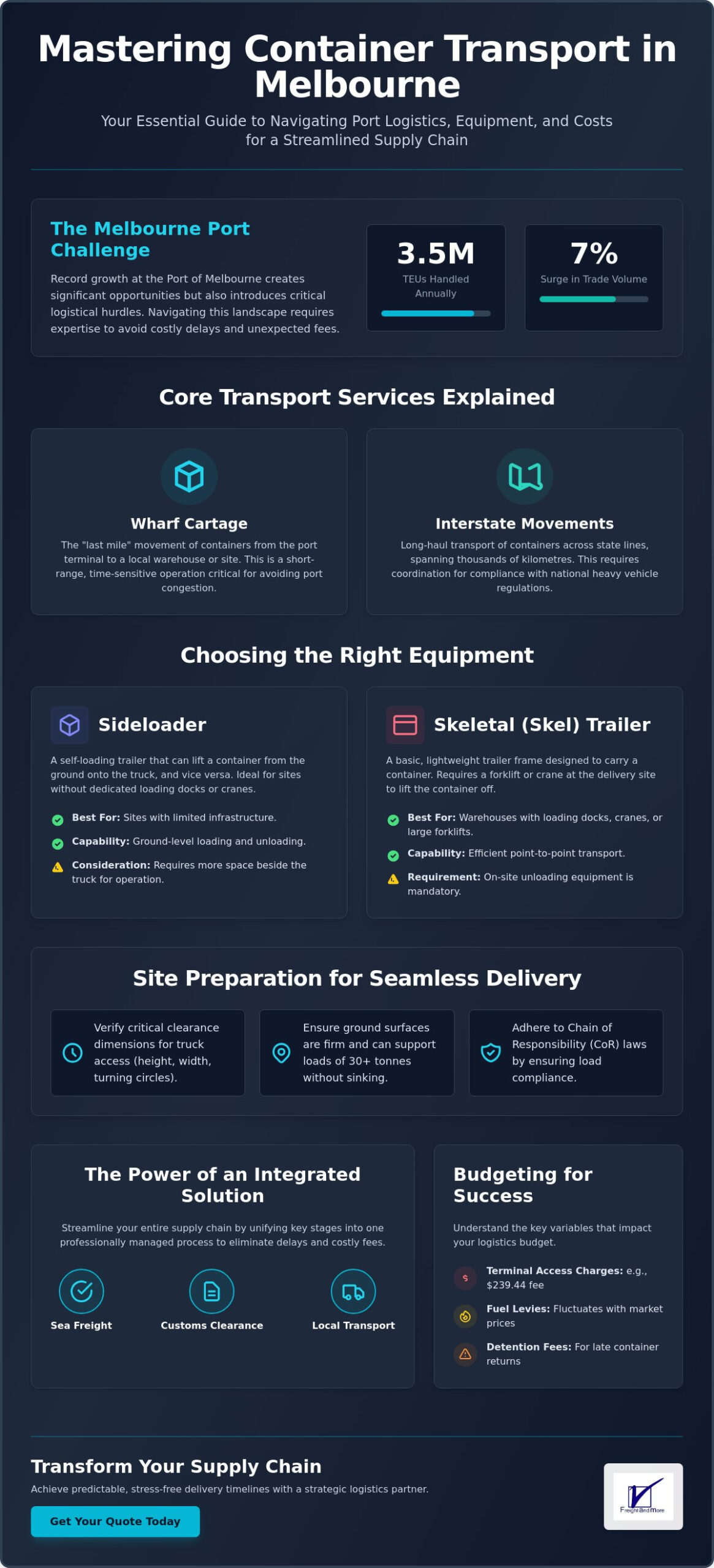
Did you know that the Port of Melbourne handled a record 3.5 million TEUs in 2025, with trade volumes surging by nearly 7 percent in April 2026 alone? This rapid growth brings both incredible opportunity and significant logistical hurdles for your operation. We understand the frustration of navigating unpredictable delivery windows or the sudden sting of a $239.44 terminal access charge appearing unexpectedly on your invoice. Mastering container transport melbourne requires more than just a truck. It demands a proactive partner who knows how to navigate fluctuating port fees and strict NHVR mass limits without missing a beat.
We’re dedicated to ensuring your cargo moves with precision, professional care, and absolute reliability. You’ll learn exactly how to choose between sideloaders and skeletal trailers, prepare your site for seamless arrivals, and integrate your sea freight with local transport to eliminate costly demurrage. This guide provides a comprehensive look at the 2026 logistics landscape, offering the expert insights you need to maintain compliance and achieve predictable, stress-free delivery timelines every single time. Let’s transform your supply chain into a streamlined competitive advantage today.
Key Takeaways
- Distinguish between wharf cartage and interstate movements to ensure you select the most efficient transport route for your specific cargo needs.
- Master the mechanical differences between sideloaders and skeletal trailers to choose the right equipment for your facility’s loading capabilities.
- Navigate the complexities of container transport melbourne by understanding how port access fees and fuel levies impact your overall logistics budget.
- Prepare your site for a seamless delivery process by verifying critical clearance dimensions and ensuring ground surfaces can support 30 plus tonne loads.
- Streamline your entire supply chain by integrating sea freight, customs clearance, and local transport into one cohesive and professionally managed solution.
Understanding Container Transport Services in the Australian Supply Chain
In the Australian supply chain, container transport services act as the vital “last mile” link that connects bustling port terminals directly to your warehouse or project site. While global shipping carries your goods across oceans, it’s the local logistics phase that determines whether your delivery is a success or a costly delay. This stage involves the complex orchestration of heavy vehicle movements, terminal time slots, and strict regulatory compliance. Wharf Cartage is the professional movement of shipping containers from port terminals to inland sites under strict regulatory standards.
To see how complex wharf collections and specialised unloads are handled in practice, watch this helpful video:
It’s essential to distinguish between wharf cartage, which is the short-range shuttle from the port to a local warehouse, and interstate container movements that span thousands of kilometres. Synchronising these local movements with your sea freight services is the only way to avoid the punishing container detention fees that shipping lines charge when equipment isn’t returned on time. We take pride in managing these timelines with meticulous care so you don’t have to worry about hidden costs.
The Critical Link: From Port to Door
Major terminals in Australia, especially during the high-volume periods of 2026, often face “bottleneck” effects where cargo sits idle due to poor transport coordination. Reliable container transport melbourne services prevent these logjams by ensuring trucks are ready the moment a container is discharged. This is especially critical for underbond transport, where goods haven’t yet been cleared by customs and must move between licensed facilities. Many businesses now view door to door shipping australia as the gold standard for efficiency. Effective logistics relies on the principles of intermodal freight transport, where the same container moves seamlessly from ship to road without the need to handle the cargo itself.
FCL vs LCL: How Transport Requirements Differ
Your transport requirements change significantly depending on whether you’re moving a Full Container Load (FCL) or a Less-than-Container Load (LCL). FCL transport requires specialised heavy vehicle equipment, such as sideloaders or skeletal trailers, to handle the sheer weight and scale of a 20ft or 40ft unit. In contrast, LCL freight is typically palletised and distributed via standard curtain-side trucks once the container has been unpacked at a deconsolidation hub. Freight and More manages both scales through a robust national network. We provide the same level of authoritative expertise whether you’re moving a single pallet or a fleet of high-cube containers.
Exploring the Mechanics: Sideloaders, Skels, and Heavy Haulage Options
Choosing the right equipment is the difference between a smooth delivery and a site-stopping disaster. In the context of container transport melbourne, operators must align their fleet with the National Freight and Supply Chain Strategy, which emphasizes safety and infrastructure efficiency. Every transport provider you engage must adhere to National Heavy Vehicle Regulator (NHVR) standards. This isn’t just a legal checkbox; it’s a critical protection for your business. Under Chain of Responsibility (CoR) laws, you share the liability for mass, dimension, and load restraint breaches. We take this responsibility seriously, ensuring every load is compliant and every vehicle is fit for purpose.
Sideloaders: Flexibility for On-Site Delivery
Sideloaders are the versatile workhorses of the industry, specifically designed for ground-level delivery without the need for expensive cranes or heavy-duty forklifts. These vehicles use hydraulic cranes at the front and rear of the trailer to lift and place containers directly to the side. If your site lacks a loading dock or specialized lifting gear, a sideloader is your go-to solution. However, they require significant space. You’ll generally need a minimum width of 6 metres and a height clearance of 4.5 metres to operate safely. Our team loves a challenge. If you have a tight site or difficult access issues, our “can-do” approach ensures we find a way to position your cargo exactly where it needs to be.
While sideloaders are ideal for many sites, some projects require dedicated crane services. For readers in the UK and Ireland seeking such specialized lifting solutions, you can learn more about Bewlake Lift & Haul Ltd.
Standard Trailers and Tipping Skels
When your facility is equipped with a raised loading dock or a container-rated forklift, a skeletal trailer (or “Skel”) is usually the most cost-effective option. These trailers are lightweight frames designed purely to carry the container, allowing for a higher payload and rapid turnaround at the port. For bulk goods like grain or scrap metal, we utilize tipping skels that can tilt the container to discharge contents efficiently. Precision is key here. Mass management and correct weight distribution across axles are vital to stay within NHVR mass limits. If you’re unsure which trailer suits your specific volume, reach out for a tailored equipment recommendation based on your site’s unique layout.
Sometimes, your cargo exceeds standard dimensions or weights. Heavy haulage solutions come into play for overweight or out-of-gauge (OOG) containers, such as flat racks or open tops. These movements require specialized permits and, occasionally, pilot vehicles to navigate the container transport melbourne road network. We handle the permit applications and route planning with meticulous care, removing the administrative burden from your shoulders. Whether it’s a standard 20ft unit or a massive industrial component, our expertise ensures your freight moves safely and legally across the state.
Optimising Logistics: Selecting the Right Container Transport Solution
Choosing the right strategy for container transport melbourne isn’t just about picking a truck. It’s about balancing cost, site constraints, and the rigid timelines of Australian port operations. While Section 2 explored the physical mechanics of different trailers, the decision-making process requires a deeper look at your facility’s readiness and your budget’s flexibility. Sideloaders offer incredible convenience for ground-level deliveries, but they often command a higher rate due to the specialised machinery involved. Skeletal trailers are the economical standard for high-volume dock-to-dock movements, provided you have the infrastructure to unload them quickly.
We often hear clients ask why container logistics rates involve so many variables. The reality is that transport providers must manage significant pass-through costs that are entirely out of their control. Port access fees, which have seen permanent structural increases throughout 2026, and fluctuating fuel levies are standard industry components. We pride ourselves on transparency, ensuring you understand exactly how these fees impact your final invoice. By partnering with a proactive manager, you can navigate these costs without the stress of hidden surprises.
For businesses looking beyond local delivery, interstate road transport australia connects Melbourne’s port to major distribution hubs across the country. Throughout these long-haul movements, the “Chain of Responsibility” (CoR) remains a critical legal framework. This legislation, enforced by the National Heavy Vehicle Regulator, ensures that every party in the supply chain is held accountable for safety. As a sender or receiver, you share the responsibility for ensuring loads are safe, legal, and within mass limits. We act as your expert guide to ensure you remain fully compliant with these evolving regulations.
Factors Influencing Your Transport Choice
- Weight Limitations: The mass of your cargo dictates the specific truck and trailer combination required to meet Victorian road standards.
- Site Access: Identify overhead power lines, narrow gateways, or soft ground surfaces that might block a 30 plus tonne vehicle.
- Urgency: Last-minute bookings often face limited equipment availability for container transport melbourne, potentially increasing your costs during peak import seasons.
Minimising Port Charges and Detention
Australian ports operate on a strict “Free Time” window, which typically allows only a few days for container collection before storage fees begin to accumulate. Proactive scheduling is the only way to avoid these penalties. We coordinate your transport well before the vessel berths, ensuring a time slot is secured the moment the container is ready for pick-up. Container Detention is the daily fee charged by shipping lines when a container is not returned within the agreed timeframe. By integrating your local transport with sea freight management, we ensure empty containers are returned promptly, protecting your bottom line from avoidable expenses. For high-volume shippers evaluating long-distance distribution strategies, understanding the full implications of road vs rail freight australia can reveal significant cost and sustainability advantages worth considering alongside your port logistics planning.
Preparation Guide: Ensuring a Seamless Container Delivery Process
Excellence in logistics doesn’t end at the port gate; it continues until the container is safely positioned on your site. Preparing your facility for a heavy vehicle is the most effective way to ensure your container transport melbourne experience is efficient and free from avoidable surcharges. A proactive approach here saves time and builds immediate trust with drivers and operators alike. We take pride in helping you get these details right, ensuring your cargo is handled with meticulous care from the moment it leaves the terminal.
- Step 1: Confirm site access dimensions. Heavy vehicles typically require a minimum of 3m width and 4.5m height clearance to navigate gateways and driveways safely.
- Step 2: Assess ground stability. Ensure the ground surface is level and capable of supporting a 30 plus tonne load to prevent the truck from sinking or tipping during the lift.
- Step 3: Finalise documentation. Coordinate with your customs clearance australia provider to ensure the “Authority to Deliver” is issued before the truck arrives at the terminal.
- Step 4: Designate a “drop zone”. Create a clear space that allows the driver to exit safely without the need for complex reversing into oncoming traffic.
- Step 5: Establish communication. Keep a dedicated point of contact available for real-time delivery updates to manage any last-minute site changes or unexpected delays.
Site Safety and Access Checklist
Checking for overhanging trees or low-hanging power lines is vital, as these can easily catch a sideloader arm during operation. You should also specify whether container doors need to face the front or rear of the truck; getting this wrong can mean your team can’t access the goods once the unit is on the ground. Verifying that the site is fully ready for the allocated time slot is the best way to avoid expensive “Wait Time” charges that accumulate when drivers are kept idle. We always recommend a “safety first” mindset to protect both your staff and the transport equipment.
The Documentation Trail
A smooth delivery relies on a clear documentation trail, including the Delivery Order and the container weight declaration. We manage these documents digitally to prevent administrative delays and ensure the driver has everything they need before leaving the port. Having a point of contact ready on-site ensures the driver can be directed quickly, maintaining the steady, methodical rhythm of your supply chain. If you need help auditing your site’s readiness, contact our logistics experts for a site assessment checklist to ensure your next container transport melbourne delivery is flawless.
Why Freight and More is Your Strategic Partner for Container Logistics
Choosing a partner for container transport melbourne is about more than just booking a vehicle; it’s about securing a dedicated ally who understands the high stakes of your supply chain. We don’t just act as a transport broker. Instead, we function as a proactive manager of your entire logistics lifecycle. By housing International Sea Freight, Customs Clearance, and Local Transport under one roof, we eliminate the friction that usually occurs when juggling multiple service providers. This integrated model allows us to oversee every touchpoint, from the initial booking to the final delivery at your facility.
Our team communicates with a high degree of professional confidence and welcoming enthusiasm. We take immense pride in the quality of service we provide, creating an environment where you feel your needs are handled with meticulous care and personal attention. You aren’t just another booking to us; you’re a partner. If you’re ready to experience a more reliable way to move your cargo, contact us for a tailored logistics enquiry today and let us simplify your operations.
Expertise Across the Australian Network
Our global agent network gives us the scale to handle international movements, while our deep local transport knowledge ensures the final leg of the journey is executed with absolute precision. We’ve built a reputation as a bold overachiever that goes beyond industry norms to solve problems before they impact your bottom line. Whether you’re facing a complex multi-drop delivery or a time-sensitive wharf collection, our “can-do” attitude turns logistical hurdles into seamless successes. We offer the reliability of a large-scale national transport network combined with the bespoke advice only a seasoned veteran can provide.
Beyond the Truck: A Holistic Approach
A truly efficient supply chain requires a holistic approach that starts long before a truck arrives at the terminal. Our customs brokerage services save you valuable time by ensuring all documentation is perfectly aligned before the container even hits the wharf. This level of detail-oriented management prevents the “bottleneck” effect and protects you from avoidable storage fees. We manage the big picture so you can focus on growing your business. Trust your container transport melbourne to a team that values transparency, dependability, and excellence in every movement. We’re ready to assist you in navigating the complexities of 2026 logistics with total confidence.
Elevate Your Logistics Strategy for a Competitive 2026
Navigating the evolving landscape of Australian trade requires a partner who looks beyond the immediate delivery. You’ve seen how selecting the right equipment and preparing your site can eliminate hidden fees and safety risks. By synchronizing your wharf cartage with broader supply chain goals, you turn a potential bottleneck into a streamlined advantage. Precise coordination is the only way to maintain a steady pulse in your operations while avoiding the sting of detention and storage penalties.
Freight and More has been a dedicated leader in this field since 2009, providing deep industry expertise that our clients depend on. We offer full NHVR and Customs compliance, ensuring your cargo moves legally and safely across the country. Our extensive global network of agents guarantees that your door to door delivery is handled with meticulous care at every stage. Whether you’re managing complex international imports or local container transport melbourne, our proactive team is ready to assist with a “can-do” attitude.
Get a Professional Container Transport Quote from Freight and More and experience the peace of mind that comes with expert management. We’re excited to help you master the complexities of the modern supply chain. Let’s get your cargo moving with precision and total confidence today!
Frequently Asked Questions
What is the difference between a sideloader and a skel trailer?
Sideloaders provide the ultimate flexibility by using onboard hydraulic cranes to lift and place containers directly onto the ground beside the vehicle. In contrast, skeletal trailers (skels) are simple, lightweight frames designed for facilities that already have loading docks or heavy-duty forklifts. Choosing the right equipment for your container transport melbourne ensures you aren’t paying for unnecessary machinery while guaranteeing your site can actually handle the unload.
How much space do I need for a shipping container delivery?
You generally require a minimum of 3 metres in width and 4.5 metres in height clearance for a standard heavy vehicle to enter your site. If you’ve requested a sideloader delivery, you’ll also need approximately 6 metres of lateral space to allow the hydraulic arms to extend and position the container safely. It’s vital to ensure the ground is level and compacted to support a total weight that can exceed 30 tonnes.
How long do I have to unpack a container before detention fees start?
Most shipping lines offer a “free time” window of seven days to unpack and return the empty container before daily detention fees begin to accumulate. This clock usually starts the moment the unit is discharged from the vessel, not when it reaches your warehouse! We meticulously track these arrival dates to ensure your empty equipment is returned promptly, protecting your bottom line from these avoidable daily penalties.
Can you transport overweight containers in Australia?
Yes, we can manage overweight containers by utilizing specialized heavy haulage equipment and obtaining the necessary permits from the National Heavy Vehicle Regulator. Transporting these units requires precise route planning and strict adherence to axle mass limits to ensure both road safety and legal compliance. If your cargo exceeds standard weight limits, we provide the authoritative guidance and specialized trailers needed to move it without administrative delays.
What is “Wharf Cartage” and why is it separate from sea freight?
Wharf cartage is the professional movement of containers between the port terminal and your local inland site. It’s treated as a separate service because it involves landside logistics, specific terminal access fees, and vehicle booking systems that operate independently of the ocean voyage. Integrating this “last mile” leg with your sea freight provider ensures a seamless transition and significantly reduces the risk of expensive port storage charges appearing on your invoice.
Do I need my own insurance for container transport?
We highly recommend securing marine transit insurance because standard carrier liability is often limited and may not cover the full replacement value of your cargo. While we handle every shipment with meticulous care and professional pride, insurance provides essential peace of mind against unforeseen maritime or transit risks. We can assist you in arranging comprehensive coverage to ensure your investment is fully protected from the port to your door.
How far in advance should I book my container transport?
You should ideally book your container transport melbourne at least 48 to 72 hours before the vessel berths to secure a preferred time slot at the terminal. During peak seasons or high-volume periods, providing even more notice allows us to guarantee equipment availability and avoid the congestion common at major terminals. Proactive scheduling is the most effective way to maintain a predictable and stress-free delivery timeline for your business.
What happens if my container is selected for a Customs X-ray or inspection?
If your container is selected for a Customs X-ray or physical inspection, it will be directed to a secure, bonded facility known as a Container Examination Site. This is a mandatory regulatory process that will result in additional handling fees and a delay to your original delivery schedule. We manage all communication with customs officials and immediately adjust your transport bookings to minimize the impact on your supply chain and keep you informed.
