Container Freight Costs Australia: The 2026 Strategic Business Guide

With port and terminal charges climbing by up to 14% this year, the era of predictable shipping has evolved into a complex landscape where every line item matters. It’s exhausting to manage a supply chain when unexpected bunker adjustment factors and fluctuating fuel surcharges constantly threaten your bottom line. You want transparency, not a list of acronyms that hide the true price of doing business. We understand that frustration, and we’re here to provide the expert clarity you deserve.
This strategic guide empowers you to master container freight costs australia by providing a transparent breakdown of the current market, from regulatory lodgement fees to the nuances of biosecurity cost recovery. You’ll gain the confidence to choose between LCL and FCL shipping based on hard data rather than guesswork. We’ll explore the structural cost shifts of 2026, analyze the impact of new tolling infrastructure, and show you exactly how to utilize free trade agreements to protect your margins. Get ready to transform your logistics into a predictable, optimized engine for growth!
Key Takeaways
- Decode the complex layers of your shipping invoice by distinguishing between base rates and mandatory surcharges like BAF and LSS.
- Gain the tactical knowledge to choose between FCL and LCL shipping methods, ensuring you only pay for the capacity and security your cargo actually requires.
- Navigate the strict requirements of the Australian Border Force with confidence by leveraging professional customs brokerage to eliminate avoidable delays and penalties.
- Protect your bottom line against 2026’s structural price increases and seasonal peaks through proactive planning and comprehensive marine transit insurance.
- Uncover the “port-to-door” variables that define container freight costs australia to transform your supply chain into a predictable and optimized business asset.
Understanding the Components of Container Freight Costs in Australia
If you’re looking to move goods, it’s easy to get confused by the difference between buying a steel box and paying to move one across the ocean. While a used 20ft container in Australia might cost you between $2,100 and $3,200 as of July 2026, the actual container freight costs australia businesses pay are determined by a complex interplay of global logistics factors. Understanding the global containerization system is the first step toward gaining control over your supply chain budget. We’ve seen many clients surprised by how the base ocean rate is merely the starting point of their invoice.
To help you visualize what a shipping container really costs in the current Australian market, watch this helpful 2026 update:
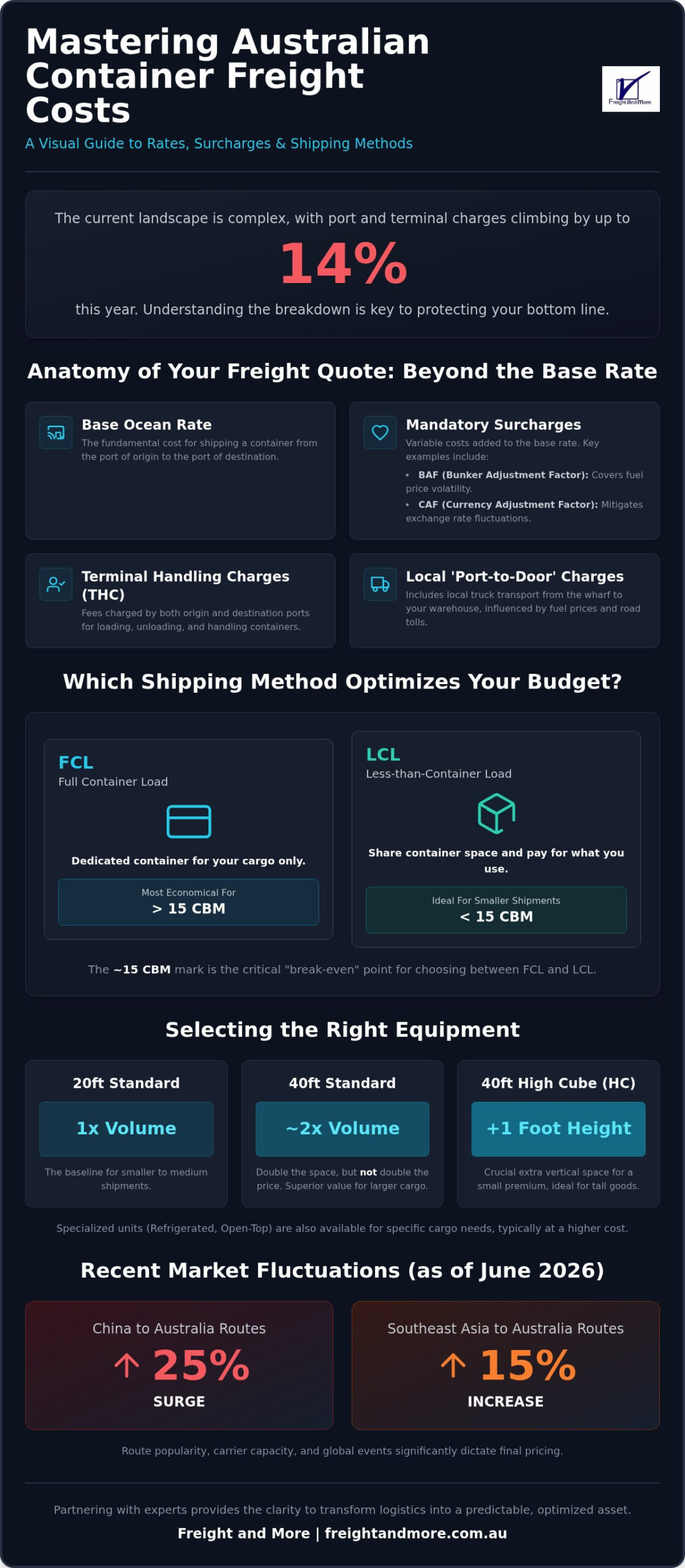
Your quote will usually feature a ‘Base Rate’ which covers the space on the vessel from port to port. However, mandatory surcharges like the Bunker Adjustment Factor (BAF) for fuel volatility and the Currency Adjustment Factor (CAF) can significantly alter the final price. Route popularity also dictates your bottom line. For instance, as of June 2026, shipping rates from China to Australia surged by 25%, while routes from Southeast Asia saw a more modest 15% increase. If you’re shipping from a less-frequented port, expect higher rates due to limited carrier capacity and fewer vessel calls.
Size and Type: 20ft vs. 40ft Containers
Ocean Freight vs. Local Australian Charges
Total landed cost is where many budgets break. Beyond the ocean voyage, you must account for Terminal Handling Charges (THC) at both the origin and destination ports. Local transport from the wharf to your warehouse is another critical item that often fluctuates based on toll increases and fuel prices. If you’re looking for a transparent breakdown of these international sea freight components, our team is ready to help. Don’t let hidden administrative fees or documentation charges catch you off guard. Instead, demand a quote that covers every step from port to door.
FCL vs. LCL: Which Shipping Method Optimizes Your Budget?
Choosing between Full Container Load (FCL) and Less-than-Container Load (LCL) isn’t just a matter of volume; it’s a strategic decision that dictates your speed to market and overall risk profile. This choice sits at the heart of managing container freight costs australia businesses must navigate. While FCL offers the advantage of a dedicated unit, LCL provides the flexibility that many growing enterprises need to maintain steady inventory levels without overcommitting capital. When analyzing recent trends in freight costs, it becomes clear that the agility to switch between these methods is a major competitive advantage.
The “break-even” point is the most critical metric for your budget. Generally, once your cargo exceeds 15 cubic metres (CBM), the cost of booking a full 20ft container often becomes more economical than paying for individual CBM rates in a shared space. Below this threshold, sharing a container allows you to pay only for the space you use, though you must account for the additional handling involved at both ends.
Maximizing Value with FCL Shipments
The primary advantage of Sea freight services utilizing FCL is the reduction in transit time and handling risks. Because the container is sealed at the origin and remains unopened until it reaches your warehouse, the chance of damage or loss is significantly lower. To maximize value, focus on your packing strategy. Utilizing every inch of vertical space or palletizing goods to fit the internal dimensions of the container can drastically lower your per-unit shipping cost. This method is the gold standard for high-volume importers who demand maximum security and predictable arrival windows.
The Flexibility of LCL and Consolidation
LCL is a lifeline for small businesses and those testing new product lines. Rates are typically calculated based on volume (per cubic metre) or weight, whichever is greater. However, you must be wary of the “minimum shipment” trap. Most carriers charge for a minimum of 1 CBM, even if your goods occupy less space. By using consolidated shipping services, you can maintain a lean inventory while still accessing global markets. This approach removes the obstacle of high upfront costs, allowing you to scale your operations at your own pace. To ensure you’re utilizing the most cost-effective method for your next shipment, consider discussing your specific cargo requirements with a specialist who can provide a tailored comparison.
Navigating Australian Customs and Port-Related Expenses
While many businesses focus on the ocean voyage, the true complexity of container freight costs australia often lies within our own borders. The Australian Border Force (ABF) and the Department of Agriculture play a pivotal role in these expenses, enforcing regulations that can either streamline your arrival or lead to expensive bottlenecks. According to the ACCC Container Stevedoring Monitoring Report, landside charges and terminal congestion remain significant factors in the overall pricing structure. We’ve seen how these local variables, from infrastructure levies to security fees, can catch even seasoned importers off guard if they aren’t prepared with accurate data.
For goods valued over $1,000, you’ll face an Import Processing Charge (IPC) of $50 for electronic lodgement, which increases to $152 for consignments exceeding $10,000. Additionally, the Biosecurity Cost Recovery (BCR) charge for sea freight is now $71.00 per declaration. Beyond these administrative fees, you must budget for the standard 5% customs duty and the 10% GST. It’s important to remember that GST is calculated on the Value of the Taxable Importation (VoTI), which includes the customs value, the duty, and the costs of international freight and insurance. These aren’t optional extras; they’re the baseline for doing business in the Australian market.
Customs Clearance and Compliance Costs
Accurate documentation is your best defense against the high cost of quarantine inspections or unexpected delays. By utilizing expert customs clearance services, you ensure that every tariff classification and origin certificate is handled with meticulous care. This proactive approach helps you avoid the “hidden” costs of 2026, such as terminal storage or demurrage fees that quickly erode profit margins. If your paperwork is in order, your cargo moves; if it isn’t, the port becomes a very expensive parking lot. We take pride in removing these obstacles before they impact your budget.
Local Transport and Final Mile Delivery
The final leg of the journey often presents its own set of logistical hurdles. Choosing between road and rail depends on your urgency and the specific destination, though recent toll increases in Melbourne and rising fuel surcharges have made road transport more expensive. If you’re managing interstate transport, the impact of these fluctuating costs must be factored into your 2026 strategy. We specialize in door-to-door delivery, managing the transition from port to warehouse so you can enjoy a seamless experience. If you need a reliable partner to handle these complexities, we’re ready to step in and guide your shipment home.
Strategic Cost Management: Mitigating Market Fluctuations in 2026
Managing your supply chain in 2026 requires a shift from reactive booking to proactive forecasting. The volatility we’ve seen in container freight costs australia businesses face is no longer just a seasonal spike; it’s a structural reality. Global fuel regulations and “Green Shipping” initiatives are driving up operational costs for carriers, which are inevitably passed down to importers through various surcharges. By leveraging a robust freight forwarder network, you gain access to negotiated contract rates that offer a buffer against the volatile spot market. We pride ourselves on being that dedicated partner, helping you secure space even when capacity is tight.
Timing Your Shipments for Maximum Savings
Success in the current market depends heavily on your ability to avoid the Peak Season Surcharge (PSS). In 2026, we’re seeing these surcharges kick in earlier as carriers exercise strict capacity discipline on the Asia-Australia lanes to keep demand high and supply low. Identifying off-peak windows, such as the period immediately following the Lunar New Year or the mid-winter lull, can result in significant savings. While spot rates might look tempting during a dip, long-term contracts provide the budget predictability that allows for better financial planning. In 2026, the Bunker Adjustment Factor (BAF) is calculated using a formula that tracks the monthly average of low-sulphur fuel costs against specific vessel consumption metrics on Australia-bound trade lanes.
Risk Management and Insurance
Protecting your investment is just as important as securing a good rate. Marine transit insurance is a non-negotiable cost for any commercial cargo, especially given the increased frequency of geopolitical disruptions and the rise of Emergency Bunker Surcharges. A common pitfall is assuming that carrier liability provides sufficient coverage. In reality, carrier liability is often limited and won’t cover the full value of your goods in the event of a total loss or General Average declaration. To truly master your importing strategy, you should also understand how your logistics choices intersect with regulatory requirements. For a deeper dive into this, see our sibling guide on Customs Clearance Australia: The 2026 Business Guide. Ensuring your cargo is insured and your paperwork is compliant is the only way to achieve total peace of mind.
Partnering with Freight and More for Transparent Logistics Solutions
At Freight and More, we believe that managing your supply chain shouldn’t feel like a gamble. While the variables influencing container freight costs australia can feel overwhelming, having a partner who prioritizes transparency changes the entire equation. We don’t just provide a service; we act as a dedicated extension of your business, ensuring every shipment is handled with the meticulous care it deserves. Our proactive approach means we identify potential bottlenecks before they become expensive delays, giving you the freedom to focus on growing your enterprise while we handle the heavy lifting.
Transparency in pricing is the cornerstone of our logistics partnerships. We’ve seen how “hidden” fees can erode trust, which is why we provide a clear, comprehensive breakdown of every charge. From the initial sea freight booking to the final mile of local transport, you’ll have full visibility into your shipment’s journey. Our national expertise allows us to manage cargo across all major Australian ports, including Melbourne, Sydney, Brisbane, Perth, and Adelaide, ensuring a consistent and reliable experience regardless of your destination. If your business expansion also involves securing commercial or residential space in these areas, you can discover The Agency Coffs Coast to connect with experts in the Australian property market.
Our Comprehensive Sea Freight and Customs Services
Integrating sea freight, customs clearance, and local transport into a single, streamlined workflow is the most efficient way to manage your 2026 logistics. By removing the need to coordinate between multiple vendors, we eliminate the friction that often leads to communication breakdowns and mounting costs. Our extensive global agent network allows us to support Australian businesses of all sizes, providing the scale of a multinational firm combined with the personalized, “can-do” attitude of a boutique provider. If you’re ready to move beyond generic estimates and secure a strategy tailored to your specific needs, we invite you to submit a tailored freight enquiry for your 2026 shipments.
The Advantage of a Dedicated Logistics Partner
The modern shipping market moves too fast for “automated quotes” that lack real-world context. While a computer can provide a number in seconds, it cannot navigate a sudden port congestion issue or provide bespoke advice on complex tariff concessions that could save your business thousands. Our commitment to professional confidence means you’ll always have an authoritative expert to guide you through the complexities of container freight costs australia. We take pride in being bold overachievers who go beyond industry norms to solve problems. Join the growing list of businesses that trust Freight and More for reliable national logistics and experience the peace of mind that comes with a truly dependable partner.
Secure Your Competitive Edge in 2026
Mastering the nuances of container freight costs australia is no longer just about finding the cheapest vessel; it’s about understanding the vital synergy between global ocean rates and local regulatory compliance. By distinguishing between FCL and LCL benefits and preparing for structural shifts in port charges, you’ve already taken the first step toward a more resilient and profitable supply chain. Our dedicated team brings over 15 years of industry-leading expertise to every shipment, ensuring your cargo moves through the complex Australian customs landscape with absolute precision.
As a proud member of a vast global logistics network, we combine massive international reach with deep local attention to remove the obstacles that often slow your business down. We’re committed to providing the proactive advice and meticulous care you need to thrive in a volatile 2026 market. You don’t have to navigate these complexities alone when you have a partner who values transparency as much as you do.
We’re excited to partner with you and transform your logistics challenges into a streamlined, high-performance engine for growth!
Frequently Asked Questions
How much does it cost to ship a 20ft container to Australia in 2026?
Shipping a 20ft container involves various price layers including the base ocean rate and mandatory surcharges that change monthly. In 2026, rates are heavily influenced by carrier capacity discipline on Asia-Australia lanes and the prevailing fuel prices. Because these figures fluctuate based on your specific origin port and the time of year, we recommend requesting a tailored quote to secure the most accurate pricing for your budget.
What are the main factors that cause container shipping rates to fluctuate?
Several global factors drive the volatility in shipping rates, most notably carrier capacity management and seasonal demand. In 2026, “Green Shipping” initiatives and new fuel regulations have added structural costs to the industry. Additionally, geopolitical events often trigger Emergency Bunker Surcharges, while local Australian port congestion can lead to temporary infrastructure levies that impact your total bottom line.
What is the difference between FCL and LCL shipping costs?
FCL involves paying a flat fee for the exclusive use of a 20ft or 40ft container, regardless of how much cargo is inside. LCL allows you to pay only for the volume you occupy, usually calculated per cubic metre (CBM). Generally, FCL becomes more cost-effective once your shipment exceeds 15 CBM, as the per-unit handling costs of LCL begin to outweigh the flat container rate.
Are there hidden fees when importing containers into Australia?
While we prioritize transparency, many importers are surprised by mandatory regulatory and port-related expenses. These include the Import Processing Charge (IPC) for electronic lodgement and the Biosecurity Cost Recovery (BCR) charge, which for sea freight is $71.00 per declaration as of July 2026. Terminal infrastructure levies and empty container park fees also contribute to the total container freight costs australia businesses must manage.
How long does it typically take for a container to clear Australian customs?
Most containers clear Australian customs within 24 to 72 hours provided all documentation is accurate and compliant. Delays typically occur if the Department of Agriculture flags a shipment for a biosecurity inspection or if there are discrepancies in the tariff classifications. We use our in-house expertise to ensure your paperwork is perfect before the vessel even arrives, removing obstacles that lead to expensive storage fees.
Do I need marine insurance for my international container shipment?
Marine transit insurance is essential because carrier liability is strictly limited by international conventions and rarely covers the full value of your goods. If a vessel encounters a “General Average” event where cargo is sacrificed to save the ship, you could be liable for a portion of the total loss. Insurance protects your financial investment against theft, damage, and these rare but catastrophic maritime events.
What is a Bunker Adjustment Factor (BAF) and how does it affect my quote?
The Bunker Adjustment Factor (BAF) is a mandatory surcharge designed to account for the volatile price of ship fuel. It is typically reviewed monthly or quarterly and reflects the cost of low-sulphur fuel used on specific trade routes to Australia. Because BAF is a variable cost, it can significantly impact your final container freight costs australia quote if fuel prices spike during your shipment’s transit window.
Can I get a door-to-door quote for container freight in Australia?
We specialize in providing comprehensive door-to-door solutions that handle every step of the logistics chain. This service integrates international sea freight, customs clearance, and local transport into a single, managed process. By choosing a door-to-door approach, you gain total visibility and eliminate the stress of coordinating multiple providers for the final mile delivery, ensuring a seamless experience from the origin port to your warehouse.
