Customs Clearance Agent Sydney: A Strategic Guide to Australian Import Costs in 2026

Is your supply chain currently losing thousands of dollars to “nuisance tariffs” that were scheduled for abolition on July 1, 2026? Most importers feel the sting of opaque government fee structures and the heavy anxiety of cargo held at the border due to minor HS code classification errors. It’s frustrating when you’re striving for growth but find yourself bogged down by the shifting landscape of Australian Border Force requirements. We understand that you need predictable landing costs and absolute certainty that your shipments are compliant. By working with a strategic customs clearance agent, you can finally eliminate hidden fees and streamline your entire logistics operation.
This guide provides a comprehensive roadmap to mastering Australian import costs in 2026. We’ll explore the latest Import Processing Charges, including the A$152 fee for high-value electronic lodgements, and show you how to leverage new Free Trade Agreements to your advantage. You’ll discover how a proactive approach ensures 100% compliance, faster transit times, and a significant competitive edge for your business! We’re excited to help you transform these regulatory complexities into a streamlined, cost-effective success story.
Key Takeaways
- Navigate the A$1,000 import threshold with confidence to distinguish between simple low-value entries and complex formal declarations.
- Uncover the precise calculation methods for Duty and the 10% GST to ensure your landing costs remain predictable and transparent.
- Learn how to utilize 10-digit HS codes and Free Trade Agreements to legally reduce your duty rates to 0% and maximize your profit margins.
- Streamline your border clearance by mastering the essential requirements for commercial invoices and meticulous packing lists.
- Discover how partnering with an expert customs clearance agent sydney provides the professional oversight needed to prevent costly classification errors and shipping delays!
Understanding Australian Customs Thresholds and the $1,000 Rule
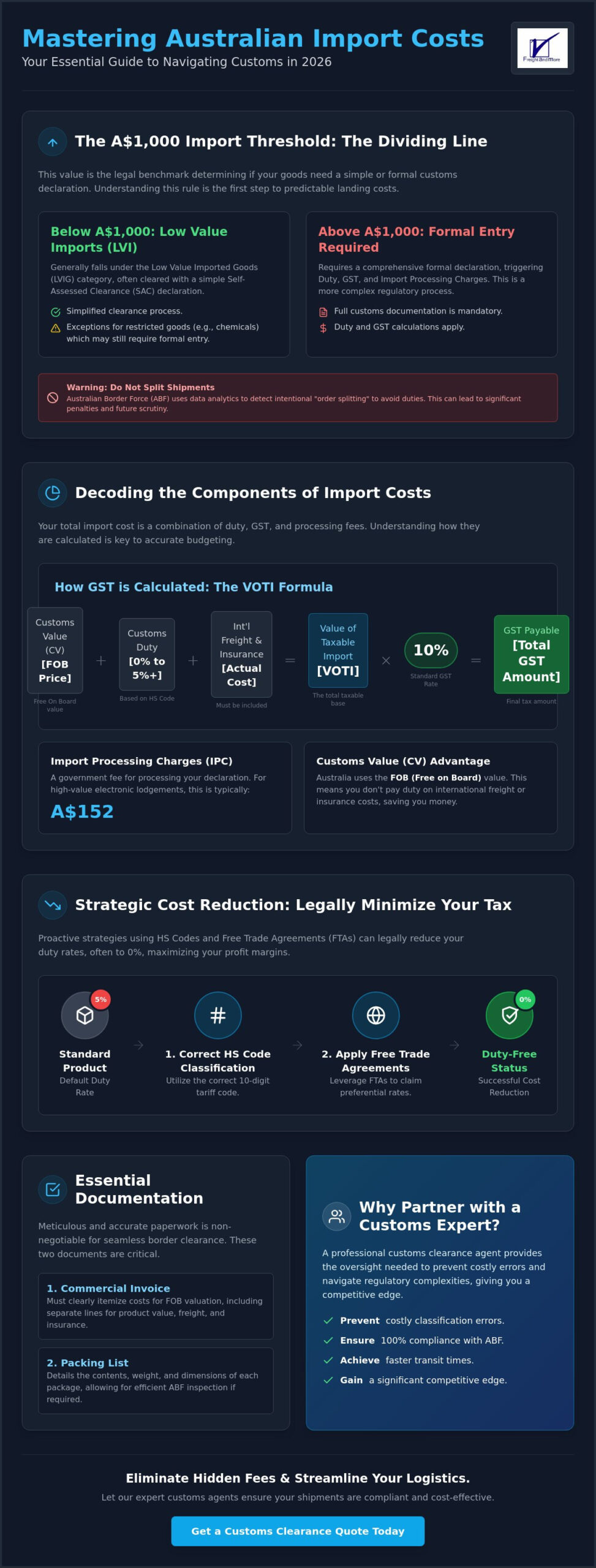
The A$1,000 threshold isn’t just a convenient number; it’s the legal dividing line between a simple delivery and a complex regulatory process. For any business importing goods into Australia, this benchmark determines whether your cargo enters via a simplified declaration or requires a comprehensive formal entry. While many believe that staying under this limit grants total immunity from taxes, the 2026 landscape is far more nuanced. Partnering with a seasoned customs clearance agent sydney ensures you don’t fall into common traps that lead to unexpected costs or border delays.
Some importers attempt to bypass duties by splitting one large order into several smaller packages. We strongly advise against this. The Australian Border Force uses sophisticated data analytics to identify repetitive low-value shipments from a single supplier to the same recipient. If they determine you’re intentionally avoiding a formal entry, you could face significant penalties and increased scrutiny on all future shipments.
To better understand this concept, watch this helpful video:
Low Value Imports (LVI) vs. Formal Entry
If your goods have a value of A$1,000 or less, they generally fall under the Low Value Imported Goods (LVIG) category. These typically move through the border using a Self-Assessed Clearance (SAC) declaration, often managed by international couriers. However, commercial sea or air freight arrivals are different. Even if the value is low, certain “restricted” goods in 2026, such as specific industrial chemicals or dual-use technologies, require a formal entry regardless of their price. You must proactively file a formal entry if you want to claim specific tax credits or if your cargo arrives as part of a larger commercial consolidation.
Determining Your Customs Value (CV)
Calculating your Customs Value (CV) requires meticulous attention to detail. Australia calculates duty based on the “Price Paid or Payable” using the Free on Board (FOB) value. This is a significant advantage because it means you don’t pay duty on the international freight or insurance costs, provided they are clearly itemised. You’re legally required to use the official exchange rates for the day of export when dealing with foreign currency invoices. Because these rates fluctuate, a customs clearance agent sydney acts as your dedicated guide, ensuring your valuation is 100% compliant with current 2026 standards so you never pay a cent more than necessary.
Decoding the Components of Import Costs: Duty, GST, and Fees
Once your shipment exceeds the A$1,000 threshold discussed previously, you enter a multi-layered tax environment. It isn’t just a single tax; it’s a strategic combination of duty, GST, and government processing charges that interact to form your total border liability. Understanding these distinct layers is essential for accurate budgeting and maintaining a healthy bottom line. A dedicated customs clearance agent sydney helps you dissect these costs, ensuring you aren’t overpaying due to incorrect classification or missed concessions. Accuracy matters here.
The VOTI Formula for GST Calculation
Calculating GST isn’t as simple as taking 10% of your invoice price. In the Australian system, GST is applied to the Value of the Taxable Importation (VOTI). This figure is the sum of the Customs Value (CV), any applicable Customs Duty, the international freight cost, and the insurance premium. Even if your duty rate is 0%, you must still include freight and insurance in the VOTI calculation. Neglecting to include insurance, even if you are self-insured, can lead to compliance audits from the Australian Border Force. You can explore current duty rates and requirements for various goods using DFAT’s FTA Portal, which is an invaluable resource for identifying potential savings through various trade agreements.
Government Processing and Administrative Charges
Beyond taxes, the government levies mandatory Import Processing Charges (IPC) for digital declarations. As of 2026, these fees are tiered based on the value of the goods and the mode of transport. For electronic lodgements on goods valued between A$1,000 and A$10,000, the fee is A$50.00. If the value reaches or exceeds A$10,000, the charge rises to A$152.00. These fees are non-negotiable and apply to every formal entry lodged.
Additionally, you must account for Biosecurity Cost Recovery Charges collected by the ABF on behalf of the Department of Agriculture, Fisheries and Forestry (DAFF). Don’t leave it to chance. The standard 2026 rates for these charges are:
- Air Freight: A$46.00 per full import declaration.
- Sea Freight: A$68.00 per full import declaration.
High-risk product categories may incur further quarantine inspection fees if an officer is required to physically examine the cargo. If you are unsure how these specific 2026 rates apply to your next shipment, it’s wise to request a detailed cost estimate to avoid any surprises at the wharf. We take pride in providing this level of meticulous detail so your business can move forward with total confidence.
Strategic Cost Reduction: Leveraging HS Codes and Free Trade Agreements
While paying the mandatory fees we decoded in the previous section is unavoidable, the specific amount you pay is often highly flexible. A strategic customs clearance agent sydney doesn’t just lodge paperwork; they actively hunt for legal ways to minimize your duty exposure through expert analysis. This process begins with the Harmonized System (HS) code, which acts as the 10-digit DNA of your imported cargo. Every product, from industrial machinery to consumer electronics, has a specific code that dictates its duty rate, and getting this classification right is the most effective way to protect your profit margins.
Mastering HS Code Classifications
Getting your HS code wrong is a recipe for financial disaster. The Australian Border Force maintains strict oversight, and they don’t accept “clerical error” as a valid excuse for underpayment. Financial penalties for mis-classification can be severe, often wiping out the entire profit margin of a shipment. We meticulously use the Australian Customs Tariff to find the most advantageous legal code for your specific goods, ensuring you pay the correct rate without overstepping regulatory boundaries. For a deeper dive into managing these requirements, you can explore our Customs Clearance Australia guide for 2026.
Navigating Modern Free Trade Agreements
Australia’s trade network is one of the most robust in the world, offering incredible opportunities for cost reduction. From the long-standing ChAFTA (China-Australia Free Trade Agreement) to recent AUKUS-aligned updates, there are dozens of pathways to reduce your duty rate to 0% legally. These benefits aren’t applied automatically. You must provide specific documentation, such as a valid Certificate of Origin, at the exact time of entry to claim these preferential tax treatments. Accuracy in your paperwork is non-negotiable if you want to unlock these savings.
Even when you successfully secure a 0% duty rate through an agreement, remember that GST is still a factor in your total landing cost. The Australian Border Force explains GST on imports as a standard 10% levy that applies to the total value of the taxable importation. For businesses that operate globally, we also look for “Duty Drawback” opportunities. This scheme allows you to recover taxes paid on goods that are subsequently re-exported from Australia, effectively turning a previous expense back into working capital. We take pride in identifying these high-level savings that others might overlook!
Essential Documentation for Seamless Border Clearance
Having the right strategy is only half the battle; the other half is won through meticulous documentation. Even the most clever tariff concession won’t save you if your paperwork is incomplete or inconsistent. A professional customs clearance agent sydney acts as your final line of defense, reviewing every document to ensure it meets the rigorous standards of the Australian Border Force. This proactive attention to detail prevents your cargo from being flagged for manual inspection, which can add days or even weeks to your lead times. We take pride in ensuring your shipment is audit-ready before it even leaves the port of origin!
To ensure a smooth transition from the wharf to your warehouse, you must prepare a specific set of documents for every shipment:
- Step 1: Secure an accurate Commercial Invoice with clear, detailed line-item descriptions.
- Step 2: Obtain a Packing List specifying gross and net weights, dimensions, and the exact types of packaging used.
- Step 3: Ensure the Bill of Lading or Air Waybill is correctly endorsed and matches the physical cargo.
- Step 4: Verify the Certificate of Origin if you intend to claim preferential tax treatments under an FTA.
- Step 5: Prepare specific permits for regulated goods, such as timber, chemicals, or certain agricultural products.
The Commercial Invoice: Your Most Critical Document
Vague descriptions are the fastest way to trigger a red flag. If your invoice simply says “Machine Parts,” expect an immediate customs inspection. You must provide clear unit pricing, the specific currency used, and a description that allows an officer to verify the HS code. It’s vital that this data matches your Sea Freight documentation perfectly. Mismatched data leads to valuation disputes and potential financial penalties that can quickly erode your margins. We help you audit these documents early to ensure total transparency.
Avoiding Common Paperwork Delays
Missing “Packing Declarations” are a major bottleneck in Australian biosecurity processing. These forms confirm whether wood packaging has been treated; without them, your goods might be held for expensive fumigation. Additionally, ensure all digital documentation is legible and formatted specifically for modern Australian systems. For those moving time-sensitive goods, our Air Freight Forwarding Guide offers deeper insights into expediting these critical shipments. Accuracy is non-negotiable when your reputation and bottom line are on the line.
Ready to ensure your paperwork is bulletproof? Contact our expert team today for a comprehensive document audit.
Why Partnering with a Professional Customs Clearance Agent is Vital
Mastering the intricacies of thresholds, tariffs, and documentation is a significant achievement, but the final piece of the puzzle is having a dedicated partner to execute the strategy. A licensed customs clearance agent sydney does more than just type data into a system; they act as your legal representative and expert advocate before the Australian Border Force. By assuming the responsibilities associated with being the “Importer of Record,” a professional broker ensures that every declaration is technically perfect and legally sound. This removes the exhausting burden of government liaison and complex digital lodgments from your shoulders, allowing you to focus entirely on scaling your business operations.
To further support this growth, many Australian importers are also turning to MyBPO for dedicated offshore staffing, ensuring their administrative and logistics support teams can keep pace with their expanding trade activities.
We believe that a strategic customs approach is the backbone of a resilient supply chain. It isn’t just about getting goods across the border; it’s about doing so with a level of precision that eliminates waste and maximizes your competitive advantage. Our team functions as a bold overachiever in the industry, going beyond standard norms to provide bespoke advice that fits your specific business model. We’re here to guide you through every regulatory shift with confidence and enthusiasm!
The Legal Risks of DIY Customs Entry
Attempting to handle your own entries might seem like a cost-saving measure, but the risks are often disproportionate to the rewards. The ABF maintains a zero-tolerance policy for “False or Misleading” statements, even if the error was unintentional. These penalties can be severe, ranging from heavy fines to the suspension of your importing privileges. Professional Customs Clearance is essentially a form of business insurance; it protects your reputation and your bottom line from the fallout of classification errors. When an audit or physical inspection occurs, having an expert by your side provides the reassurance that your interests are being protected by a seasoned veteran who knows the regulations inside out.
The Freight and More Advantage
We don’t just provide a service; we build a proactive logistics partnership designed to fuel your growth. Our “can-do” attitude means we’re always looking for ways to streamline your supply chain, whether that’s through better route planning or identifying tax-saving opportunities you hadn’t considered. By integrating International Freight with our local transport and warehouse management capabilities, we offer a seamless door-to-door experience that feels effortless. We take immense pride in our meticulous care and global connectivity, ensuring that your goods move from the port to your warehouse with total precision. Ready to streamline your imports? Enquire with our expert team today!
Empowering Your Australian Import Strategy for 2026 and Beyond!
We’ve explored how mastering the A$1,000 threshold and leveraging the latest Free Trade Agreements can transform your bottom line. You now have the roadmap to navigate the complex VOTI formula and ensure your documentation is audit-ready for the Australian Border Force. These strategic steps don’t just prevent costly delays; they turn regulatory compliance into a genuine financial asset for your business. It’s about moving beyond simple paperwork to embrace a proactive approach that safeguards your margins.
When you’re ready to eliminate hidden fees and secure your supply chain, partnering with an expert customs clearance agent sydney is the most reliable path forward. Since 2009, Freight and More Pty Ltd has served as a dedicated guide for importers, offering comprehensive national coverage across all Australian ports and airports. Our team of licensed Australian Customs Brokers is motivated to handle your shipments with the precision, scale, and personal attention you deserve! We’re excited to help you navigate the future of international trade with total confidence.
Get a Professional Customs Quote from Freight and More Pty Ltd today and let’s streamline your imports together!
Frequently Asked Questions
Do I need to pay GST on commercial imports under $1,000 in Australia?
Yes, GST is generally payable on all commercial imports regardless of their value. For goods valued at A$1,000 or less, the overseas supplier usually collects the 10% GST at the point of sale if they meet the Australian registration threshold. If the seller isn’t registered, you might not pay it at the border, but most commercial transactions include this tax in the final landed cost. Working with a customs clearance agent sydney ensures you account for these taxes in your initial budgeting.
What is the current customs duty rate for most commercial goods in 2026?
The standard customs duty rate for most commercial goods in 2026 ranges from 0% to 5% of the customs value. Following the abolition of nearly 500 “nuisance tariffs” on July 1, 2026, many common items now enter the country duty-free. However, specific goods like clothing or certain industrial products may still attract the 5% rate. We always recommend a proactive review of the current tariff schedule to identify the most accurate rate for your specific cargo.
How do I find the correct HS code for my specific products?
Finding the correct 10-digit HS code requires a meticulous analysis of the Australian Customs Tariff. You start by identifying the broad category of your product and then narrow it down based on its material composition, function, and technical characteristics. Because a single digit error can lead to heavy financial penalties, many businesses rely on our expert team to provide a definitive classification that stands up to Australian Border Force scrutiny and protects their profit margins.
Can I claim a Free Trade Agreement preference after the goods have arrived?
You can absolutely claim a Free Trade Agreement preference after your goods have cleared the border. If you discover a valid FTA applies after paying the full duty rate, you can lodge a refund application with the ABF, typically within four years of the original import date. You’ll still need to provide a valid Certificate of Origin or relevant supporting evidence to prove the goods meet the specific rules of origin required by that specific agreement.
What is an Import Processing Charge and is it a fixed cost?
An Import Processing Charge (IPC) is a mandatory government fee for lodging a formal import declaration for goods valued over A$1,000. It isn’t a single fixed cost but a tiered charge based on the value of your shipment and the mode of lodgment. For electronic entries in 2026, the fee is A$50.00 for goods valued between A$1,000 and A$10,000, and it rises to A$152.00 for shipments that reach or exceed the A$10,000 value threshold.
What happens if the Australian Border Force disputes my cargo valuation?
If the Australian Border Force disputes your cargo valuation, they will typically issue a “Request for Information” to verify the price paid. You’ll be required to provide evidence such as bank transfer records, contracts, or manufacturer price lists to justify the declared value. This is where having a professional customs clearance agent sydney is vital; we act as your advocate to resolve these disputes quickly and prevent your goods from being held at the wharf indefinitely.
Do I need a customs broker for small air freight shipments?
While you aren’t legally required to use a broker, it’s highly recommended for any commercial air freight shipment valued over A$1,000. Small air shipments move quickly, and even a minor documentation error can lead to storage fees that far outweigh the cost of professional assistance. We provide the meticulous care needed to ensure your time-sensitive cargo clears the airport within hours, maintaining your supply chain’s momentum and avoiding unnecessary terminal charges.
How long does the typical customs clearance process take for sea freight?
The typical customs clearance process for sea freight takes between 24 and 48 hours from the time the declaration is lodged. We usually lodge these entries several days before the vessel arrives to ensure the cargo is “Clear” by the time it hits the wharf. If your documentation is 100% accurate and no biosecurity inspections are required, you can expect a seamless transition from the port to your local transport provider without any delays.
