International Air Freight Brisbane: The 2026 Guide to Fast Global Shipping

In 2026, air freight isn’t just an emergency backup for when sea freight fails; it’s the engine driving the most resilient supply chains in Australia. When you leverage international air freight Brisbane, you’re choosing more than just speed. You’re choosing a strategic advantage that keeps your goods moving while others wait for vessel reliability to stabilize. We understand that you’re likely tired of the unpredictability that comes with global shipping, especially when hidden customs brokerage fees and complex documentation start eating into your margins. It’s frustrating to have cargo in the air and feel like you’ve lost all visibility until it hits the tarmac.
This guide will show you how to secure predictable delivery windows and transparent end-to-end pricing while ensuring your customs compliance is seamless. You’ll discover how to navigate a landscape where Asia Pacific spot rates have recently climbed 40 percent above previous levels, making precision and expert guidance more valuable than ever. We’ll explore the latest import processing charges, the legal responsibilities of the modern importer, and how a proactive approach helps you reduce inventory holding times. It’s time to transform your logistics from a source of stress into a reliable, high-performance tool for your business.
Key Takeaways
- Learn why international air freight Brisbane is the most strategic choice for managing time-sensitive cargo and high-value goods in the 2026 market.
- Understand the mechanics of global shipping and how IATA safety standards ensure your cargo remains secure from the factory floor to the tarmac.
- Discover the critical differences between air and sea freight costs, including how to calculate “chargeable weight” to optimize your logistics budget.
- Master Australian customs compliance to prevent costly airport storage fees by leveraging the expertise of a licensed Customs Broker.
- Achieve total supply chain visibility with seamless door-to-door solutions that manage every step of the journey, from local transport to global delivery.
The Strategic Role of International Air Freight Brisbane in 2026
International air freight Brisbane serves as the premium tier of global logistics, specifically designed for those who value speed and precision above all else. In 2026, the landscape has evolved to offer even greater flight frequencies and sophisticated cargo handling technology that ensures your goods are processed with absolute care. We see this as a strategic partnership where your success depends on our ability to move high-value or perishable cargo across the globe in record time. It’s no longer just an alternative to sea freight; it’s a proactive tool for businesses that refuse to let their supply chains be dictated by vessel schedules or port congestion.
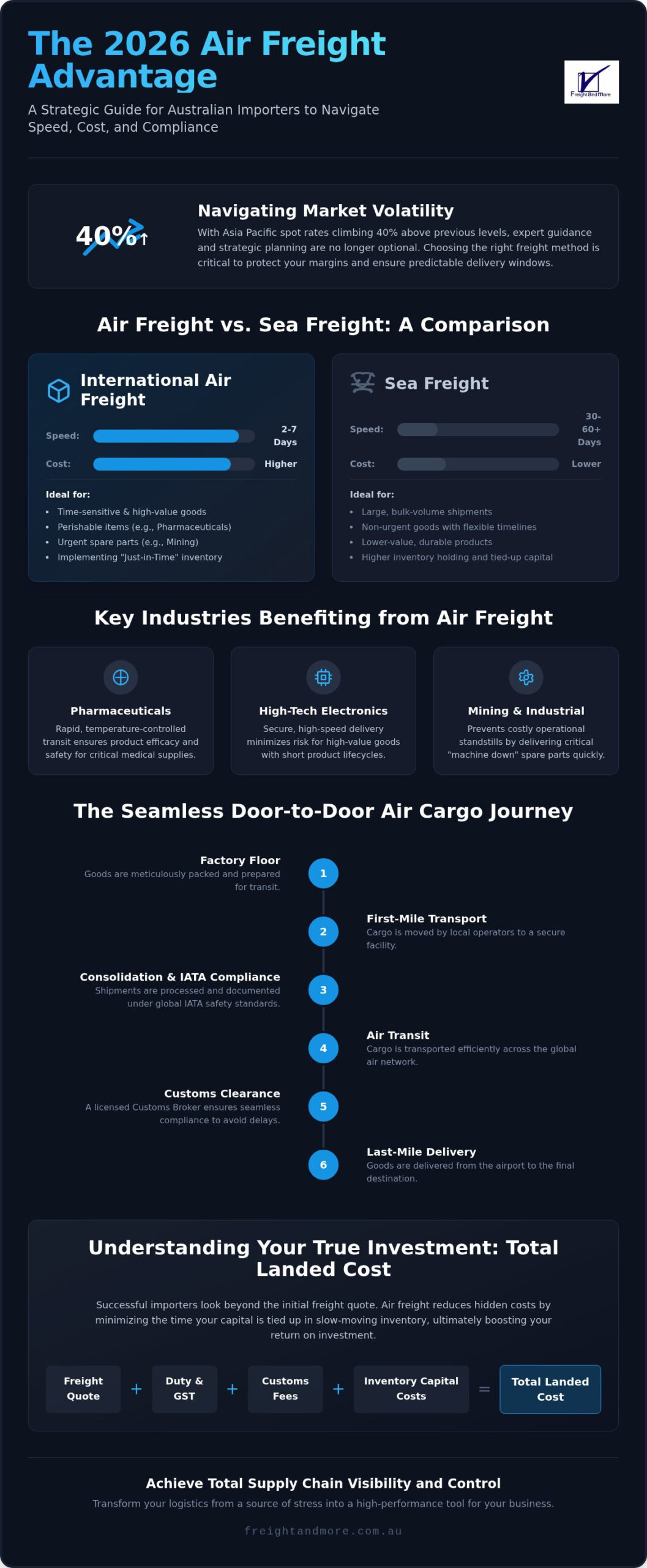
Successful importers look beyond the initial freight quote to understand the concept of “Total Landed Cost.” This perspective accounts for every expense, from duty and GST to the less obvious costs of capital tied up in slow-moving inventory. When you choose air freight, you’re investing in a more agile supply chain that responds to market demand in real-time, effectively bypassing the delays that can plague traditional shipping routes. It’s about making your capital work harder and faster for you.
To better understand this concept, watch this helpful video:
Why Speed Equals Savings for Australian Importers
Reducing the weeks that capital remains tied up in stock-in-transit is a primary driver for choosing air over sea. By utilizing international air freight Brisbane, you can implement “Just-in-Time” inventory models that are specifically tailored to the unique demands of the Australian market. This agility allows you to pivot quickly when consumer trends change or supply chain disruptions occur elsewhere. High warehouse turnover rates, fueled by rapid air delivery, directly correlate to a superior return on investment by maximizing liquidity and minimizing storage overheads.
Key Industries Benefiting from Global Air Networks
Several key industries rely on these global networks to maintain their operations with confidence. Understanding How Air Cargo Works helps you appreciate the complex coordination required to keep these vital supply chains flowing smoothly. Key sectors include:
- Pharmaceuticals: These shipments require rigorous temperature-controlled logistics and rapid transit to maintain efficacy and safety.
- High-tech Electronics: With high value and short product lifecycles, electronics need the high-security transport that minimizes the risk of theft or damage.
- Mining and Industrial: In these sectors, getting “machine down” spare parts delivered via air is often the only way to prevent massive financial losses due to operational standstills.
- Custom Apparel: Specialized manufacturers like melboragears.com.au depend on global air networks to deliver custom sportswear to teams and clubs in time for the start of their competition seasons.
Speed, Safety, and Global Connectivity: How Air Cargo Works
Understanding the lifecycle of international air freight Brisbane is essential for any business aiming to master its supply chain. The process begins long before the plane leaves the ground, starting at the factory floor where goods are meticulously packed for transit. From there, local transport operators move the cargo to a secure facility for consolidation. It is here that the global network of agents becomes invaluable, providing the boots-on-the-ground presence needed to manage handovers and ensure your cargo is tracked across multiple international borders with total precision.
Reliability in this chain is governed by the International Air Transport Association (IATA). By setting universal safety and security standards, IATA ensures that every stakeholder in the air cargo industry operates under the same rigorous guidelines. This global consistency is what allows for the seamless transfer of goods between different carriers and countries. The “first-mile” and “last-mile” segments are just as critical as the flight itself, as they represent the physical connection between the airport tarmac and your warehouse. If you have questions about how these standards apply to your specific industry, feel free to speak with our logistics experts today.
The Anatomy of an Air Waybill (AWB)
The Air Waybill is the most critical document in air logistics, acting as a non-negotiable contract of carriage between the shipper and the carrier. You’ll typically encounter two types: the House Air Waybill (HAWB), issued by a freight forwarder for individual shipments, and the Master Air Waybill (MAWB), which covers the consolidated load on the actual aircraft. Mastering these details is a key part of The Comprehensive Guide to the Freight Forwarding Process, ensuring you maintain legal compliance and cargo visibility at every stage.
Security and Handling Standards for International Cargo
Security is paramount in modern air freight. Every piece of commercial cargo undergoes strict screening, often involving advanced X-ray technology or explosive trace detection, to meet international aviation requirements. This level of scrutiny extends to how we manage specialized inventory. Whether you’re moving dangerous goods, oversized industrial components, or fragile electronics, specific handling protocols are enforced to maintain integrity. Secure warehousing plays a vital role here, providing a controlled environment where cargo is protected from environmental factors and unauthorized access before it reaches the airport tarmac. This detail-oriented approach is what separates a standard shipment from a premium logistics experience.
Comparing Air Freight vs. Sea Freight for Australian Importers
Choosing between transport modes is a strategic decision that directly impacts your bottom line and customer satisfaction. While sea freight remains the go-to for bulk commodities, international air freight Brisbane offers a level of responsiveness that ocean lanes simply can’t match. In the current market, the decision often comes down to a trade-off between the lowest possible freight rate and the necessity of a predictable, high-speed supply chain. We see air cargo as a precision tool that allows you to bypass the systemic delays that often plague maritime routes.
While sea freight transit times from major Asian hubs can stretch to six or eight weeks depending on port congestion, air shipments typically arrive within five to ten days. This difference is even more pronounced when you consider that global vessel schedule reliability reached just 62.2 percent in early 2026. Air freight is far less vulnerable to the shocks that affect ocean lanes, such as port strikes or severe maritime weather. It provides a more dependable delivery window, which is essential for maintaining trust with your own clients and meeting strict contractual deadlines.
Beyond speed and reliability, you should also consider the environmental footprint and total landed cost. It’s true that air transport has a larger carbon footprint per tonne of cargo compared to ocean vessels. However, many proactive businesses offset this by using air freight strategically for high-value items while maintaining bulk inventory through more sustainable sea routes. This hybrid approach allows you to stay agile without compromising your commitment to responsible logistics practices.
When the Higher Cost of Air Freight is Justified
Sometimes, paying the premium for air is the only logical choice for your business. If you’re facing a “stock-out” situation where a lack of inventory stops production or sales, the lost revenue far outweighs the shipping cost. Seasonal spikes like Black Friday or Christmas also demand the rapid replenishment that only air can provide. For your bulkier, less time-sensitive shipments, you can always explore our Comprehensive International Sea Freight Services to balance your overall logistics budget effectively.
Chargeable Weight Explained
Air freight pricing is based on “chargeable weight,” which is the greater of the actual weight or the volumetric weight of your goods. This ensures carriers are fairly compensated for the space light but bulky items occupy in the cargo hold. In the air freight industry, the standard volume-to-weight conversion ratio is 1:6000, meaning one cubic metre is treated as equivalent to 166.67 kilograms. To optimize your costs, focus on minimizing excess packaging and using boxes that fit your products snugly to reduce unnecessary volume.
Navigating Australian Customs and Compliance for Air Shipments
Air freight doesn’t give you the luxury of time that sea freight provides. While a vessel might take weeks to arrive, giving you plenty of room to fix paperwork errors, air cargo is on the ground in days. This rapid pace makes international air freight Brisbane uniquely sensitive to customs delays. If your documentation isn’t perfect when the plane touches down, you’re not just looking at a minor hold; you’re looking at expensive airport storage fees that accumulate much faster than their sea port counterparts. It’s a high-stakes environment where precision is your best friend.
A licensed Customs Broker is your first line of defense against these avoidable costs. They ensure that your commercial invoices, packing lists, and certificates of origin are accurate and ready for submission well before arrival. In Australia, most goods are subject to a 10 percent GST on their landed value. Additionally, you’ll encounter a standard import duty of 0 to 5 percent depending on the tariff classification. Under Australian law, the importer holds full legal responsibility for the correct self-assessment of these classifications for all goods valued above AUD $1,000. It’s a significant compliance burden that we help you manage with total confidence.
For shipments valued between AUD $1,000 and AUD $10,000, the current import processing charge is AUD $96, while shipments exceeding AUD $10,000 incur a fee of AUD $198. These costs are fixed by the government as of July 2026 and must be factored into your landed cost calculations. Eligible regular importers can also utilize the Deferred GST Scheme to improve cash flow by pushing the payment to their next Business Activity Statement. These small strategic shifts can make a massive difference in your monthly overheads.
Avoiding Common Customs Delays at the Airport
Incorrect tariff classification is one of the most frequent causes of cargo being held at the border. It doesn’t just lead to unexpected fines; it can trigger audits that disrupt your entire supply chain for months. We recommend a proactive pre-clearance strategy where your cargo is electronically cleared before the aircraft even enters Australian airspace. For a deeper dive into these complexities, consult our Customs Clearance Australia: The 2026 Business Guide.
Biosecurity and Quarantine Standards
The Department of Agriculture, Fisheries and Forestry (DAFF) maintains strict oversight of all air cargo entering the country to protect our local ecosystem. Biosecurity is a major priority, and certain items like timber, plant material, or animal products require specific permits or treatments before they can be released. If your descriptions are vague or generic, your goods might be flagged as high-risk, leading to mandatory physical inspections. Accurate, detailed descriptions on your packing list are the best way to ensure a smooth transition through quarantine and into your warehouse.
Seamless Door-to-Door Solutions with Freight and More
Managing the entire lifecycle of an international air shipment requires more than just a booking on a flight. It demands a dedicated partner who oversees every touchpoint, from the initial pickup at a foreign factory to the final delivery at your Brisbane warehouse. At Freight and More, we pride ourselves on a proactive, “can-do” attitude that anticipates bottlenecks before they disrupt your schedule. While global logistics giants often rely on automated, faceless systems, we offer a bespoke service where your specific business needs are handled with meticulous care and personal attention. We don’t just move boxes; we manage your supply chain’s reputation.
Our integrated service model combines international air freight Brisbane with robust local transport and warehouse management. This end-to-end approach ensures that your cargo doesn’t sit idle on a tarmac waiting for a third-party courier who doesn’t understand the urgency of your shipment. By maintaining control over the local transport leg, we provide a level of reliability that terminal-to-terminal providers simply cannot match. It’s about creating a seamless flow where information and physical goods move in perfect synchronization, giving you total confidence in your delivery windows.
National Reach with a Personal Touch
Leveraging our national network allows us to provide local expertise in every major Australian hub. This presence is vital for navigating the specific logistical quirks of different regions, ensuring your cargo moves efficiently once it reaches Australian soil. Our 3PL warehousing solutions further support your distribution strategy, allowing you to store and dispatch goods directly from our secure facilities. For those looking to extend their reach beyond the airport, our Road Freight Services Brisbane: National Interstate Transport provides the strategic link needed for comprehensive nationwide coverage.
Requesting a Quote for Your Next Air Shipment
Getting an accurate estimate for international air freight Brisbane is a straightforward process when you have the right data ready. To provide a precise quote, we typically require the cargo’s weight, dimensions, commodity type, and the specific terms of trade (Incoterms) used for the purchase. Transparency is at the heart of our operations, so you’ll never find hidden fees in our customs brokerage or handling charges. We believe in providing clear, end-to-end pricing that allows you to calculate your total landed cost with absolute certainty. When you’re ready to experience a more supportive and energetic approach to global shipping, our team is standing by to assist.
Master Your Global Logistics Strategy in 2026
Mastering your supply chain in 2026 requires more than just moving goods; it requires a proactive partnership that bridges the gap between the airport tarmac and your warehouse floor. By choosing international air freight Brisbane, you’ve already prioritized the speed and reliability necessary to stay competitive in a fast-paced market. You now understand that navigating complex customs regulations and managing “first-mile” logistics are the keys to avoiding costly delays and maintaining total visibility over your cargo. It’s about transforming your logistics from a standard business expense into a high-performance engine for growth.
Freight and More has been a dedicated partner for Australian businesses since 2009, offering a proven track record of excellence in door-to-door delivery. Our extensive global network of agents and in-house licensed Customs Brokers ensure that every shipment is handled with meticulous care and professional precision. We take pride in removing obstacles and providing the bespoke advice you need to succeed in the global marketplace. Whether you’re moving high-tech electronics or urgent industrial parts, our team is ready to support your ambitions with a personal touch.
We look forward to helping you accelerate your growth and secure your supply chain with our energetic, can-do approach!
Frequently Asked Questions
How is international air freight cost calculated?
Air freight costs are calculated based on the “chargeable weight” of your shipment, which is the greater of its actual physical weight or its volumetric weight. This method ensures that carriers are fairly compensated for the space that light but bulky items occupy in the cargo hold. Your total cost will also include essential components like fuel surcharges, security fees, and terminal handling charges at both the origin and destination.
What is the average transit time for air freight to Australia?
Average transit times for air cargo to Australia typically range from 5 to 10 days depending on the origin hub and flight availability. Shipments from major Asian or North American cities often arrive faster due to higher flight frequencies, while cargo from regional locations may require additional layovers. We focus on selecting the most efficient routes to ensure your goods spend as little time as possible in transit.
Can I ship dangerous goods via international air freight?
You can ship dangerous goods via air provided they strictly comply with the IATA Dangerous Goods Regulations (DGR). This process involves specialized packaging, precise labeling, and the completion of a Shippers Declaration for Dangerous Goods to ensure safety during flight. Our proactive team helps you navigate these requirements so your specialized cargo meets all aviation security standards without unnecessary delays.
What is the difference between a freight forwarder and a carrier like Qantas?
A carrier like Qantas owns the aircraft and provides the physical transport from airport to airport, while a freight forwarder like Freight and More manages the entire logistics chain. We act as your dedicated partner, coordinating local transport, customs brokerage, and the complex documentation required for global trade. This integrated approach offers a level of personal attention and flexibility that airlines simply don’t provide to individual shippers.
Do I need marine transit insurance for air freight?
Yes, securing marine transit insurance is a vital step for air shipments to protect your business against the financial impact of theft, damage, or loss. Despite the name, this industry-standard insurance covers cargo across all transport modes, including air and local road transport. It’s a proactive measure that ensures your high-value inventory is protected throughout its entire journey from the factory floor to your warehouse.
How does customs clearance work for air cargo arriving in Australia?
Customs clearance for air cargo involves the electronic lodgment of an import declaration with the Australian Border Force and biosecurity authorities. For all commercial shipments valued above AUD $1,000, a formal entry is required to calculate the applicable duty and GST. We prioritize pre-clearance strategies, submitting your paperwork before the aircraft lands to ensure your goods are released as quickly as possible upon arrival.
What is the maximum weight for an air freight shipment?
There isn’t a single maximum weight for air freight, but the limits are determined by the specific aircraft’s cargo door dimensions and floor loading capacity. While passenger planes have smaller bellyhold limits, dedicated freighter aircraft can carry massive, oversized industrial components weighing several tonnes. We analyze your shipment’s dimensions and weight to book the most appropriate aircraft for your specific cargo needs.
Can Freight and More handle door-to-door delivery from the airport?
We provide comprehensive door-to-door solutions for international air freight Brisbane by integrating our local transport and warehouse management capabilities. Our “can-do” team manages every step, from the initial pickup at the overseas supplier to the final delivery at your Australian facility. This seamless service model eliminates the need for you to coordinate multiple vendors, ensuring a reliable and stress-free logistics experience.
