LCL Shipping Melbourne: The 2026 Guide to Australian Sea Freight Consolidation

Most importers treat sea freight consolidation as a mere budget-saving tactic, but in the volatile market of 2026, LCL shipping Melbourne is actually your most powerful tool for agile scaling. You’ve likely felt the sting of unpredictable wharf ancillary charges or the frustration of waiting for a callback from a global giant while your cargo sits in limbo. Managing complex Australian customs regulations is exhausting. We understand that you need more than just a space on a ship; you need a proactive partner who treats your cargo with meticulous care.
This comprehensive guide empowers you to master the complexities of sea freight so you can streamline your supply chain and slash international freight costs without the usual headaches. You’ll gain a clear understanding of total landed costs, including the latest 2026 biosecurity fees and terminal handling updates. We’ll walk through exactly how to achieve seamless customs clearance, navigate the new European Union Carbon Border Adjustment Mechanism (CBAM) requirements, and manage current port delays to establish predictable shipping timelines that keep your customers happy.
Key Takeaways
- Discover how to leverage sea freight consolidation to pay only for the space you use, which keeps your supply chain lean and responsive.
- Master the intricacies of lcl shipping melbourne by understanding how accurate cargo classification prevents costly delays with the Australian Border Force.
- Gain a competitive edge with our 2026 transit guide, designed to help you navigate current port conditions and establish reliable delivery schedules.
- Follow the step-by-step journey of your cargo from overseas consolidation to your doorstep, ensuring total transparency at every milestone.
- Learn why a proactive, detail-oriented freight partner is essential for managing the high-scrutiny environment of Australian sea freight.
Understanding LCL Shipping in the Australian Context
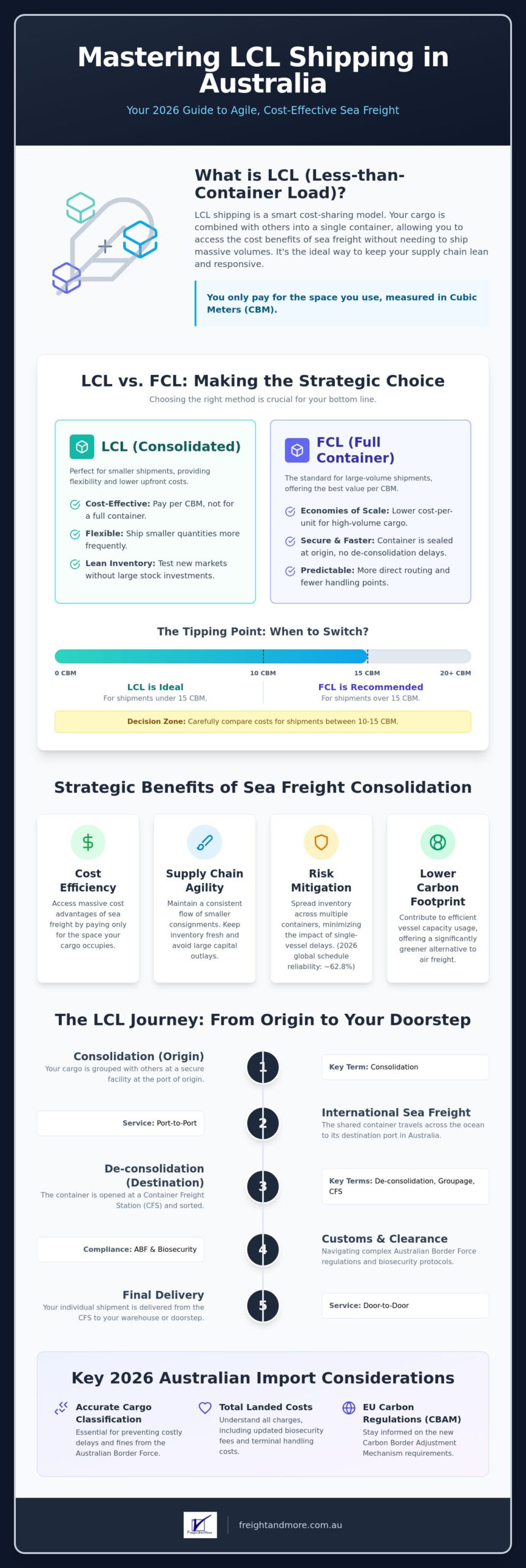
In the complex landscape of Australian logistics, Less-than-container load (LCL) represents a sophisticated cost-sharing model designed for businesses that don’t require a full 20ft or 40ft container. By choosing lcl shipping melbourne, you’re essentially renting a portion of a shared container; this allows you to access the massive cost advantages of international sea freight without needing to move massive volumes. Your freight forwarder acts as the master coordinator, gathering cargo from multiple suppliers and expertly packing them into a single unit. It’s a precise puzzle that requires a proactive partner to ensure every cubic meter is managed with care.
To better understand how this consolidation process works in practice, watch this helpful video:
Quoting for LCL is typically based on volume or weight, whichever is greater. We use Cubic Meters (CBM) as the primary unit of measurement. If you’re shipping dense materials, the weight might dictate the cost, but for most retail or commercial goods, the physical space you occupy in the container is the deciding factor. Deciding when to move away from air freight is a pivotal moment for your bottom line. If your shipment is larger than 0.5 CBM and doesn’t require the overnight speed of air transport, switching to lcl shipping melbourne can significantly reduce your overheads while still maintaining a steady supply chain rhythm.
LCL vs FCL: Making the Strategic Choice
There is a distinct tipping point where LCL becomes less economical than a Full Container Load (FCL). Based on current 2026 market data, shipments between 10 to 15 CBM require a careful cost comparison; however, once you exceed 15 CBM, FCL is almost always the more strategic choice. For smaller businesses, LCL provides the incredible flexibility to test new Australian market trends or maintain lean inventory levels without the heavy capital investment of a full container. It’s the perfect middle ground for companies that have outgrown courier services but aren’t yet ready for the scale of full containers.
Key Terminology for Australian Importers
Strategic Benefits of Sea Freight Consolidation for National Growth
Scaling a business in Australia requires a logistics strategy that balances speed with fiscal responsibility. Choosing lcl shipping melbourne is a savvy move for brands that want to expand their product range without the crippling overhead of massive stock orders. Instead of waiting months to fill a 40ft container, you can maintain a consistent flow of smaller consignments. This approach keeps your inventory fresh and your warehouse manageable while ensuring you only pay for the physical space your cargo occupies.
In 2026, global schedule reliability for container shipping sits at approximately 62.8%, meaning delays are a reality of the trade. Spreading your inventory across multiple shared containers mitigates the risk of a single-point failure. If one vessel is delayed by the average five-day window, only a fraction of your stock is affected. This risk mitigation is a proactive way to protect your reputation with local customers who expect consistent availability.
For the environmentally conscious enterprise, sea freight consolidation is a clear winner. It offers a much lower carbon footprint per unit compared to international air cargo. By utilizing shared container space, you contribute to a more efficient use of vessel capacity, helping you meet sustainability targets while keeping transport costs under control.
Optimising Supply Chain Cash Flow
Smaller capital outlays mean better cash flow for your business. You can order what you need, when you need it, rather than tying up thousands in “safety stock” that gathers dust. This “just-in-time” delivery model is particularly effective for high-volume, low-margin goods where every cent counts. If you’re ready to see how this fits your specific business model, you can reach out for a tailored logistics assessment from our expert team.
Accessing Global Markets from Australia
Our global agent network connects you to every major manufacturing hub, from Southeast Asia to Europe; for a closer look at the international infrastructure supporting these routes, check out CWT Globelink. We prioritise direct services to Melbourne, which minimises the handling of your goods and reduces the risk of damage during transit. Local expertise is your best defense against the current 1-2 day delays seen at Melbourne ports. We ensure your cargo moves through the terminal with precision, bypassing the common obstacles that slow down less experienced operators.
Navigating Australian Customs and Compliance for LCL Cargo
LCL shipments are often flagged for higher scrutiny by the Australian Border Force (ABF) because a single container holds cargo from multiple unrelated parties. This creates a “co-loading risk” where one non-compliant shipment, perhaps containing undeclared organic material or misclassified hazardous goods, can hold up the entire container for everyone else. Navigating the complexities of lcl shipping melbourne requires a deep understanding of these shared dynamics. You need a partner who meticulously vets every aspect of the paperwork before the vessel even leaves the origin port. A licensed Customs Broker is your first line of defense, ensuring that your specific consignment meets every regulatory hurdle so you don’t get caught in someone else’s delay.
Accuracy is your best protection against the heavy penalties associated with misclassification under the Australian Customs Tariff. The ABF doesn’t just look for prohibited items; they look for revenue leakage caused by incorrect duty rates. When you’re coordinating lcl shipping melbourne, our in-house brokerage team focuses on the granular details of your cargo, from the raw materials used to the final intended use, to ensure you pay the correct amount and nothing more. This proactive management turns a potentially stressful clearance process into a routine, predictable part of your logistics chain.
Essential Documentation for Seamless Clearance
Your documentation must be flawless to avoid the “red line” at the border. The Bill of Lading, Commercial Invoice, and Packing List are the standard requirements, but for Australian ports, the Packing Declaration is just as vital. This document confirms whether your packaging materials, like timber pallets, have been treated to meet strict biosecurity standards. If you’re unsure about the latest 2026 requirements for these forms, you can learn more about our professional customs clearance services to ensure your paperwork is audit-ready.
Managing Duties, GST, and Port Charges
Calculating the total landed cost of your goods involves more than just the freight rate. You’ll need to account for the 10% GST on the taxable importation and any applicable customs duties based on your cargo’s classification. Be prepared for standard port charges like Destination Terminal Handling Charges (DTHC) and de-consolidation fees at the Melbourne CFS. As of July 1, 2026, government biosecurity charges have increased by approximately AUD 2–3 per transaction, making it even more important to get your filing right the first time. For a deeper dive into these financial variables, read our 2026 Business Guide to Seamless Importing.
The Logistics Journey: From Overseas Port to Australian Doorstep
The physical journey of your cargo begins at the origin Container Freight Station (CFS), where our overseas partners meticulously measure and pack your goods alongside compatible shipments. In 2026, securing space for lcl shipping melbourne requires navigating tight capacity and container shortages, particularly for 40ft units in Southeast Asia. Once the vessel departs, we monitor global schedule reliability rates to provide you with the most accurate arrival estimates. Freight and More Pty Ltd manages the transition from sea to land with proactive oversight, anticipating the 1 to 2 day delays currently observed at major Melbourne terminals.
Upon arrival at the Melbourne wharf, the container is transferred to a bonded facility for de-consolidation. This is a high-precision phase where the physical container is stripped and individual consignments are sorted for final delivery. We ensure this process moves swiftly to help you avoid escalating wharf storage costs. Our team at Freight and More Pty Ltd coordinates every detail so that your cargo is ready for domestic transport immediately after it clears the terminal gates.
Ensuring Cargo Safety During Transit
Because LCL cargo undergoes multiple touchpoints during consolidation and stripping, export-grade packaging is essential. We recommend robust palletising and heavy-duty shrink-wrapping to protect your goods against movement during the sea voyage. Since shared containers carry diverse products, Freight and More Pty Ltd also assists in arranging marine transit insurance to safeguard your financial investment. We treat your cargo with personal attention, ensuring it’s handled with the meticulous care required for a secure international journey.
Local Transport and Warehousing Integration
The final leg of the journey involves integrating road or rail transport to reach your doorstep. We bridge the gap between the port and your warehouse by utilizing our extensive national transport network. If you’re managing fluctuating inventory levels, our comprehensive sea freight services include access to 3PL warehousing solutions. This allows you to store goods strategically after customs clearance, providing a resilient buffer for your supply chain. Freight and More Pty Ltd takes care of the complex logistics so you can focus on your core business growth.
Why Choose Freight and More for Your LCL Shipping Needs?
Since our inception in 2009, Freight and More Pty Ltd has focused on transforming the complexities of global trade into a streamlined, stress-free experience for our clients. Choosing a partner for lcl shipping melbourne shouldn’t feel like a gamble with a faceless corporation. We bring over 15 years of deep Australian logistics expertise to the table, combining professional confidence with a welcoming, “can-do” attitude that ensures your cargo is never just another number in a spreadsheet. Our team takes immense pride in providing a premium level of service that global giants simply can’t match; we offer the proactive communication and detail-oriented management required to navigate the volatile 2026 market.
We don’t just move boxes; we manage your entire international presence. Whether you need the cost-efficiency of sea freight or the rapid response of international air freight, Freight and More Pty Ltd provides a truly integrated supply chain solution. Our goal is to function as a dedicated partner and guide, removing the obstacles of international trade so you can focus on what you do best. We’re large enough to possess an extensive global network, yet personal enough to offer the bespoke advice that keeps your business competitive. You deserve a partner who anticipates market shifts and provides reliable solutions before problems arise.
Bespoke Solutions for Every Industry
Every business has a unique rhythm, and we tailor our logistics plans to match yours. From ambitious entrepreneurs testing their first product lines to large corporate entities managing complex national distribution, Freight and More Pty Ltd provides the specific level of care your cargo requires. We offer expert advice on navigating the Australian regulatory landscape, ensuring you stay compliant while minimizing costs. If you’re ready to experience a more personal approach to lcl shipping melbourne, you can Contact our expert team for a tailored quote today.
A Global Network with a Local Heart
Leveraging our extensive agent network allows us to ensure reliability across every major trade lane, from the busy hubs of Southeast Asia to the established ports of Europe. We combine this global reach with the “local heart” of a seasoned veteran of the Australian freight industry. This means you get the best of both worlds: world-class connectivity and the meticulous care of a local team that knows the Melbourne wharf like the back of their hand. To see how we manage the entire logistics journey, Discover our full range of international freight forwarding services and take the first step toward a more resilient supply chain with Freight and More Pty Ltd.
Future-Proof Your Australian Supply Chain
Success in the 2026 trade environment requires more than just booking space on a vessel; it demands a proactive strategy that balances cost-efficiency with absolute compliance. By mastering lcl shipping melbourne, you’ve gained the ability to scale your inventory with precision while avoiding the heavy capital commitments of full containers. We’ve explored how shared container space keeps your supply chain lean and how expert de-consolidation at a local CFS ensures your goods are ready for the final mile without unnecessary delays.
As an Australian owned and operated business since 2009, we take immense pride in acting as your dedicated logistics partner. Our licensed in-house Customs Brokerage and end-to-end door-to-door logistics solutions are designed to remove every obstacle from your path. We’re ready to apply our detail-oriented management to your specific business needs, ensuring your cargo is handled with the meticulous care and personal attention it deserves at every milestone.
Let’s work together to build a more resilient, cost-effective future for your international trade operations. We’re eager to assist you in navigating the complexities of global freight with confidence and ease.
Frequently Asked Questions
What is the difference between LCL and FCL shipping?
LCL, or Less-than-Container Load, involves sharing container space with other shippers, making it the most cost-effective choice for smaller volumes. FCL, or Full Container Load, means you’ve booked the entire 20ft or 40ft unit for your exclusive use. While FCL is faster because it avoids the consolidation process, LCL provides the flexibility to ship smaller quantities between 1 to 15 CBM without the expense of a whole container.
How are LCL shipping rates calculated for Australian imports?
Rates are primarily calculated based on the volume of your cargo in Cubic Meters (CBM) or its weight, whichever is greater. Most commercial goods are quoted by volume. It’s vital to factor in the 2026 market updates, including the 2% to 4.5% increase in terminal handling charges and current peak season surcharges on the Asia-Australia trade lane, to ensure your landed cost calculations remain accurate.
How long does LCL sea freight take to arrive in Australia?
Transit times depend on the origin port, though you should currently account for 1-2 day delays at Melbourne terminals due to peak congestion. With global schedule reliability at 62.8% as of late 2025, late vessels are averaging delays of just over five days. We recommend booking your shipment at least three weeks in advance to secure space amid tight capacity and potential equipment shortages in Southeast Asia.
Is LCL shipping safe for fragile or high-value commercial goods?
Yes, LCL is safe provided you use export-grade packaging and robust palletising to protect your goods during the “multi-touch” consolidation process. Because your cargo is handled at both the origin and destination Container Freight Stations, we treat every consignment with meticulous care. We also strongly advise securing marine transit insurance to provide total peace of mind against the inherent risks of international sea travel.
What are the common ‘hidden’ costs in LCL shipping?
Beyond the base freight rate, you’ll encounter Destination Terminal Handling Charges (DTHC), de-consolidation fees, and wharf ancillary charges. In July 2026, empty container park fees increased by approximately AUD 5 to 15 per container. You should also prepare for government biosecurity transaction fees, which recently saw a small increase, and ensure your quote includes these local Melbourne port costs to avoid surprises at the border.
Do I need a customs broker for my LCL shipment?
While not a legal requirement, using a licensed customs broker is the best way to avoid expensive Australian Border Force penalties and biosecurity holds. LCL shipments often face higher scrutiny because they are co-loaded with goods from multiple parties. Our in-house brokerage team ensures your lcl shipping melbourne documentation is flawless, which is essential for navigating the complex 2026 regulatory environment and ensuring a seamless clearance process.
Can I track my LCL shipment once it leaves the origin port?
Yes, we provide comprehensive tracking that monitors your cargo from the initial consolidation at the origin CFS through to its arrival in Australia. You’ll receive updates on vessel departure, any transshipment milestones, and the estimated time of arrival at the Melbourne terminal. This transparency allows you to coordinate your local transport and warehouse management with total confidence, ensuring your supply chain remains responsive and predictable.
What happens if my cargo is the only one delayed in a shared container?
If the Australian Border Force flags your specific consignment for a customs or biosecurity inspection, your goods will be held at the CFS while the rest of the container’s cargo is released. This highlights why accurate cargo classification is so critical. We work proactively to verify your lcl shipping melbourne paperwork before departure, significantly reducing the risk of your goods being singled out for time-consuming and costly inspections.
