Shipping Container Transport Cost Australia: The 2026 Logistics Guide

Did you know that a single overlooked port surcharge can inflate your logistics budget by thousands of dollars before your cargo even leaves the wharf? It’s a frustrating reality for many Australian businesses that trying to pin down a reliable shipping container transport cost australia feels like aiming at a moving target in a volatile 2026 market. You’ve likely felt the stress of unexpected fees or the confusion of weighing FCL against LCL options while trying to maintain a predictable bottom line.
We’re here to act as your dedicated partner, providing the clarity and expert guidance you need to move your cargo with total confidence. This guide offers a comprehensive breakdown of the variables, hidden fees, and strategic choices that define the modern logistics environment. If you’re a high-volume importer seeking budget stability, we’ll show you how to optimize your routes, and if you’re an entrepreneur exploring your first shipment, we’ll simplify the pricing maze for you. By exploring the impact of the Marine Order 27 updates effective April 2026 and shifting market trends, you’ll be empowered to eliminate unexpected surcharges and master your logistics budget for the year ahead!
Key Takeaways
- Learn the critical distinction between container hardware and service fees to ensure you’re only paying for the logistics you actually need.
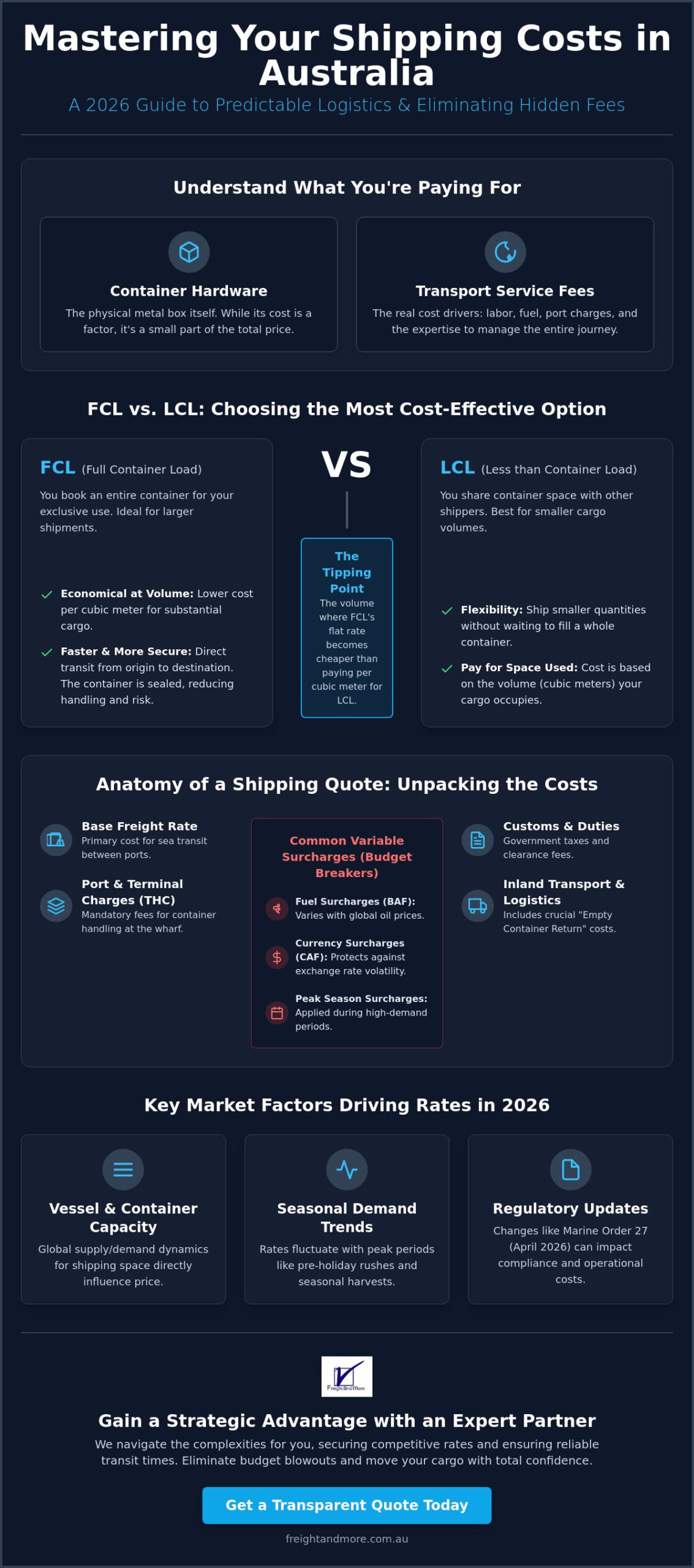
- Discover the specific tipping point where FCL becomes more economical than LCL, allowing you to master your shipping container transport cost australia through smarter volume choices.
- Identify the common variable surcharges and empty container return logistics that often lead to budget blowouts if not managed proactively.
- Stay ahead of the curve by understanding how vessel capacity and 2026 seasonal demand trends directly influence your bottom line.
- See how professional freight forwarding and global agent networks act as your strategic advantage in securing more competitive rates and reliable transit times.
What Defines Shipping Container Transport in Australia?
To better understand the nuances of these expenses, watch this helpful video:
The Intermodal Advantage
Efficiency in the Australian market relies on the seamless transition between different modes of transport. Because our coastline is vast and our inland hubs are distant, combining sea freight with rail and road networks is non-negotiable. This global containerization system allows goods to remain sealed and secure from the moment they leave a factory overseas until they arrive at a warehouse in Sydney or Perth. Door-to-door logistics is where the true value is found. It removes the burden of coordination from your shoulders and places it in the hands of experts who understand the intricacies of intermodal connectivity.
Commercial vs. Personal Container Transport
It’s important to clarify that this guide is designed specifically for commercial cargo and professional business logistics. Business-grade transport demands a higher level of precision, specialized marine transit insurance, and rigorous handling protocols that differ significantly from personal shipping. At Freight and More, we specialize in International Sea Freight and corporate supply chain management. Please be aware that we do not handle residential household moving or personal effects. Our focus remains entirely on supporting the growth of Australian businesses by providing reliable, large-scale transport solutions that keep their operations running smoothly.
Reliability is the cornerstone of our service. We take immense pride in managing the details that others might overlook, ensuring that your commercial interests are protected at every stage of the journey. Whether you are moving a single container or managing a complex national supply chain, we are here to provide the proactive support and authoritative expertise you deserve.
Key Components of Shipping Container Transport Costs
Understanding your total shipping container transport cost australia requires looking far beyond the initial base quote. While the base freight rate covers the primary transit between ports, a complex series of variable surcharges and administrative fees often dictates the final figure on your invoice. For example, moving a standard dry container involves vastly different cost structures than transporting a specialized refrigerated unit, which necessitates constant power supply and technical monitoring. You must also account for the physical distance between the port and your facility. The logistics of “empty container return” can add surprising overhead if your warehouse is located far from the designated de-hire depot, as you’re responsible for the cost of getting that empty box back to the terminal.
Port and Terminal Handling Charges
Every major gateway in Australia, from Brisbane to Adelaide, operates under its own unique fee structure. Terminal Handling Charges (THC) are the costs charged by terminal authorities for moving containers between the vessel and the quay. These wharfage fees are entirely unavoidable and vary based on local labor agreements, recent infrastructure investments, and overall port efficiency. Common port-side expenses include:
- Wharfage and stevedoring fees
- Crane hire and equipment levies
- Port security and infrastructure charges
- Terminal access fees for road carriers
Being aware of these specific port-side expenses allows you to better predict your landed costs before your cargo even arrives. It’s a proactive step that ensures your budget remains intact.
Fuel Surcharges and Variable Levies
Fuel is perhaps the most volatile element in your logistics budget. In 2026, the Bunker Adjustment Factor (BAF) remains a standard industry levy that fluctuates with global oil prices, directly influencing sea freight rates on a monthly basis. On the domestic front, road transport quotes are subject to fuel levies that help carriers manage the rising cost of diesel across the Australian road network. According to data from the Australian Bureau of Statistics freight cost trends, these variable levies are crucial for maintaining the stability of national supply chains despite market volatility. We monitor these shifts closely to provide you with the most accurate and reliable information possible.
Customs and Compliance Fees
Navigating the regulatory landscape is a non-negotiable part of the process. Securing professional customs clearance is a vital step that ensures your business remains compliant with Australian Border Force requirements. Beyond the mandatory duty and GST, your total cost will include brokerage fees and potentially quarantine inspection charges if your goods are high-risk. Expert brokerage doesn’t just handle the paperwork; it proactively prevents expensive port storage delays that can quickly erode your profit margins. If you want to ensure every detail is accounted for, we encourage you to discuss your specific requirements with our dedicated team of experts.
FCL vs. LCL: Evaluating Cost-Efficiency for Your Cargo
Choosing between a Full Container Load (FCL) and a Less-than-Container Load (LCL) is one of the most significant decisions affecting your total shipping container transport cost australia. It isn’t just about the volume of your goods; it’s about balancing speed, security, and the intricate fee structures that govern shared space. While FCL offers the exclusivity of an entire container, LCL provides a flexible gateway for smaller shipments by allowing multiple importers to share the same unit. Understanding the mechanics of these two methods is essential for any business looking to optimize their international trade lanes and maintain a lean logistics budget.
There is a definitive tipping point where moving from LCL to FCL becomes the more economical choice. Generally, once your cargo exceeds approximately 13 to 15 cubic meters (CBM), the flat rate of a 20ft container often proves cheaper than the cumulative volume-based charges of LCL. This is because LCL pricing is calculated based on the space your goods occupy, typically measured in CBM. However, you must also factor in the consolidation costs, which include the labor and facility fees required to group and ungroup cargo from various suppliers at a Container Freight Station (CFS). These handling fees can sometimes outweigh the savings of a shared freight rate if your volume is nearing that critical tipping point. If your supply chain includes North American suppliers, our detailed breakdown of sea freight costs from USA to Australia provides a comprehensive reference for understanding how these LCL and FCL thresholds apply specifically to trans-Pacific shipments.
When to Choose Full Container Load (FCL)
If your priority is maximum security and the fastest possible transit time, FCL is your premier option. Because the container remains sealed from the point of origin to your warehouse door, you bypass the delays associated with third-party handling and de-consolidation warehouses. For high-volume businesses, our sea freight services provide the scale and reliability needed to maintain a tight and predictable supply chain. It’s the bold choice for those who value total control over their cargo’s environment and wish to minimize the risk of damage from adjacent goods.
Strategic Use of LCL Shipping
Small businesses and entrepreneurs often find that LCL is the perfect vehicle for accessing global markets without the financial burden of filling an entire box. It allows you to pay only for the space you use, though it’s important to remember that lower freight rates are often balanced by higher handling and documentation fees at the destination port. For a deeper dive into these mechanics, we recommend exploring our LCL Shipping Australia guide. This strategic choice requires a partner who can navigate the complexities of consolidation with meticulous care and personal attention to your specific cargo needs.
Market Factors Driving Container Transport Rates in 2026
Market volatility doesn’t have to mean budget uncertainty. In 2026, your shipping container transport cost australia is heavily influenced by a shifting landscape of global manufacturing and localized infrastructure pressures. While we’ve discussed the specific fees and equipment types in previous sections, it’s vital to recognize that these costs are governed by broader economic forces. Vessel capacity and seasonal demand spikes, such as the traditional peak season rushes, can cause rates to fluctuate rapidly. We take immense pride in providing the transparency you need to stay ahead of these shifts, ensuring you’re never caught off guard by a sudden change in the market climate.
Global Supply Chain Dynamics
The China-Australia trade route continues to dominate pricing structures across the region. When manufacturing hubs in Asia experience shifts in output or holiday closures, the ripple effects are felt immediately at Australian ports. International port congestion in major global hubs often leads to vessel bunching, which disrupts schedules and forces local carriers to adjust their pricing to account for terminal delays. Global container availability directly dictates local spot rates in Australia. Because our nation relies so heavily on imported goods, any imbalance in the global circulation of empty units can lead to temporary price hikes as carriers scramble to secure equipment for their clients. Businesses sourcing from North America face a distinct set of variables, and understanding how to accurately calculate sea freight costs from USA to Australia is an essential step in building a resilient and budget-stable trans-Pacific supply chain.
Domestic Road and Rail Constraints
Once your cargo arrives on our shores, domestic factors take center stage. The Australian transport industry is currently managing ongoing driver shortages and equipment availability challenges, which put upward pressure on road freight quotes. To combat this, many savvy businesses are turning to rail transport as a cost-effective alternative for long-haul interstate routes. Rail offers a level of budget stability that road transport sometimes lacks, especially when fuel prices are high. If your operations allow for slightly longer lead times, rail can be a strategic masterstroke for your bottom line. We always recommend booking as far in advance as possible. Early coordination is the most reliable strategy for securing equipment and locking in competitive rates before seasonal demand peaks.
We understand that managing a business requires precision and a partner you can depend on. Our proactive approach means we’re constantly monitoring these market drivers to provide you with the most accurate, up-to-date advice. If you’re ready to secure your 2026 supply chain and eliminate the guesswork, we invite you to request a tailored logistics quote from our expert team today. We’re here to solve your problems and help your business thrive in any market condition.
Strategic Logistics: How Professional Forwarding Minimizes Transport Overheads
Choosing the right partner is the final, and perhaps most critical, step in mastering your shipping container transport cost australia. A freight forwarder is much more than a middleman; they are a strategic asset that transforms your supply chain from a cost center into a competitive advantage. By leveraging deep industry expertise and a global agent network, we secure rates and routes that are often inaccessible to individual businesses. This proactive approach ensures that every dollar spent is an investment in reliability and speed, rather than a response to poorly managed logistics hurdles.
Visibility is the foundation of a predictable budget. Our end-to-door tracking and communication protocols mean you’re always informed about your cargo’s status, allowing you to plan your operations with precision. When you integrate warehousing and distribution into your transport strategy, you effectively eliminate the friction points that drive up “last mile” costs. By coordinating the arrival of your container with available warehouse space and local delivery schedules, we ensure your goods move seamlessly from the port to their final destination without sitting idle.
Consolidated Solutions for Australian Businesses
At Freight and More Pty Ltd, we pride ourselves on being a bold overachiever that goes beyond industry norms to protect your bottom line. We leverage our high-volume shipping lanes to secure competitive pricing, passing those efficiencies directly to our clients. You benefit from a single, authoritative point of contact for sea freight, customs, and local transport, which removes the confusion of managing multiple vendors. For those operating through Victoria, our Container Shipping Melbourne guide offers specific process insights tailored to the local landscape, helping you navigate one of Australia’s busiest gateways with total confidence.
Proactive Management of Potential Delays
Avoiding the sting of demurrage and detention fees is one of the fastest ways to lower your total shipping container transport cost australia. These charges, applied when containers aren’t returned to the port on time, can quickly spiral into thousands of dollars if not managed with meticulous care. Our team acts as your dedicated guide, ensuring that every compliance requirement is met before your cargo hits the wharf. Professional customs clearance is essential here; it maintains the flow of your goods and prevents the expensive port storage delays that often trap unprepared importers. We invite you to request a tailored logistics enquiry today so we can provide you with an accurate, transparent breakdown for your 2026 transport needs. Let us handle the complexities while you focus on growing your business!
Master Your 2026 Logistics Strategy Today!
Mastering your 2026 logistics strategy requires more than just a glance at a base rate; it demands a deep understanding of the variables that shape your final invoice. By distinguishing between container hardware and service fees, choosing the right load type for your volume, and anticipating market fluctuations, you’ve already taken the first step toward total budget control. Navigating the complexities of a shipping container transport cost australia doesn’t have to be a solo journey when you have a seasoned partner by your side.
We’ve been providing dedicated door-to-door service since 2009, combining our global network of logistics agents with expert Australian customs brokerage to ensure your cargo moves without delay. Our proactive team is ready to help you eliminate hidden fees and optimize your supply chain for the year ahead. If you’re ready to secure a reliable and transparent partner for your next shipment, let’s start the conversation!
Get a Professional Container Transport Quote from Freight and More today and experience the confidence of expert logistics management. We’re eager to assist you in reaching your business goals with precision and care!
Frequently Asked Questions
How much does it cost to transport a 20ft container in Australia?
Prices vary based on your specific route and the level of service required. For domestic moves, industry data from April 2026 suggests costs generally range between $2,000 and $7,000. Interstate transport from hubs like Adelaide to Melbourne typically falls between $2,600 and $3,200 for a 20ft unit. These figures depend on whether you’re utilizing a self-pack option or a full-service commercial logistics provider to manage the journey.
What is the difference between port-to-port and door-to-door transport costs?
Port-to-port costs only cover the ocean transit between international terminals, which leaves you responsible for the final logistical leg. Door-to-door costs provide a comprehensive solution that includes the “last mile” delivery directly to your warehouse. While door-to-door quotes appear higher initially, they often prevent the logistical headaches and separate carrier fees that inflate a shipping container transport cost australia when managed piece-meal by an inexperienced importer.
Are there hidden fees in shipping container transport quotes?
Fees aren’t usually hidden, but they are often variable and highly complex. You might encounter terminal handling charges, wharfage fees, or quarantine inspection costs that don’t appear in a basic freight rate. Working with a transparent partner ensures these components are identified early in the process. This proactive approach helps you avoid the shock of unexpected port surcharges or administrative levies during the final stages of your cargo’s delivery.
Does the price of container transport change during peak seasons?
Yes, seasonal demand significantly impacts pricing due to vessel capacity constraints and equipment availability. During the traditional end-of-year peak, increased competition for space drives up spot rates across all major Australian shipping lanes. We recommend booking your shipments at least four to six weeks in advance during these busy periods. This strategy helps you secure the necessary equipment and lock in more stable rates before the market experiences peak volatility.
Is it cheaper to transport a container by road or rail in Australia?
Rail is generally the more cost-effective choice for long-haul interstate routes, especially when moving goods between Perth and the eastern states. Road transport offers superior flexibility and speed for shorter distances or urgent “last mile” deliveries directly to your door; for specialized heavy machinery or oversized cargo in Western Australia, you can explore Towing and Transport Services to facilitate a secure delivery from the port. The right choice depends on your specific timeline. If your schedule allows for a few extra days in transit, rail can provide a significant reduction in your overall shipping container transport cost australia.
What insurance do I need for shipping container transport?
Marine transit insurance is essential for protecting your commercial investment against loss or damage during transit. Carrier liability is often limited by international conventions and may not cover the full value of your goods if an accident occurs. Specialized business insurance provides the peace of mind that your cargo is protected from the moment it leaves the supplier until it reaches your facility. It’s a small investment that prevents catastrophic financial loss.
How do fuel surcharges affect my final shipping quote?
Fuel surcharges, such as the Bunker Adjustment Factor, fluctuate monthly based on global oil prices. These levies are applied as a percentage of the base freight rate to help carriers manage energy costs during transit. Because fuel is a major expense in both sea and road transport, these surcharges are a standard industry mechanism. We monitor these shifts closely to ensure your quotes reflect the most current market conditions and provide you with total pricing clarity.
Can a freight forwarder help reduce my container transport costs?
Absolutely, a professional forwarder acts as a dedicated cost optimizer by leveraging high-volume contracts and an extensive global network. We identify the most efficient routes and consolidation opportunities that individual businesses might otherwise miss. By managing customs clearance and port logistics proactively, we help you avoid expensive delays like demurrage or detention. Our goal is to handle the complex details so you can focus entirely on your core business growth.
