Calculating Sea Freight Costs from USA to Australia: The 2026 Importer’s Reference

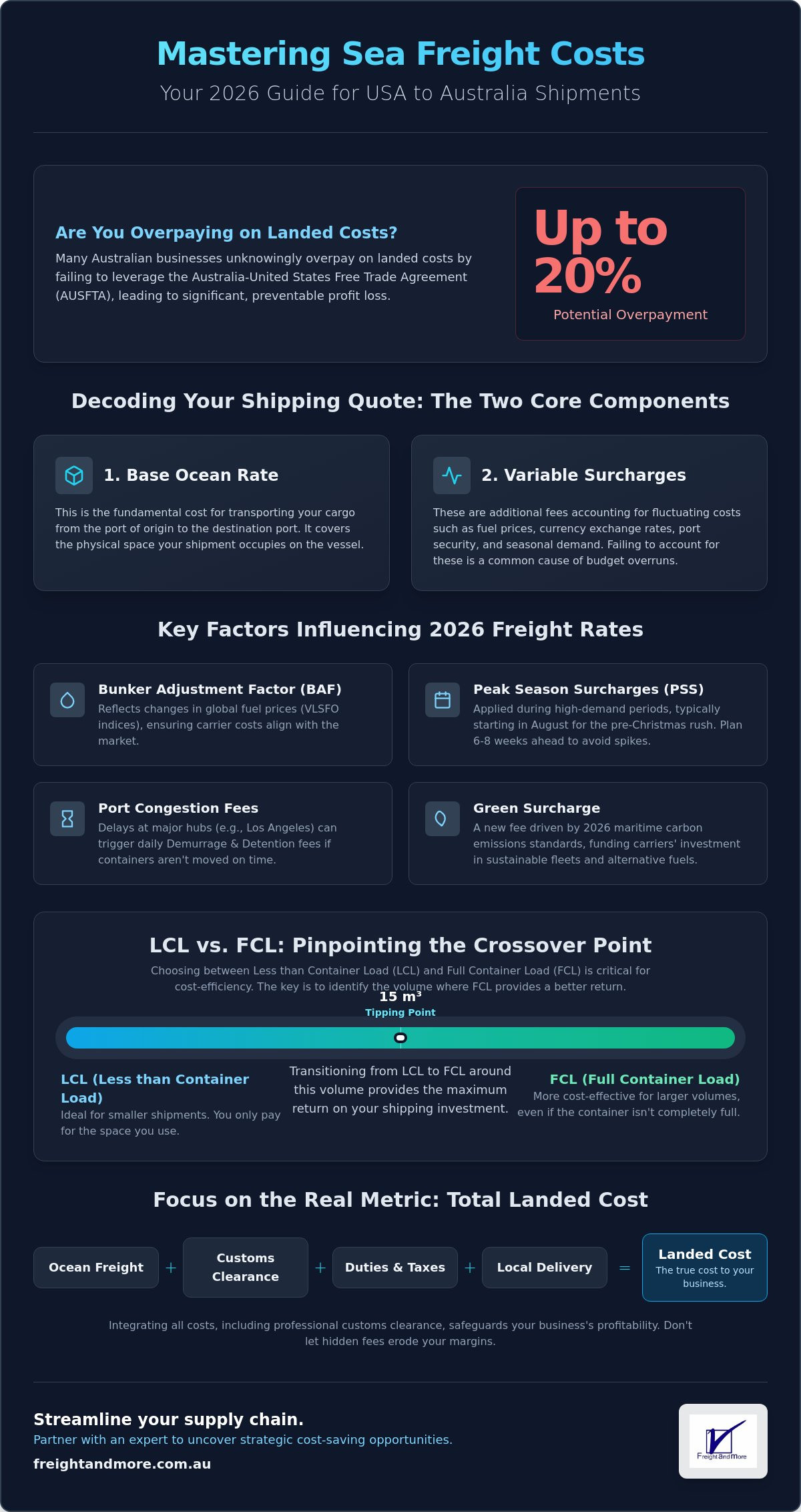
Did you know that many Australian businesses overpay on landed costs by up to 20% simply by failing to fully leverage the Australia-United States Free Trade Agreement? It is a staggering figure that highlights how easily profits can slip away when you are managing complex logistics and trying to calculate precise sea freight costs from USA to Australia. We understand how frustrating it is to face unpredictable fuel surcharges or unexpected Australian port fees that seem to appear out of nowhere. You deserve a shipping partner that prioritizes transparency and helps you avoid these common pitfalls through meticulous planning and expert guidance.
This reference is designed to help you master the complexities of trans-Pacific shipping, providing a clear roadmap to build your logistics budget with total precision. We will guide you through the critical differences between LCL and FCL pricing, explain how to maximize your savings under the AUSFTA, and prepare you for the latest 2026 biosecurity and customs compliance standards. By the end of this guide, you will have the confidence to choose the freight mode that best serves your business goals while ensuring every shipment remains compliant and cost-effective. Let’s dive into the details and streamline your supply chain together.
Key Takeaways
- Decode the complex structure of base ocean rates and variable surcharges to ensure your logistics budget remains predictable and precise.
- Navigate the impact of seasonal demand and fuel adjustments to accurately calculate sea freight costs from USA to Australia for your 2026 shipments.
- Pinpoint the 15 cubic metre volume threshold where transitioning from LCL to FCL provides the maximum return on your shipping investment.
- Shift your focus to the “Landed Cost” metric, integrating professional customs clearance to safeguard your business profitability.
- Leverage the expertise of a dedicated freight partner to streamline your supply chain and uncover strategic cost-saving opportunities.
Understanding the Components of Sea Freight Costs from USA to Australia
The United States remains Australia’s second-largest two-way trading partner, making the trans-Pacific route a vital artery for our national supply chain. For businesses moving high-volume shipments or heavy commercial cargo, sea freight is the most cost-effective solution available. It allows for the transportation of massive quantities of non-perishable goods that would be prohibitively expensive to send by air. If you are looking to optimize your budget, mastering the variables that influence sea freight costs from USA to Australia is your first step toward long-term profitability.
When you receive a shipping quote, it’s typically divided into two main categories that require careful review. The ‘Base Rate’ covers the actual space on the vessel, while ‘Surcharges’ account for variable factors like fuel, currency fluctuations, and port security. We’ve seen that failing to account for these moving parts can lead to significant budget overruns. By breaking down these components, we help you build a transparent and reliable financial plan for your imports. Understanding these layers is essential for anyone trying to manage sea freight costs from USA to Australia with total confidence, and you can discover Comet Couriers to see how professional domestic transport further secures your US-side logistics.
The Role of Ocean Freight in Global Logistics
Ocean transport serves as the primary engine for international sea freight services worldwide. In 2026, many carriers utilize “Slow Steaming” practices to manage operational efficiency. This involves operating vessels at lower speeds to reduce fuel consumption and carbon emissions. While this extends transit times slightly, it offers significant environmental benefits compared to air freight and helps keep base rates stable. A broader look at the history of freight transport reveals why ocean shipping remains the preferred choice for sustainable, large-scale commerce. It’s a reliable method that balances cost with capacity perfectly.
Key Terminology for Australian Importers
Precision in documentation is the hallmark of a successful import strategy. You’ll need to master Incoterms like EXW (Ex Works), FOB (Free on Board), and CIF (Cost, Insurance, and Freight), as these define exactly where your financial responsibility begins. They dictate who pays for the transport, insurance, and customs fees at each leg of the journey. The Bill of Lading (B/L) is another critical document; it acts as both a receipt for cargo and a document of title. Finally, you must decide between port-to-port pricing, which covers the ocean leg only, or a door-to-door model that manages the entire journey from the US warehouse to your Australian facility. Each choice has a direct impact on your total landed cost.
Factors Influencing Sea Freight Rates in 2026
While the base rate provides a starting point, the actual sea freight costs from USA to Australia are shaped by a dynamic set of global variables. In 2026, we’re seeing a shift toward more granular surcharge structures that reflect real-time market shifts. Staying ahead of these fluctuations isn’t just about watching the news; it’s about understanding how specific indices impact your bottom line. We take pride in helping you decode these shifts, ensuring your logistics budget remains as resilient as your business.
Market Volatility and Surcharges
The Bunker Adjustment Factor (BAF) is currently calculated using a quarterly average of the 2026 Very Low Sulphur Fuel Oil (VLSFO) indices to ensure carrier costs align with global energy prices. Peak Season Surcharges (PSS) typically hit during the pre-Christmas rush, often starting as early as August. We recommend booking your space at least six to eight weeks in advance to bypass these premium spikes and secure equipment during high-demand windows. Port congestion remains a factor in major US hubs like Los Angeles and Savannah, where delays can trigger “Demurrage and Detention” fees. These costs accumulate daily when containers aren’t moved or returned on time, making efficient local transport coordination essential.
Geopolitical and Environmental Factors
New 2026 maritime carbon emissions standards have introduced a “Green Surcharge” as carriers invest in fleet modernization and alternative fuels. While this adds a layer to the pricing, it ensures your supply chain meets evolving environmental regulations. The US-Australia trade route remains remarkably stable compared to more volatile lanes in Europe or the Middle East. However, compliance with U.S. export controls is non-negotiable and can influence the complexity and duration of your documentation process. Don’t let compliance hurdles slow you down.
The Currency Adjustment Factor (CAF) is another vital component, as it hedges against the volatility of the AUD/USD exchange rate. Since most ocean freight is billed in US dollars, a weakening Australian dollar can effectively increase your sea freight costs from USA to Australia even if the base rate stays flat. Protecting your investment with marine transit insurance is a proactive step we always encourage. It covers the total value of your cargo against unforeseen events, providing peace of mind in an unpredictable global market. If you have questions about how these specific factors might impact your next shipment, our team is ready to provide a tailored logistics assessment.
FCL vs. LCL: Choosing the Most Cost-Effective Shipping Mode
Choosing between Full Container Load (FCL) and Less-than-Container Load (LCL) is a pivotal moment in your logistics planning. This decision dictates not only your transit speed but also how you calculate sea freight costs from USA to Australia. While LCL allows you to pay only for the space you use, FCL offers the security of a dedicated unit. We often find that importers struggle to identify the exact moment when switching modes makes financial sense. Our goal is to provide you with the clarity needed to make that call with absolute certainty. It’s about finding the perfect balance between volume and value.
The critical “tipping point” for most trans-Pacific shipments is approximately 15 cubic metres. If your cargo volume is below this mark, LCL is typically the most budget-friendly path. Once you surpass this threshold, the flat-rate pricing of a 20ft container often becomes more economical than paying per cubic metre for LCL space. For a deeper dive into these nuances, we recommend reviewing our LCL Shipping Australia: A Strategic Guide to refine your approach. Making the right choice here can save your business thousands of dollars over the course of a year.
Full Container Load (FCL) Dynamics
FCL is the gold standard for high-volume importers who prioritize speed and cargo integrity. You can choose between standard 20ft containers, which hold roughly 33 cubic metres, or 40ft units that offer double the capacity. Because your goods are the only ones in the box, FCL shipments generally enjoy faster transit times. They bypass the time-consuming consolidation and deconsolidation phases at the port. If you’re targeting Victoria, our guide to container shipping melbourne provides a step-by-step look at how these units move through one of Australia’s busiest maritime hubs. It’s a streamlined process that minimizes handling and maximizes security.
Less-than-Container Load (LCL) Strategies
LCL is the ideal solution for smaller businesses or those testing new product lines without committing to massive inventory. Your goods share a container with other shipments, and you’re billed based on the “CBM” (Cubic Metre) volume. While this lowers the entry cost, it’s vital to account for the deconsolidation process at the destination port. This stage involves unpacking the container and sorting individual consignments, which adds both time and specific handling fees to your invoice. You must also remain vigilant regarding Australian import and biosecurity requirements during this phase. Shared containers can sometimes face longer inspection delays if another shipment in the same box triggers a biosecurity alert. We proactively manage these risks to keep your sea freight costs from USA to Australia predictable and your cargo moving smoothly.
Navigating Australian Customs and Hidden Landed Costs
Calculating the true sea freight costs from USA to Australia requires a shift in perspective from simple ocean rates to a comprehensive Landed Cost model. Your Landed Cost is the total price of a product once it has arrived at your warehouse, encompassing the base freight, marine insurance, customs duties, and local taxes. If you only budget for the port-to-port charge, you risk eroding your profit margins before the goods even touch Australian soil. We advocate for a proactive approach where every fee is accounted for well before the vessel departs the United States.
A significant component of these destination costs is the mandatory 10% Goods and Services Tax (GST), which applies to the value of the goods plus the cost of shipping and insurance. You must also factor in the Import Processing Charge (IPC) applied by the Australian Border Force; for goods valued over AUD $10,000, this fee is currently AUD $152. Professional customs clearance australia is essential to navigate these regulatory requirements and ensure you aren’t hit with Terminal Handling Charges (THC) or wharfage fees that haven’t been properly anticipated.
Leveraging the US-Australia Free Trade Agreement (AUSFTA)
The AUSFTA allows the vast majority of US-origin goods to enter Australia with a 0% customs duty rate, providing a massive competitive advantage for savvy importers. To claim this benefit, you must provide a valid Certificate of Origin or a Declaration of Origin that proves the goods meet specific ‘Rules of Origin’ criteria. These rules determine if the product was sufficiently manufactured or transformed in the United States to qualify for duty-free entry. We help you verify these details early to ensure you don’t pay the standard 5% duty unnecessarily.
Local Transport and Final Mile Logistics
The journey doesn’t end at the port, and understanding the shipping container transport cost australia is vital for your final budget. You’ll need to choose between a ‘Sideloader’ delivery, which can place a container directly on the ground, or a ‘Standard Trailer’ if you have a loading dock or a forklift ready. Each method has a different fee structure that impacts your total sea freight costs from USA to Australia. Securing efficient customs clearance is the best way to avoid expensive port storage penalties, which can escalate quickly if your cargo is held up by documentation errors. If you want to ensure your next shipment arrives without a single hidden fee, request a detailed landed cost breakdown from our expert team today.
Why Partnering with an Expert Freight Forwarder Minimises Costs
Managing the intricate variables of international trade requires more than just a booking agent; it demands a dedicated partner who understands the high stakes of your supply chain. We recognize that every dollar saved in transit is a dollar added to your bottom line, which is why Freight and More Pty Ltd focuses on removing every possible logistics obstacle before it impacts your schedule. By choosing an expert to manage your sea freight costs from USA to Australia, you gain access to a wealth of industry-literate knowledge that transforms shipping from a headache into a competitive advantage. We take immense pride in our ability to identify cost-saving opportunities across the entire journey, from the initial US-side pick-up to the final delivery through our specialized our services suite.
Our expansive global agent network is a cornerstone of this cost-minimisation strategy. By having boots on the ground in major US export hubs, we can coordinate pick-ups with precision, ensuring your cargo is ready for the earliest possible vessel departure. This proactive management reduces the risk of expensive storage fees and ensures that your sea freight costs from USA to Australia remain within your initial budget. We don’t just move boxes; we orchestrate a seamless flow of goods that prioritises reliability and financial efficiency at every turn. This local presence allows us to manage US-side logistics with a level of detail that remote providers simply cannot match.
Bespoke Logistics Management
Personalised advice is the hallmark of our approach, whether you’re an individual entrepreneur launching a new product or a large corporate entity managing a complex inventory. Freight and More Pty Ltd provides a single point of contact for all your air, sea, and local transport needs, which eliminates the confusion often caused by juggling multiple providers. This streamlined communication ensures that our “can-do” attitude is applied directly to your specific US-AU supply chain requirements. If a challenge arises at the port or a documentation error is detected, we’re already on the case with a tailored solution. We believe that professional logistics should feel supportive and energetic, never dry or exclusionary.
Securing Your 2026 Shipping Strategy
Precision in 2026 requires a forward-thinking strategy that accounts for every component of the landed cost. We invite you to contact Freight and More Pty Ltd for a comprehensive analysis of your upcoming shipments. Our team provides the peace of mind that comes from expert customs brokerage and robust marine transit insurance, protecting your investment from the moment it leaves the US warehouse. We remain steadfastly committed to excellence in our sea freight services, ensuring your business stays competitive in an evolving global market. Let us help you build a logistics budget that is as dependable and transparent as the service we provide.
Secure Your Competitive Edge in Trans-Pacific Trade!
Success in international importing hinges on your ability to look beyond the initial quote and master the full landed cost of your goods. You’ve now gained the insights needed to manage 2026 biosecurity standards, choose the most economical shipping mode, and unlock the significant duty savings offered by the AUSFTA. By understanding these variables, you can precisely manage sea freight costs from USA to Australia while avoiding the hidden fees that often catch unprepared businesses off guard.
Our team is ready to provide the professional Australian customs brokerage and end-to-end supply chain management your business deserves. With our global network of expert agents, we ensure every detail of your US import is handled with meticulous care and proactive enthusiasm. Don’t leave your logistics to chance when you can partner with a bold overachiever dedicated to your success. It’s time to transform your shipping process into a streamlined, reliable engine for growth.
Get a Meticulous Sea Freight Quote for Your US Imports
We’re excited to help you manage your next shipment with total confidence and ease!
Frequently Asked Questions
How long does sea freight take from the USA to Australia in 2026?
Transit times for sea freight from the USA to Australia typically range between 25 and 45 days depending on your specific origin and destination ports. Shipments departing from West Coast hubs like Los Angeles or Long Beach generally arrive faster than those originating from the East Coast or Gulf ports. Factors such as 2026 “slow steaming” practices and seasonal port congestion can influence these windows, but we always provide a proactive schedule to keep your planning precise!
Is LCL or FCL better for shipping from the United States?
The choice between LCL and FCL depends entirely on your cargo volume and how quickly you need your goods. FCL is the superior choice for shipments exceeding 15 cubic metres because it offers a flat rate and faster, more secure transit. LCL is the most cost-effective solution for smaller consignments where you only pay for the space you use. We’ll help you calculate the exact tipping point to ensure your sea freight costs from USA to Australia remain as low as possible.
What documents do I need for customs clearance in Australia for US goods?
You’ll need a commercial invoice, a detailed packing list, and a Bill of Lading to facilitate a smooth customs entry. To claim duty-free status under the AUSFTA, a valid Certificate of Origin or a Declaration of Origin is also mandatory. Our expert team meticulously reviews every document to prevent any administrative errors that could lead to expensive port delays. We take immense pride in managing these complexities so you can focus on your business!
How much is the import duty on goods from the USA under AUSFTA?
Most goods manufactured in the United States qualify for a 0% import duty rate under the Australia-United States Free Trade Agreement. This significant saving applies as long as your products meet the specific “Rules of Origin” criteria and are supported by the correct origin documentation. If your goods don’t qualify for AUSFTA, a standard duty rate of 5% typically applies. We’ll verify your eligibility early to maximize your profitability!
What are the common hidden costs in sea freight to Australia?
Common hidden costs often include the Import Processing Charge, biosecurity inspection fees, and Terminal Handling Charges at the destination port. You may also encounter unexpected storage fees if your cargo isn’t cleared and collected within the port’s free-time window. We provide a transparent landed cost analysis to ensure these sea freight costs from USA to Australia are integrated into your budget from day one. There are no surprises when you partner with a proactive expert!
Can I track my sea freight shipment from the USA to Australia?
Yes, you can track your shipment in real-time using your unique container number or the Bill of Lading through our carrier portals. We provide regular status updates to ensure you have total visibility as your cargo moves across the Pacific. This proactive communication allows you to coordinate your local transport and warehouse staff with absolute confidence. You’ll always know exactly where your investment is located during its journey.
What is the difference between port-to-port and door-to-door sea freight?
Port-to-port sea freight covers only the ocean journey between the US departure port and the Australian arrival port. Door-to-door service is a comprehensive, end-to-end solution that includes inland transport at both ends of the journey. While port-to-port might seem cheaper initially, door-to-door service often provides better value by removing the logistical burden of coordinating multiple local carriers. It’s the perfect choice for importers who value efficiency and peace of mind!
